

For a hotel group managing multiple properties, financial management is more than an accounting exercise.
Every reservation, room stay, F&B purchase, event, supplier invoice and payroll transaction generates financial data. However, this information often sits across different systems, from Property Management Systems (PMS) and revenue platforms to financial management software.
When these systems are disconnected, finance teams spend more time collecting and reconciling data and less time understanding performance.
A connected approach to hotel financial management brings operational activities, accounting, reporting, budgeting and forecasting together, giving hotels a clearer view of performance across individual properties and the wider group.
Key takeaways
- Hotel financial management connects operations with revenue, accounting, reporting, and planning.
- Occupancy, ADR, RevPAR, seasonality and multiple revenue streams make hotel finance different from finance in many other industries.
- Infor HMS provides the operational and property-management foundation, while Infor SunSystems supports the financial-management layer.
- Infor EPM brings financial and operational information into planning, budgeting, forecasting and scenario modelling.
- Infor SunSystems Cloud acts as the core financial layer for multi-entity accounting, general ledger, and global reporting.
- Infor OS can help connect applications, data and workflows across the hospitality technology ecosystem.
What Is Hotel Financial Management?
Hotel financial management is the process of managing a hotel’s or hospitality organisation’s financial activities and performance.
However, hospitality accounting cannot be separated from hotel operations.
A hotel does not generate financial results in isolation. Room occupancy, room rates, guest spending, food and beverage activity, events, labour requirements, purchasing, and many other operational factors all influence its financial performance.
Read more: Personalisation vs Profit: Which Matters More for Hotels?
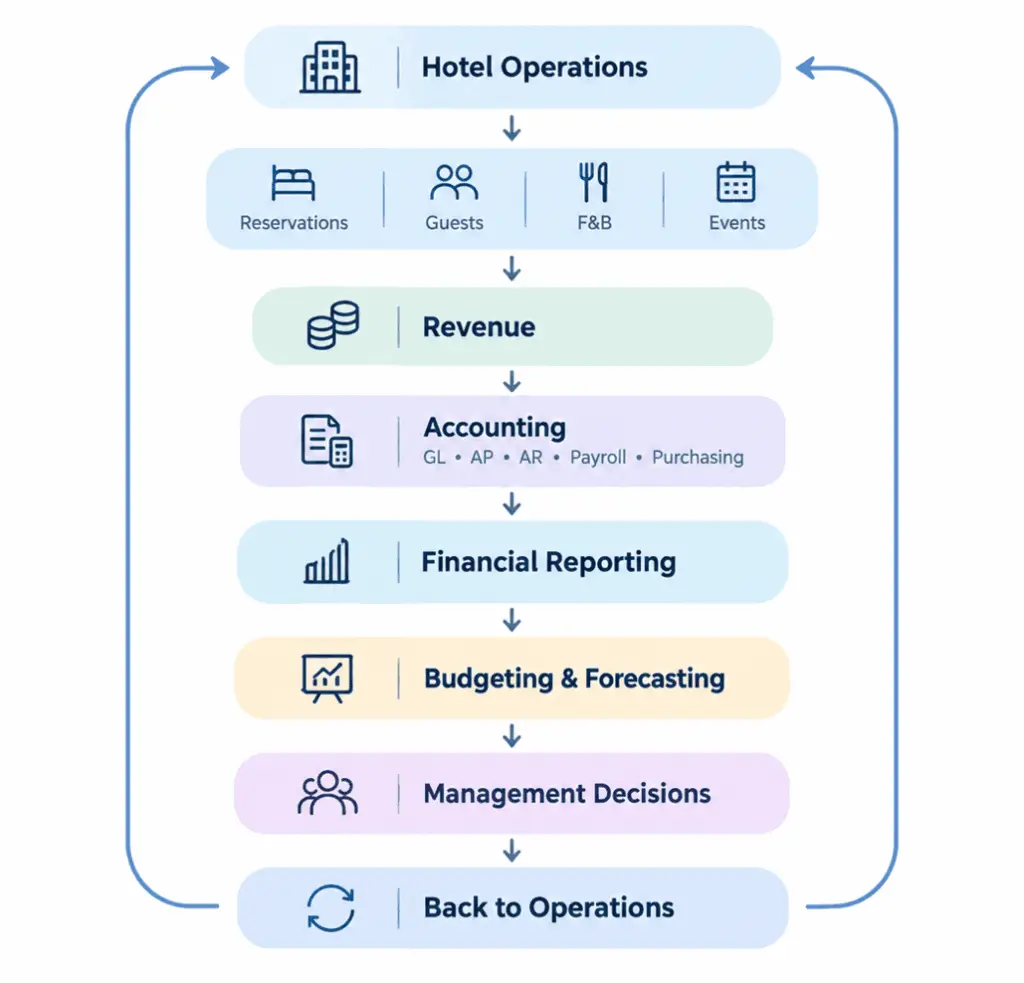
Figure 1: The complete cycle from a hotel’s front desk to back-of-house operations and financial management
The process starts with what happens at the property.
Reservations, guest stays, room availability, events, guest services and other activities generate operational information. Infor HMS, for example, supports hotel processes including reservations, guest stays, folios, room availability and events.
Read more: Solving the 4 Core Financial Management Challenges in Hospitality
Then, operational activity creates revenue. Room nights contribute accommodation revenue, while food and beverage, events and other services can create additional revenue streams.
Financial transactions then need to be recorded and organised. This includes:
- The general ledger
- Accounts payable
- Accounts receivable
- Purchasing
- And other financial processes
Next, financial data is transformed into reports that help finance and management teams understand revenue, costs, profitability and variances.
Finally, historical and current information can support budgets, forecasts and scenario analysis.
The objective is to connect these stages rather than treat them as separate processes. This connection becomes particularly important as a hotel group grows. More properties, currencies, departments and revenue streams create more financial data to manage.

What Are the Main Components of Hotel Financial Management?
Hotel financial management connects day-to-day hotel operations with the financial processes used to record, reconcile and report those activities. As shown in the finance process flow, information can move from sales and reservations through reception, POS, purchasing, and inventory activities before reaching accounts receivable, accounts payable, and the general ledger.
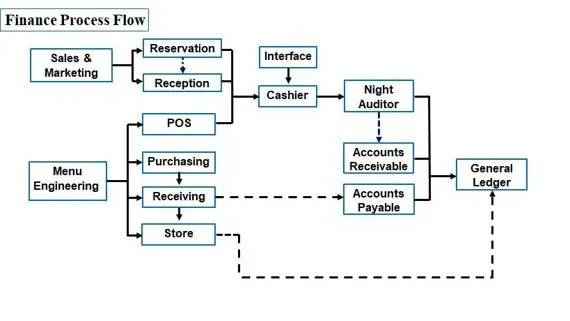
Figure 2: Hotel financial process flow
The financial process begins before a guest arrives. Sales and marketing activities generate demand, while reservations capture booking information such as room type, rates, dates and guest details.
This operational data provides an important starting point for tracking room revenue and occupancy.
At reception, reservations become actual guest stays. Check-in, room charges, additional services, and guest account activity create transactions that must be captured accurately. These transactions eventually feed into the hotel’s financial records.
Additionally, point-of-sale (POS) systems capture transactions from outlets such as restaurants, bars and other hotel services. Connecting POS activity with the wider financial process helps ensure that revenue generated outside the rooms division is also reflected in hotel financial records.
Cashiering brings together financial transactions generated during daily hotel operations. The night auditors then provide an important control point by reviewing and reconciling the day’s transactions, including guest accounts, room revenue and other operational postings.
Once transactions are reviewed, relevant information moves into accounts receivable and the general ledger.
Accounts receivable can include guest balances, corporate accounts and other customer receivables. Accurate transaction details help finance teams maintain visibility over outstanding balances.
On the other hand, the general ledger brings financial transactions from AP/AR, cashiering, purchasing, and beyond together into the hotel’s core accounting records, providing a consolidated view of financial activity.
Once operational transactions are consolidated into financial records, finance teams can use the information for financial reporting, budgeting, and forecasting.
Financial reporting shows how the property or group performed, while budgeting and forecasting use historical and current information to support future planning.
Discover: USALI 12: What Is It and Why Does It Matter for Hospitality Businesses?
The Link between the Purchasing Process and Finance Performance
Purchasing connects operational requirements with supplier transactions, as every hotel needs a steady supply of not just food and beverages but also maintenance materials, housekeeping supplies, and other goods. These items need to be stored in proper locations and monitored regularly to ensure timely procurement.
Inventory and storage are particularly important for food and beverage operations, where purchasing, consumption, stock levels and wastage can affect departmental costs and profitability.
The receiving process confirms that purchased goods have been delivered, creating the information needed to support accounts payable and cost control.
Information from purchasing and receiving can support verifying and processing supplier invoices before recording the resulting financial transactions in the accounting system.
Read more: Don’t Miss Out On These Cost-saving Tips For Hotels
Why Is Hotel Financial Management Different From General Business Finance?
Hotels have many of the same accounting requirements as other businesses. Hotel finance differs because financial performance is closely tied to operational capacity.
- Occupancy: Hotel revenue is strongly influenced by how many rooms are occupied, which also affects housekeeping needs, staffing, utilities, and other operating costs.
- Average Daily Rate (ADR): ADR indicates the average room rate achieved over a particular period. Finance and commercial teams use ADR alongside occupancy rate to understand room-revenue performance.
- Revenue per Available Room (RevPAR): RevPAR combines room revenue with available room capacity, providing another important indicator of room-revenue performance.
- Seasonality and event-driven demand: Demand in this industry can change significantly throughout the year because of holidays, tourism patterns, conferences, local events and other factors, all of which make forecasting particularly challenging.
- Multiple revenue streams: Hotel revenue comes not only from room sales but also from F&B, events, banqueting, activities and other services.
- Property-level reporting: A hotel group may need to understand performance at multiple levels: Group → Region → Property → Department. This creates additional requirements for financial structures and reporting dimensions.
- Multiple properties and currencies: Finance teams for international hotel groups need to maintain consistency while still understanding individual property performance and regulatory compliance.
This is one reason why static annual budgets can become less useful when market conditions change rapidly.
TRG’s current hospitality solution suite highlights industry KPIs such as RevPAR, occupancy, and GOP, alongside budgeting and scenario modelling capabilities.

What Role Does Infor HMS Play in Hotel Management?
Infor HMS sits primarily on the hotel operations and property-management side of the hospitality ecosystem. The solution supports processes including reservations, guest stays, guest folios, room management, events and other property-management activities. Infor HMS therefore provides an important source of operational information. However, it should not be viewed as the entire hotel financial management environment.
Once operational activity generates financial transactions, finance teams need a system that can manage and organise that information.
This is where Infor SunSystems becomes relevant.
Watch our on-demand webinar: Hospitality Management – Meet Modern Guest Demands with Modern Solutions
How Does Infor SunSystems Support Hotel Financial Management?
Infor SunSystems Cloud is a financial-management solution capable of supporting financial information collection, analysis, management and reporting. Its flexible financial structures can support different operating and ownership models, while its global capabilities address areas such as multi-currencies and multiple accounting requirements.
For hospitality organisations, the financial management layer using Infor SunSystems Cloud includes:
- Centralised financial data
- General ledger
- Accounts payable
- Accounts receivable
- Multi-entity accounting
- Multi-currency finance
- Financial reporting
- And more
Read more: A Comprehensive Overview of Infor SunSystems Cloud Core Modules
Infor Query & Analysis (Q&A), an Excel-based ad-hoc querying and business intelligence tool, is offered alongside Infor SunSystems Cloud. Infor Q&A also lets users create customised reports and perform drill-down analysis without advanced SQL knowledge.
This lets finance teams work in a familiar spreadsheet environment while accessing financial information for analysis.
How Does Infor EPM Support Hotel Budgeting and Forecasting?
Historical financial information tells finance teams what happened. The bigger question is: What happens next?
This is where Infor EPM becomes important. Infor EPM is designed to support:
- Budgeting: Finance teams can build budgets around revenue, operating costs, labour, capital expenditure and other financial drivers.
- Forecasting: Forecasts can be updated as business conditions change. For example, if occupancy expectations change during a peak season, the forecast can be adjusted rather than relying solely on an annual budget prepared months earlier.
- Consolidation: The solution can pull data from different systems, tools, and applications in the hotel to create a centralised single source of truth that can then feed into other financial processes, improving visibility and efficiency across the function.
- Multi-property consolidation: For hotel groups, financial planning also needs to consider multiple properties, entities as well as currencies. Infor EPM supports financial consolidation and planning across a hospitality portfolio, helping finance teams move toward a more unified view of performance.
- Scenario modelling: Hospitality demand can be difficult to predict. Scenario modelling allows finance teams to compare different assumptions, such as:
- Baseline: Expected occupancy and demand
- Optimistic: Higher occupancy and stronger demand
- Conservative: Lower occupancy and weaker demand
- KPI analysis: Planning becomes more useful when you can consider financial information alongside operational indicators. For example: Occupancy + ADR + RevPAR + Revenue + Costs + GOP. Together, these measures provide more context than any single financial figure.
The goal is to move from static budgeting toward a more responsive planning process.
TRG’s Perspective: Connecting Hotel Operations with Financial Performance
For hospitality finance teams, the biggest challenge is often not producing another report. It is understanding why the numbers changed.
A decline in RevPAR may be linked to occupancy, room rates or demand. Higher revenue may also mean higher labour and operating costs. A successful event can increase sales while creating additional inventory and staffing requirements.
This is why financial information becomes more valuable when it is connected to operational context.
Infor HMS provides the operational foundation. Infor SunSystems provides the financial-management layer. Infor EPM extends that information into budgeting, forecasting and scenario modelling, while Infor Q&A provides flexible reporting and drill-down analysis. Infor OS can help connect these systems and data flows.
The result is a more integrated approach to hotel financial management to address not just “How much are we making today?” question but also:
- What happened?
- Why did it happen?
- What could happen next?
By connecting operational platforms like Infor HMS with financial powerhouses like Infor SunSystems Cloud and Infor EPM, finance leaders gain complete visibility across every property, department, and currency.
Moving toward an integrated ecosystem shifts the finance team’s role from reactive data collection to proactive strategic guidance, positioning hotel groups to protect margins, adapt to changing demand, and drive profitable growth.
Ready to transform your hotel business? Schedule a call to discuss your concerns and challenges with TRG hospitality experts today!

Frequently asked questions
What is hotel financial management?
Hotel financial management is the process of managing, recording, analysing and planning the financial activities of a hotel or hospitality organisation. It connects operational activities such as occupancy, room sales, F&B, and events with accounting, reporting, budgeting, and forecasting.
Why is hotel finance different from other industries?
Hotel finance is closely connected to operational capacity and demand. Metrics such as occupancy, ADR, and RevPAR, along with seasonality, multiple revenue streams, and property-level reporting, can directly influence financial performance.
Is Infor HMS a financial-management system?
Infor HMS primarily supports hotel property management and operational processes such as reservations, guest stays, rooms, folios and events. It can integrate with accounting and other hospitality systems, but the financial-management layer can be handled through Infor SunSystems Cloud.
How does Infor SunSystems Cloud support hotel finance?
Infor SunSystems Cloud supports financial-management processes and helps hotels manage financial information across different operating structures, entities, and currencies. TRG positions it as a core financial-management solution within its hospitality portfolio.
How does Infor EPM help hotels with forecasting?
Infor EPM supports planning, budgeting, forecasting and financial consolidation. In hospitality, it brings financial and operational information together and supports scenario modelling around metrics such as occupancy, RevPAR, and GOP.
What is Infor Q&A used for?
Infor Q&A provides Excel-integrated reporting and analysis. It can create customised reports and let users drill down from summary information to underlying details.
How can hotels connect their financial and operational systems?
A hospitality technology ecosystem can connect the PMS and operational layer with financial management, planning, reporting and integration platforms. TRG’s hospitality portfolio brings together Infor HMS, Infor SunSystems Cloud, Infor EPM, Infor Q&A and Infor OS for this purpose.