

Infor EPM (Enterprise Performance Management) is a dedicated financial planning and analysis (FP&A) platform that connects budgeting, forecasting, financial consolidation, scenario modelling, and performance reporting in a single, integrated environment. It replaces the disconnected spreadsheets, manual consolidation cycles, and email-based approval chains that most finance teams use for planning, giving CFOs and FP&A teams a governed, real-time model that all functions contribute to and all stakeholders can see.
This article explains why spreadsheets fail at scale for financial planning, what Infor EPM does and who it is for, how it connects to your existing financial management systems, and where it has delivered measurable results. Use the hub links at the bottom to navigate the full Infor EPM content library.
Read more: Don’t Buy EPM Software Until You Read This Guide!
Where spreadsheets fail in financial planning
Spreadsheets are not a bad tool. They become the problem when used as the primary tool for running a financial planning process across a complex organisation.
- Version control is the first thing to break: As each department builds its own plan, using a template that Finance distributes. By the time the budget is approved, there are multiple live versions of the plan in circulation. Nobody is entirely confident which one is current.
- Manual consolidation consumes the time that should go to analysis: 29% of organisations take more than 10 days to finalise a single forecast iteration. As a result, many treat the process as a data management exercise (copying, reformatting, checking formula references, etc.) between different submissions rather than as strategic analysis.
- Inconsistent assumptions across the company: The revenue team’s occupancy assumption implies a staffing level that does not match the HR budget. The operations team’s cost inflation assumption differs from the finance team’s. F&B revenue projections are inconsistent with the rooms team’s occupancy forecast. These inconsistencies are not always caught before the consolidated plan is circulated for review.
- Inability to do scenario planning at scale: Testing different assumptions, e.g., a lower occupancy forecast, a commodity price spike, or a currency movement, requires building a separate copy of the model and updating it manually. In practice, most organisations maintain one version of the base case. Other alternatives exist as rough calculations in theories or in a separate file. When conditions change, the finance team starts rebuilding rather than reviewing a scenario they had already prepared.
- The audit trail lives in an inbox: In a spreadsheet-based planning process, the reasoning behind the numbers lives in email threads, not in the plan. When a budget assumption is challenged, finding the answer requires tracing back through weeks of correspondence. Moreover, the spreadsheet shows the number, not who changed it, when they changed it, or why they changed it. For a document that governs a year of financial decision-making, that is a significant gap.
Read more: The Use of Spreadsheets and Modern Cloud Adoption in Businesses
What is Infor EPM?
Infor EPM is a financial planning and analysis (FP&A) platform that addresses the structural limitations of spreadsheet-based planning by providing a single, governed model in which all planning activity occurs, eliminating manual template distribution or formatting. Finance teams configure a shared model that all functions contribute to directly, with version control, audit trails, and workflow management built into the platform.
The latest version of Infor EPM, version 12, runs on a true multi-tenant SaaS model on Amazon Web Services. Features, security patches, and compliance updates are delivered continuously and automatically, removing the internal IT maintenance burden associated with on-premise EPM environments.
Read more: A Complete Guide to Enterprise Performance Management (EPM) Software
The 6 core modules: What Infor EPM does
Infor EPM is a suite of interconnected planning modules that share a common data model, governance layer, and integration with Infor and non-Infor systems. The six core modules briefly explain essentially what Infor EPM does.
| Budgeting and Planning | Driver-based budgeting that connects operational assumptions (e.g., occupancy, headcount, production volumes, sales, etc.) directly to financial outcomes, with unlimited scenario iterations and version control. Replaces spreadsheet consolidation with a single, governed model that all functions contribute to. |
| Financial Consolidation | Automated multi-entity close with intercompany eliminations, equity pick-up logic, and multi-currency translation. Reduces days-to-close by removing the manual journal and reconciliation steps that dominate the traditional month-end process. |
| Sales Planning and Forecasting | Integrates demand-side assumptions (e.g., revenue by segment, channel mix, pricing) with the financial model so that changes in commercial strategy are immediately visible in P&L and cash flow terms. Bridges the gap between revenue management and finance. Read more: OLAP Technology: Handling Big Data in the Hotel Industry |
| Workforce Budgeting and Planning | Captures detailed headcount requirements, models salary and benefits adjustments, and performs detailed analyses of workforce-related costs, budget for positions, and employees as well as forecasts future costs. Infor EPM can also be integrated with a human capital management (HCM) system to allocate costs across departments, projects, and funds. |
| Capital Expenditure Planning | Project-level CapEx tracking with documentation packages, approval workflows, and status overviews. Multi-year capital plans connect to the balance sheet and cash flow model, giving finance teams and boards a complete view of capital commitments. |
| Financial Reporting and Dashboards | Browser-based and mobile-accessible dashboards with drill-through from board-level KPIs to transactional detail. Self-service reporting capability allows users to produce their own report templates, thus reducing the burden on the central finance team and providing business leaders with real-time visibility without waiting until month-end. |
Who is Infor EPM for?
Infor EPM serves multiple stakeholders in the financial planning process, each with distinct needs and priorities. The table below maps the primary buyer and user personas to the specific value each gets from the platform.
| Who | What they need | What EPM delivers |
| CFO / Finance Director | Needs a defensible, auditable financial plan and real-time visibility into performance, without a month-end reporting lag. |
|
| FP&A Manager / Financial Controller | Spends most of the budget cycle consolidating departmental spreadsheets, chasing submissions, and reconciling inconsistent assumptions. |
|
| Department Head / Operations Manager | Budget templates are confusing, submission timing is unclear, and queries from finance arrive weeks after submission. |
|
| IT / Finance Transformation Leader | Legacy on-premise EPM requires expensive upgrade projects Integration with ERP is fragile and breaks when either system is updated |
|
How Infor EPM connects to your financial management system via Infor OS and ION
Infor EPM is designed to receive its actuals from wherever your financial transactions live. For organisations that may already be running Infor SunSystems as their financial management system, the connection is direct and native. For organisations running SAP, Oracle, Microsoft Dynamics, or another ERP, the integration can be done via Infor OS.
Infor OS is the operating service layer that connects all Infor cloud applications. It provides the security framework, the data lake, and the workflow engine that EPM draws on. Within Infor OS, Infor ION (Intelligent Open Network) acts as the integration middleware between EPM and the third-party systems.
The integration works through Business Object Documents (BODs), standardised XML messages that carry financial data between systems in a format both can understand. When a journal entry is posted in SunSystems, ION generates a BOD and routes it to EPM, where it updates the actuals against the live budget model. The process is event-driven and near real-time, as a result, there is minimal to no manual intervention required.
Read more: Scaling Innovation and Security with Infor SunSystems Cloud
What this means for finance teams:
- Actuals in EPM are always current: No more waiting for month-end uploads. Variance analysis can happen as transactions are posted rather than after the close.
- The financial management system does not need to change: EPM connects to your existing system, whether that is SunSystems, SAP, Oracle, or another platform.
- Non-financial data can also flow through: Statistical and operational data (e.g., headcount, production volumes, energy consumption, etc.) can be fed into EPM, creating a planning model that incorporates multiple drivers.
Read more: How Does the Integration between ERP and EPM Software Work?
Infor EPM use cases
Enhanced productivity and speed
A Nucleus Research study on Infor EPM’s productivity impact found that organisations using the platform improved financial productivity by 20 per cent and achieved up to 30 times faster data processing compared to their prior spreadsheet or legacy EPM environments. The study attributed the productivity gain primarily to the elimination of manual data consolidation and the shift in the finance team’s time from data preparation to analysis.
Automate financial forecasting at Kempinski Hotels
The case study demonstrates EPM in a multi-property, multi-currency hospitality environment. Kempinski Hotels deployed Infor EPM to automate financial forecasting and ensure accurate decision-making across its global portfolio. As a result, the number of months not in line with forecasts has dropped by 60%.
Shorten the budget cycle at Dana-Farber Cancer Institute
Dana-Farber Cancer Institute deployed Infor EPM and is able to slash its budget cycle time by 40 per cent. The case study is particularly relevant for organisations managing large, complex planning processes across multiple cost centres, a structure shared by hospital networks, university groups, and multi-entity financial services organisations.
Industries that Infor EPM serves
Hospitality
Hotel groups face a persistent gap between revenue management and finance, with each building separate plans in disconnected systems. Infor EPM provides the shared planning layer where occupancy and ADR assumptions connect directly to P&L and EBITDA targets, so revenue managers and CFOs are always working from the same model, not reconciling two. The USALI 12 reporting pack developed by TRG International is available as a pre-built output for hotel group reporting.
More use cases of Infor EPM in Hospitality:
Education
International school groups face complex, multi-campus cost-allocation challenges, for instance, shared service costs, teacher headcount planning, and currency-denominated tuition revenue. Infor EPM’s driver-based allocation engine replaces fixed-percentage splits with live statistical drivers (student headcount, user licences) so that each campus’s P&L reflects its actual operational footprint rather than an arbitrary charge.
Insurance
IFRS 17 demands more frequent, more granular financial reporting, raising the value of having live scenario models built into the planning cycle. Infor EPM allows insurance finance teams to maintain base-case and stress-scenario plans, claims inflation, mass lapse, and catastrophe events, with automatic recalculation of reserve requirements, solvency impact, and P&L effect, without having to rebuild the model from scratch each time.
More use cases of Infor EPM in Insurance:
- Astra Life Improves Reporting with Infor SunSystems and Gains Greater Insights with Infor EPM
- Ready to Predict, Prevent, and Protect? Data Reinvents Insurance!
Renewable Energy
Long-dated PPA contracts and multi-year capital programs create a financial planning environment that annual spreadsheet budgets handle badly. Infor EPM’s multi-year modelling capability connects generation revenue assumptions, tariff rate, capacity factor, degradation curve, to O&M cost drivers and the consolidated debt service and cash flow model, providing a live financial picture across a portfolio of projects.
Download our whitepaper: What Does the Future Hold for Renewable Energy Businesses in APAC?
Oil and Gas
Commodity price volatility makes static annual budgets structurally inadequate for Oil & Gas finance teams. Infor EPM’s unlimited-iteration scenario modelling allows pre-built $50, $70, and $90/barrel scenarios, with automatic recalculation of revenue, lifting costs, and free cash flow, so the CFO’s response to a price movement is to review and activate a prepared scenario rather than commission a three-week modelling exercise.
Read more: How CFOs Turn Cloud EPM to “Financial Control Tower” in an Oil‑Shock Economy
Frequently asked questions
The questions below are the most common queries that arise during an Infor EPM evaluation. If you have a specific query for us, please do not hesitate to reach out.
What is the difference between EPM and ERP?
ERP (Enterprise Resource Planning) systems manage and record transactional data across the entire business, like procurement, inventory, manufacturing, sales orders, HR, and financial accounting. They are designed to run business operations and maintain the system of record for what has happened across every function.
Infor EPM sits above the ERP and uses that operational and financial data as the starting point for planning, budgeting, forecasting, and performance analysis. In other words, Infor EPM models what should happen next, tests the financial implications of different decisions, and measures how actual performance compares to plan.
Most organisations would need both: ERP for managing operations and recording transactions, EPM for financial planning and performance management.
How long does an Infor EPM implementation take?
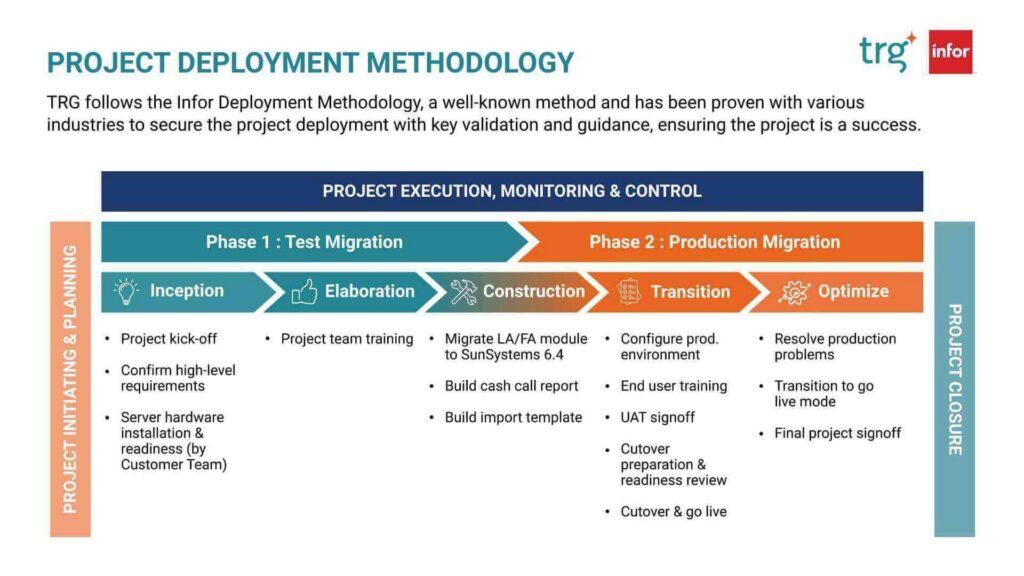
TRG follows Infor Deployment Methodology, a five-step implementation approach to keep issues at bay and achieve measurable outcomes. A focused deployment in a well-structured environment can take approximately four months. Larger, multi-entity implementations with complex consolidation requirements might take longer. TRG recommends an initial scoping assessment to establish a realistic timeline for your specific environment.
What happens to our existing spreadsheets?
They do not disappear. Infor EPM maintains a deep, native integration with Excel through the EPM Excel Add-in, which allows finance teams to work in a familiar spreadsheet environment while maintaining a single version of the plan in the cloud. The difference is that the Excel interface reads from and writes to the governed EPM model, not a local file, so version conflicts and formula errors are eliminated at the source.
Is Infor EPM the right fit for our organisation?
Infor EPM is designed for organisations with complex planning requirements, multiple entities, multi-currency environments, and cross-functional budgeting cycles. For a single-entity business with a straightforward annual budget, a well-structured spreadsheet process may be adequate. The best starting point is an in-depth assessment of where your current process breaks down. If the answer involves consolidation complexity, version management, slow close cycles, or a collaboration gap between revenue and finance, EPM is a worthwhile consideration.
Ready to move beyond spreadsheets?
Replacing spreadsheets with a dedicated FP&A platform is not a decision that should be rushed, and it is not the right decision for every organisation at every stage. But for organisations where the planning process consumes more time than the plan generates value, the case for change is clear.
TRG International is Infor’s Gold Channel Partner across APAC, with more than three decades of experience in implementing financial management solutions. We work with finance leaders in hospitality, education, insurance, renewable energy, oil and gas, and logistics to scope, implement, and get value from Infor EPM.
Share with us your requirements and what you are looking to optimise in your current financial budgeting, forecasting, and planning processes, so we can best advise you on how to utilise Infor EPM to achieve your goal.