


How do we run the business when every week brings new costs, new constraints, and new “versions of the truth”?
The answer is not a bigger spreadsheet but an operating model: Cloud Enterprise Performance Management (Cloud EPM), a layer that consolidates data, enables scenario planning, supports rolling forecasts, and turns “what‑ifs” into governed decisions across finance and operations.
Editor’s note: This article is the final of a four-part series in which we do not attempt to make geo- or even political comments about current events but rather focus on how they impact global businesses financially. To not miss out on real-life solutions and tactical tips on mitigating obnoxious decisions, subscribe to our newsletter today!
Check out the complete series and what we have covered:
- Master “what-if” scenarios and real-time visibility with Cloud EPM
The real problem isn’t only volatility, it’s fragmentation
The defining features of the current oil‑shock environment are the rapidly changing assumptions and disconnected data.
In many organisations, finance, procurement, and operations operate within their own isolated ecosystems of spreadsheets, extracts, and dashboards. This fragmentation creates “multiple versions of the truth.” When a CEO asks, “How will a 15% jump in freight premiums impact our Q3 margins?”, a fragmented organisation takes weeks to find the answer.
By the time the spreadsheets are consolidated, the data is already obsolete. A CFO cannot run an effective rolling forecast if the procurement data on fuel costs is three weeks behind the sales team’s revenue projections.
From a resilience lens, organisations need agility, visibility, and strategic foresight. The solution? EPM!
Enterprise Performance Management (EPM) exists to bridge this gap. It acts as the central nervous system for strategy, consolidating chaotic data into a single, actionable insight.
What is an Enterprise Performance Management solution? Check out our complete guide here!
Cloud EPM: The decision engine for modern leaders
Enterprise Performance Management (EPM) is a suite of applications that helps organisations plan, budget, forecast, consolidate, and report performance by consolidating data from ERP and other sources and turning it into insight and decisions.
Cloud EPM further enhances traditional platforms by adding another layer of flexibility, enabling you to turn raw data from your ERP and other sources into actionable insights for strategic decision-making.
Cloud EPM sprinkles in a “special sauce” so your finance team can achieve:
- Speed and agility (continuous planning rather than annual cycles)
- Collaboration across functions (finance + operations working from the same model)
- Lower cost of ownership and easier scaling vs traditional on‑prem
- Real-time monitoring and scenario modelling to respond quickly to uncertainty
- KPI monitoring, which alerts managers about unexpected changes so they can respond quickly
Nevertheless, EPM needs frequent revision to align with the organisation’s general vision.
Stop losing sleep over ‘Version 4.2_Final_Updated_v2.xlsx’. Move to a single source of truth today.”
But don’t buy EPM until you read this guide →
Solution spotlight: Navigating crisis with Infor EPM
As a leading provider of enterprise solutions, TRG International delivers Infor EPM to help businesses transform high-pressure uncertainty into a strategic advantage. In times of global disruption, whether it be the geopolitical shifts of 2026 or beyond, Infor EPM provides the visibility and agility required to maintain control.
Here is how the platform’s core capabilities translate into resilience:
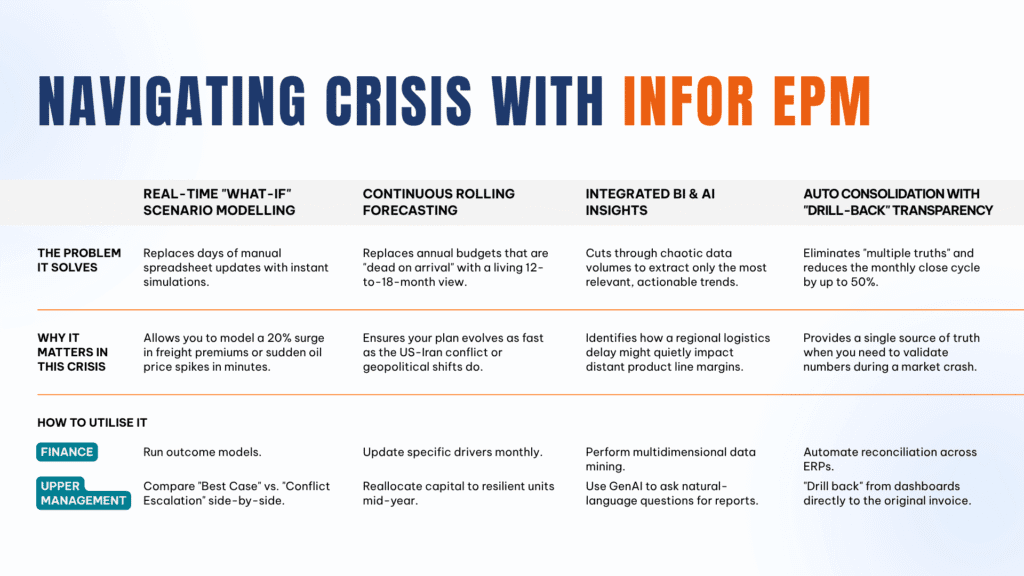
While global headlines change daily, the architecture of a resilient finance department remains constant. Deconstruct the engine behind Infor EPM and see how they power the lightning-fast ‘What-If’ models we use today.

1. Real-time “what-if” scenario modelling
- The problem it solves: Eliminates “analysis paralysis” and the days-long manual effort required to update disconnected spreadsheets to see the impact of a single variable change.
- Why it matters in this crisis: In a landscape defined by sudden US-Iran escalations or oil price spikes, you can’t wait weeks for a report. You need to know now how a 20% surge in freight premiums will ripple through your Q3 margins.
- How to utilise it:
- Finance: Finance teams can input new variables (e.g., a specific tax change or fuel cost increase) and generate multiple outcome models in minutes.
- Upper management: Executives can compare “Best Case” vs. “Conflict Escalation” scenarios side-by-side to make high-stakes pivots with confidence.
2. Continuous rolling forecasting
- The problem it solves: Replaces the static, “dead on arrival” annual budget with a living, 12-to-18-month moving horizon that actually reflects reality.
- Why it matters in this crisis: Prolonged uncertainty means the assumptions you made in October are likely irrelevant by March. A rolling forecast ensures your financial plan evolves as quickly as the geopolitical crisis.
- How to utilise it:
- Finance: Department heads update their specific drivers (headcount, project spend) monthly, which automatically rolls into the global forecast.
- Upper management: Leadership uses the “evergreen” 12-month view to re-allocate capital dynamically toward resilient business units rather than being locked into a stale yearly plan.
3. Integrated Business Intelligence & AI Insights
- The problem it solves: Cuts through the “noise” of enormous, chaotic data volumes to extract only the most relevant, actionable trends.
- Why it matters in this crisis: Crisis data is often messy and overwhelming. AI-powered insights help identify hidden rippling effects, such as how a logistics delay in one region might quietly bankrupt a product line in another, before they become visible on a standard P&L.
- How to utilise it:
- Finance: Can use a web-based, Excel-like interface to perform multidimensional data mining without needing advanced technical or IT support.
- Upper management: Utilise GenAI to receive instant, summarised strategic reports on business health and risk exposure.
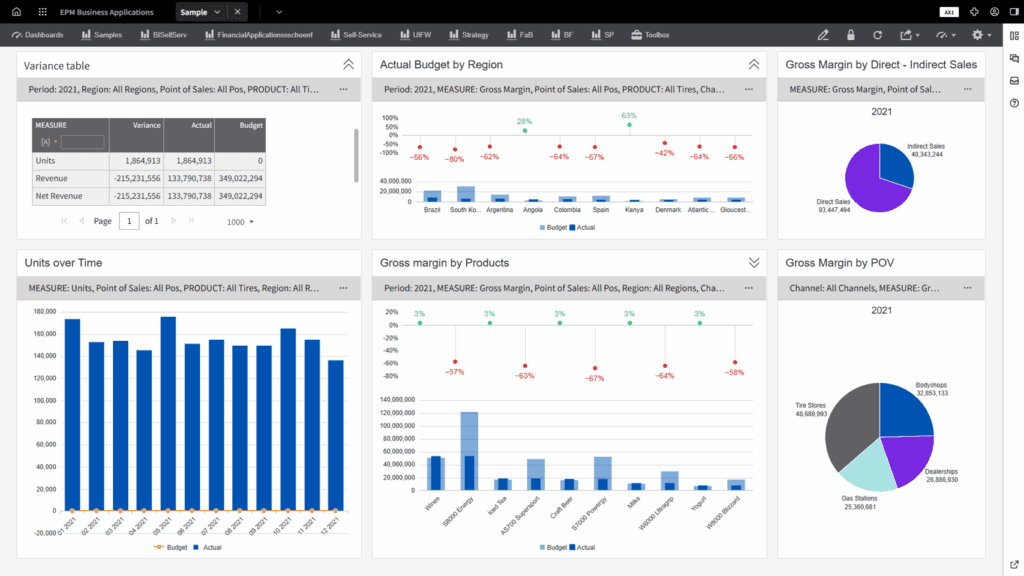
4. Automated Consolidation with “Drill-Back” Transparency
- The problem it solves: Solves the fragmentation crisis by providing a single source of truth and reducing the time required for a monthly close by up to 50%.
- Why it matters in this crisis: When the market is in freefall, “guessing” at numbers is fatal. You need to trust your data. If a variance appears in a high-pressure meeting, you need to see the source immediately.
- How to utilise it:
- Finance: Automated workflows collect data from various ERPs (like Infor SunSystems), ensuring all numbers are reconciled and validated.
- Upper management: If a specific cost looks suspicious, leadership can “drill back” from the top-level dashboard directly into the original invoice or transaction to verify the truth.
Bonus advantages:
- Automated controls and accuracy: By establishing forecast threshold rules, businesses can enforce financial discipline. If a department exceeds a spending limit, the system requires immediate justification to ensure the budget stays aligned with the organisation’s vision.
- AI-powered predictive analysis: Leveraging Generative AI (GenAI), Infor EPM allows users to ask natural-language questions and generate summary financial reports instantly. This handles the “sheer volume” of today’s data, extracting only the most relevant information for decision-making.
The TRG advantage
Technology is only half the battle; the other half is strategy. With over 30 years of experience, TRG International doesn’t just “install” software—we help you re-engineer your processes for true resilience. In a world of unpredictability, we provide the decision engine that keeps you one step ahead.
Is data fragmentation killing your financial agility? If your finance, operations, and procurement teams are still working from disconnected spreadsheets, you have multiple versions of the truth—and zero clarity. Let TRG International show you how to centralise your decision engine with Infor EPM.