


The twelfth edition of the Uniform System of Accounts for the Lodging Industry, USALI 12, is the global accounting framework for how hotels report their financial performance. This latest version introduces new requirements for how revenue, labour, and sustainability metrics are tracked and reported, as well as compared to industry benchmarks.
So what’s new in this version?
Read more: Understanding USALI Fundamentals: Your Guide to Hotel Accounting
What’s new in the 12th edition of USALI?
USALI 12 consists of six parts, with newly introduced schedules as well as key updates can be summarised as below:
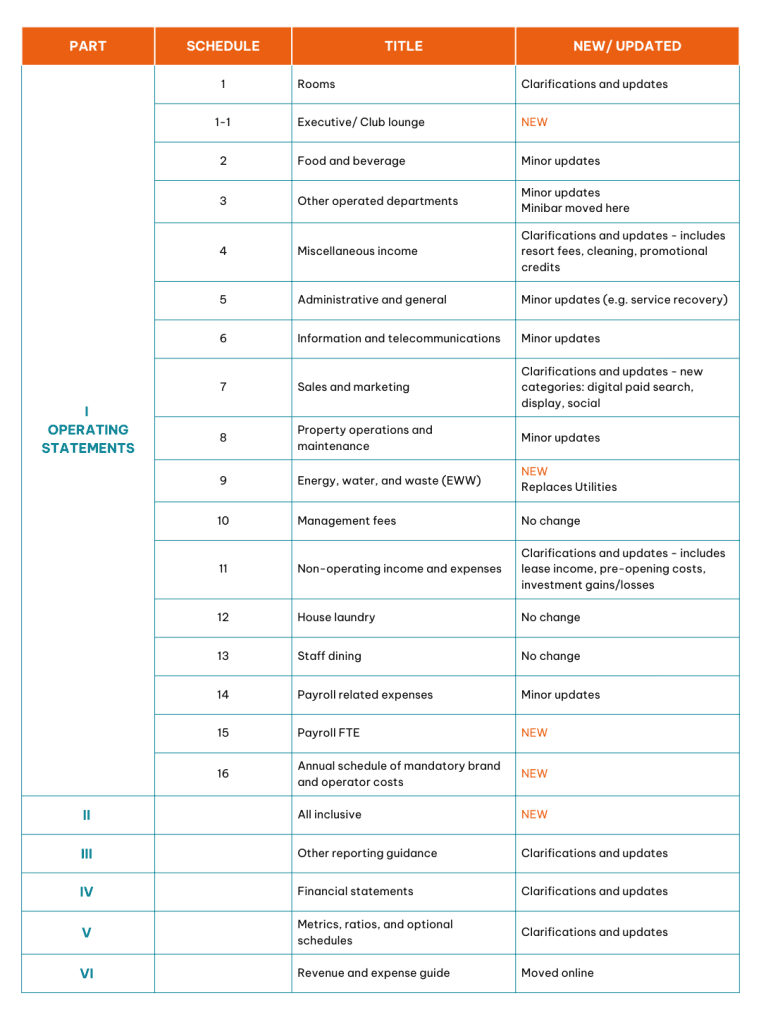
For a more comprehensive look at USALI 12, please refer to: usali.hftp.org
A brief look into new major changes of USALI 12
Part I, Schedule 1-1: Executive/ Club lounge
Previously, Club Lounge costs and similar expenses were combined, making it challenging to see their true financial picture. With USALI 12, the Lounge now has its own detailed, standalone schedule, providing hotel owners and asset managers with clear insight into the actual costs involved in running and maintaining these operations.
The Executive/ Club lounge cost schedule provides a level of detail comparable to that of the Food and Beverage department or venue schedules.
Revenue earned from guests purchasing access to a dedicated private area within the hotel (commonly referred to as a club, concierge, or executive lounge), if material, is recorded under the Other Rooms Revenue section. The recorded revenue reflects the upcharge or additional room premium paid by guests to access this exclusive space.
If the revenue is recognised, operating expenses related to guests who have paid for lounge access via an upcharge or premium are allocated here.
The Executive/ Club lounge costs are allocated to either:
– Rooms – Schedule 1, Executive Lounge Expense (when Executive Lounge Revenue is recorded), or
– Rooms – Schedule 1, Loyalty Program Member Benefits (for the residual amount)
Read more: Accor Poised for Recovery with Infor SunSystems SaaS

Part I, Schedule 9: Energy, Water, and Waste (EWW)
Waste costs were previously included within maintenance. Plus, there was little detail on the different electricity types, such as fuels, renewables, or vehicle power.
USALI 12 introduces a wider set of sustainability metrics, enabling operators and owners to gain a clearer understanding and better monitoring of their environmental footprint, with the aim of reducing it over time. While these changes do not affect profit calculations, they mark a significant step forward in sustainability.
Read more: What Are CSR, ESG, and Sustainability & Why Do They Matter for Businesses?
This update is essential. As global focus on environmental responsibility grows, it is important for the lodging industry to keep pace. Hotels need to share their sustainability progress with customers, investors and regulators. These new reporting standards will become a helpful industry benchmark.
Key highlights include:
– Waste expenses are now recorded under this Energy, Water, and Waste (EWW) Schedule 9 rather than Property Operations and Maintenance.
– This schedule offers more detailed accounts and descriptions for better insight.
– New metrics, such as energy, water, and waste per occupied room, make it easier to monitor and track environmental performance.
Read more: Sustainable Hospitality: Why Going Green Is Not That Straightforward
Part I, Schedule 15: Payroll FTE
As labour typically represents the largest expense for hotels, up to 40 per cent of total costs or higher, it is crucial to track it effectively.
In the past, USALI recorded salary, wage, and benefits data across different labour categories, but did not provide metrics on labour efficiency. To address this, a new mandatory schedule (Schedule 15) has been introduced.
Read more: Attracting and Retaining Top Talent: Creating a Culture of Excellence in Hospitality
According to this schedule, full-time employee (FTE) hours are logged separately for management and non-management roles, which are then further broken down by specific positions within each department.
It also provides data on the FTE for both the current and previous years, giving hoteliers a clear view of year-over-year changes in labour spend and staffing levels. With this information, owners and operators can easily measure a range of FTE efficiencies, from the average hourly compensation by role to the number of necessary FTEs per occupied room, cover count, spa treatment, or round of golf played.
Part I, Schedule 16: Annual schedule of mandatory brand & operator costs
This schedule is completed yearly as part of the fiscal year-end reporting package and covers non-negotiable expenses for essential programs, systems, and services. The information aims to provide higher transparency.
Please note:
– Brands and operators often group assessments for reservations, marketing, central information systems, and administrative support into bundled programme charges. Preparers should reach out to their brand or operator for guidance on how to allocate these bundled charges. Any bundled program charges that have not been specifically allocated are recorded under Franchise and Affiliation Marketing.
– Third-party ‘pass-through’ costs—such as travel agent commissions, business intelligence services, and similar items—are not included in this schedule.
Costs are separated into four sections:
1️⃣ Rooms, including:
– Reservations (including all mandated charges for the brand or operator’s central reservation system).
– Other (including complimentary food and beverage and on-property costs for loyalty program member benefits).
2️⃣ Sales and Marketing, including:
– Revenue management services
– Franchise and affiliation marketing and royalties
– Loyalty program costs and promotional costs
– E-commerce and digital marketing
– Other sales and marketing
Read more: Personalisation vs Profit: Which Matters More for Hotels?
3️⃣ Information Technology, including:
– On-property revenue systems
– Property IT support
– Centralised information systems
– Information security programs
– Other information technology costs
4️⃣ Programs, Systems and Services, including:
– Human resources and payroll systems
– Risk management program
– Procurement
– Other HR services
– Base and incentive management fees
– Centralised accounting services
– Ancillary accounting services
– Other programs, systems, and services

Part II: All inclusive
The 11th Revised Edition of USALI gives rise to the popularity of all-inclusive (AI) hotels. AI properties typically charge guests a single rate that covers key services and amenities. Since every guest uses these services differently, it is impossible to allocate revenue equitably among departments.
Thus, owners and operators have requested clearer guidance from the GFC. In response, the 12th Revised Edition now features a dedicated section for reporting revenues and expenses at AI hotels. This update supports fair benchmarking and more effective operating analysis.
All-inclusive (AI) package revenue vs. European Plan (EP) package revenue:
– AI hotels offer guests an all-in-one package rate, covering room, food and beverage, and entertainment for a single, upfront price.
– In contrast, EP hotels provide a room-only rate, with guests free to add food, drinks, and other services individually or as a package, depending on their preferences.
– Because of these differences, charges for services at AI and EP hotels are handled in distinct ways.
Why USALI12 matters?
Today, USALI has widely become the spoken “language” between hotel operators and hotel owners as well as the go-to accounting standard for the industry across the globe. Most hotel management contracts (called HMAs) require hotels to follow USALI.
The standard allows both hotel owners and operators to gain a clearer understanding of how money is earned and spent, using the same definitions, formats, and schedules. It makes comparing performance across properties easier, builds trust between stakeholders, and helps hotels stay transparent and accountable.
What this means for hotel businesses specifically and the entire hospitality industry in general is that:
– USALI 12 is not merely an accounting update. It is a strategic tool for hotel leaders to gain clearer financial insights into improving cost control, benchmarking performance, and aligning operations with modern priorities, like digital marketing and sustainability.
– To meet the new reporting standards, hotels need better data accuracy and more robust tools, such as Enterprise Performance Management (EPM) systems.
Incorporating ESG factors into the business’ accounting processes, what hotel leaders need to know. Learn the details here!
Need help transforming your hotel’s current technology stack? Share your concerns with our experts by requesting a demo today!