

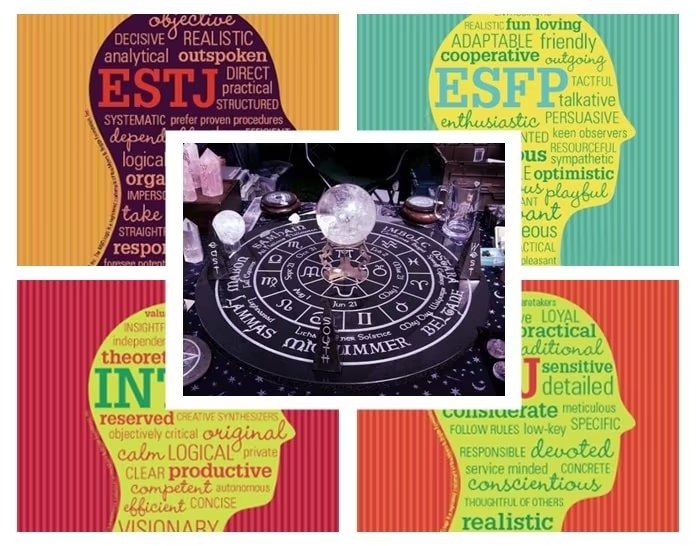
What’s your personality type? ESTP, INTJ, INFJ, or maybe something else? If it all sounds familiar to you, most likely you have taken or heard about the Myers–Briggs Type Indicator (MBTI) model before. In fact, MBTI is possibly the world’s most popular and widely used personality assessment; roughly 2 million people take it annually. It is the most (over)hyped assessment, too.

Here’s the TL,DR version:
Why do psychologists disapprove of the MBTI for recruitment?
Organisational psychologists unanimously disapprove of the Myers-Briggs Type Indicator (MBTI) for recruitment because it lacks scientific validity, test-retest reliability, and predictive utility.
No predictive value: Up to 50 per cent of individuals receive a different personality type when re-tested just five weeks apart.
Binary restrictions: The test forces complex human traits into binary boxes (e.g., Thinking vs Feeling), ignoring that personality exists on a normal distribution.
Unethical for screening: The official MBTI Manual explicitly states it is unethical to use the indicator to screen out job applicants.
A popular test that is disregarded by psychologists
The MBTI was created by two Americans, Katharine Cook Briggs and her daughter, Isabel Briggs Myers, during World War II. The model was based on a 1920s theory proposed by Carl Gustav Jung, a Swiss psychiatrist and psychotherapist. By answering a list of 88 to 93 questions, MBTI’s participants can be grouped into 16 personality types.
The MBTI concept holds that each individual’s personality consists of 4 dimensions, each with 2 possibilities. These dimensions and their corresponding possibilities are:
- Intuition/ Sensing
- Perception/ Judging
- Feeling/ Thinking
- Introversion/ Extraversion
In total, there are 16 combinations, or 16 personality types, and are referred to by an abbreviation of four letters. For example, the ISTJ type represents Introversion (I), Sensing (S), Thinking (T), and Judgment (J).
The MBTI’s dimensions are typically called the four dichotomies because, in each dimension, you can only be assigned either one of two possibilities.
Download the full description of MBTI’s personality types

The test is frequently applied in education, recruitment, career counselling, corporate training, and professional and personal development. 89 of the Fortune 100 companies, along with about 200 US federal government agencies, are using this test to assess their employees and job candidates. The MBTI has been translated and adapted into over 20 languages. CPP, the company that administers and markets the test, makes a healthy $20 million in revenues annually.
Read more: The financial risk of bad hires & recruitment ghosting.
Regardless of its popularity and commercial success, the MBTI is almost disregarded by the entire psychology community. The test has rarely been mentioned in research published in major psychology journals, except in articles that criticised it.
The only journal that frequently publishes articles about the test is The Journal of Psychological Type, which, ironically, is supported by the sales of the test itself.
Why do psychologists unanimously disapprove of such a popular personality test?
Unsupported theoretical foundations
The MBTI is based on Carl Jung’s theory of psychological types, first published in 1921, in which he proposed four dominant human cognitive functions (thinking, feeling, sensation, and intuition) that were somewhat similar to the later MBTI’s four dichotomies. This theory, however, was based solely on Jung’s subjective observations and experience rather than on any empirical evidence.
Before reading Jung’s theory, Katharine Cook Briggs herself came up with the speculation that personality falls into four temperaments: meditative, spontaneous, executive, and social.
Such a typology was also based on her own observation of her family members. Neither Katharine Cook Briggs nor Isabel Briggs Myers was a certified psychologist. Instead, Myers learned test-making techniques and statistical methods from Edward Hay, a personnel manager at a Philadelphia bank.
In other words, the MBTI is a brilliant product of pure speculation and hypotheses unsupported by scientific data and controlled experiments.
Read more: Maximising Talent Outcomes with Pre-Hire Assessments
Little scientific proof
The cornerstones of scientific methodology are validity and reliability, all of which are sorely lacking in MBTI. Additionally, the test also suffers from poor utility, i.e. practical use.

Validity
Validity refers to a test’s ability to correctly meet its aim. In this case, the test should be able to identify and categorise different individuals’ personalities. The MBTI’s poor validity partly stems from its reliance on the 4 dichotomies.
In reality, human personality traits fall on a spectrum (e.g., the degree of introversion) rather than as binaries (e.g., either introversion or extraversion). There is little chance that a person is either an absolute introvert or an extrovert. Virtually all of us are somewhere between those two extremes.
Many MBTI questions are ‘forced choices’ and constructed with only two answers representing two extreme possibilities. For example, one question would ask you: “You tend to sympathise with other people”, with only two answers: “Yes” and “No”.
Most scientific research shows that personality traits follow a normal distribution, i.e., most people are in the middle of the scale. For example, around 68% of people can be described as mildly introverted/extraverted. Only 16% can be considered clearly introverted or clearly extraverted. As a result, the MBTI’s approach fails to assess personality accurately in real life.
Read more: Hybrid Work Is Rising Fast – Can Your Business Adapt In Time
Reliability
Reliability refers to the consistency of the test. In particular, when the test is taken by one person more than once, it should still yield the same result. In this regard, the MBTI test also performs very poorly.
Research indicates that up to 50% of people get different results when taking the test twice, even though the second test is only 5 weeks after the first. The general industry standard is between 70%-90%.
Read more: Increasing fairness in your organisation’s performance management process
Utility
Given its poor validity and reliability, it is little wonder that MBTI’s value is almost limited to entertaining. In 1991, a review committee of the United States National Academy of Sciences concluded that there was “not sufficient, well-designed research to justify the use of the MBTI in career counselling programs.”
Though MBTI is widely reported as a powerful tool to determine job fit (i.e., which career you should choose), researchers find that the percentage of MBTI types within each profession is close to that within a random sample of the population.
The MBTI, therefore, is practically useless in predicting people’s possibility to perform well in specific jobs. Even the MBTI’s published ethical guidelines state: “It is unethical, and in many cases, illegal to require job applicants to take the Indicator if the results will be used to screen out applicants.”
The MBTI Manual also explicitly discourages using the test as a predictor of job success. Despite all this, millions clearly ignore the warning and use it anyway.
The hidden cost of misaligned talent in modern operations
Using unverified tools like the MBTI for critical business decisions does more than just muddy your recruitment data; it creates compounding operational risks. When organisations place the wrong individuals in key roles due to flawed data, project delivery suffers.
According to data from Harvard Business Review, up to 80 per cent of employee turnover is caused by bad hiring decisions. In an era when businesses are rapidly migrating legacy frameworks, such as moving from Infor SunSystems 4 to the cloud, the wrong team alignment can stall multi-million-dollar digital transformations.
Is your organisation managing talent based on scientific data or pure speculation?
When implementing enterprise-wide upgrades like Infor EPM (Enterprise Performance Management), your leadership needs predictive visibility not just in financial forecasting but also in human capability. Flawed assessments lead to resistance, friction, and ultimately, failed system adoption.
Why is MBTI still wildly popular?
The MBTI continues to do very well due to the same reason why astrology is still so beloved. No matter what type you fall into, your description is full of positive, flattering words like “action-oriented”, “gentle”, “creative”, or “enthusiastic”. Consequently, people are all beyond delighted after finishing the test, and hence, hold a favourable view of it.
The MBTI’s participants also experience the Forer Effect, named after psychologist Bertram R. Forer. In his experiment in 1948, Forer gave a group of students a psychology test. One week later, he gave each student a supposedly personalised result consisting of 13 statements about that student’s personality; most students considered their results very accurate.
In fact, all of them were given the same 13 statements taken from an astrology book. Those statements are vague and general enough to apply to most people. The students read their own meaning into the statements and thus considered them “personal.” The same could be said for MBTI’s results.
Read more: You Probably Already Know Most Job Interviews Are Unreliable. But Why?
Another explanation for MBTI’s popularity is its simplicity and ease of understanding. Pretty much anyone can read the results without training, whereas other scientific assessments often require some expertise to interpret the results.
Note, however, that MBTI requires you to have special qualifications as the MBTI “is a psychological instrument, it is restricted, and specific educational requirements are necessary before you can purchase and use the assessment[1].”
Beyond the typology: Implementing validated talent analytics
If your organisation is genuinely serious about performance prediction, workforce planning, and mitigating the risks of recruitment ghosting, you must rely on scientifically validated tools like the Great People Inside (GPI) platform.
Unlike the MBTI’s static 16 types, GPI assessments evaluate the full matrix of human potential: Thinking Style, Behavioural Traits, and Occupational Interests. This provides your management team with highly accurate, compliant, and actionable data to select, develop, and retain top-tier talent.
Take the next strategic step:
- For HR Leaders & Executives: Download our comprehensive Great People Inside (GPI) Product Brochure to discover how to build highly stable, high-performing teams.
- Benchmark your workforce: Contact our expert team today for a tailored talent assessment audit. Ensure your next corporate transformation is backed by data, not folklore.

[1] http://www.myersbriggs.org/frequently-asked-questions/mbti-administration/