


It is dreadful to be ghosted by one employer after another. But what’s even worse is how the ghosting trend has been intensively exacerbated in recent years, both in real life and virtually. The trend is not one-sided either; both employers and candidates have their fair share of experience when it comes to recruitment ghosting.
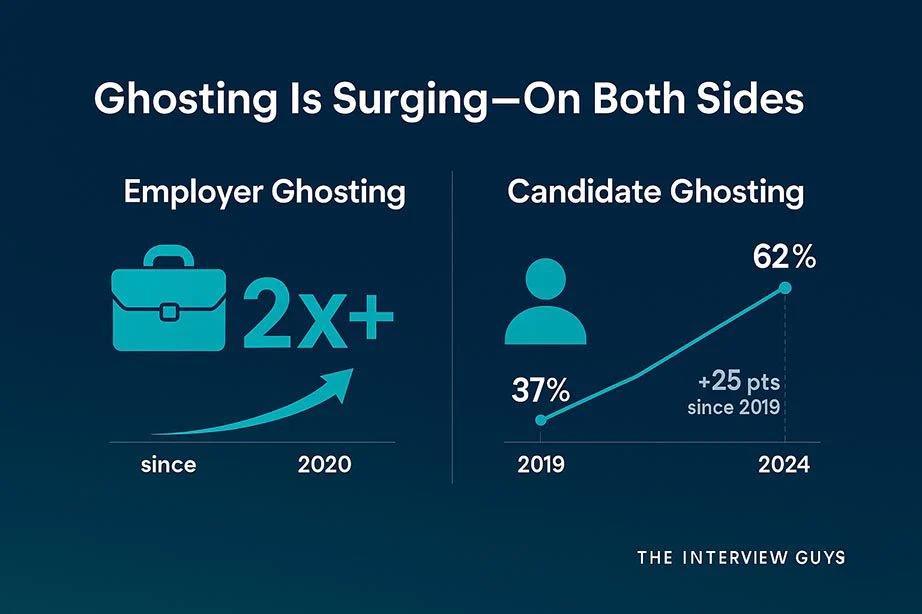
Take a look at the following statistics by The Interview Guys [1]
What gives? Is it because of a trust issue or the excitement of giving the other party a silent treatment?
In this article, let’s explore both sides of the story and examine what motivates employers and job seekers to ghost each other, as well as how both parties can at least minimise the impact of recruitment ghosting.
Read more: Green, Red, Or Yellow: Which Flag Are You Looking For in a Candidate?
Key takeaways
– Recruitment ghosting, where both employers and candidates disappear without communication, is a growing problem intensified in recent years, impacting trust and talent acquisition.
– Candidates ghost due to loss of interest, dissatisfaction with lengthy or disorganised hiring processes, finding better opportunities, and mandatory return-to-office policies.
– Recruiters ghost due to competitive hiring environments, internal obstacles, and personal shortcomings that lead to a lack of responsiveness.
Ghosting in hiring: Why does it happen?
Ghosting in the hiring process, where either employers or applicants suddenly disappear, can damage relationships and have lasting repercussions. This can manifest as candidates receiving no follow-up after applying or recruiters and hiring managers disappearing without explanation.
Post-interview ghosting is on the rise, with 61% of candidates experiencing it – a 9 percentage point increase since early 2024, according to The Interview Guys [1]. This trend extends to employer ghosting, which has more than doubled since 2020. While candidate ghosting has also surged from 37% in 2019 to 62% in 2024, the issue is particularly prevalent among small companies, which ghost candidates twice as often as large enterprises, with response rates as low as 5.83%. [2]
A 2024 Hiring Trends Survey by Resume Genius further highlights the severity of the problem, revealing that 8 out of 10 hiring managers (from a survey of 625) admitted to having ghosted candidates in the past. [3]
This is no longer a mere communication issue in the digital world; it is an alarming sound to us all that there is a shift in how employers and job seekers interact. Everything is happening right in front of our eyes, but we have little to no care about it.
As we navigate the already complex virtual world of talent acquisition, understanding the impact of recruitment ghosting first and foremost is crucial now more than ever.
Read more: You Probably Already Know Most Job Interviews Are Unreliable. But Why?
Why candidates ghost employers
Roughly one in six Millennials and Gen Z have ghosted prospective employers during the interview process [4]. There are countless reasons why candidates may ghost recruiters, but long story short, they can be summed up in the following causes:
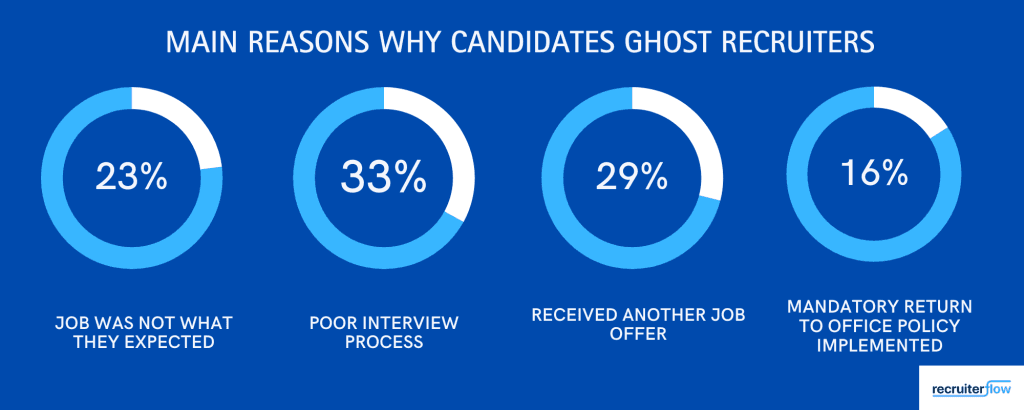
Source: Staffingindustry, Taken from Recruiterflow
🚩 Loss of interest
70% of job applicants will lose interest in a position if they do not receive a response from the employer within one week of their initial interview. [5]
What’s worth noting is that this disengagement can develop at various stages of the recruitment process. With today’s highly competitive labour market, job seekers tend to cast a wide net, mass-applying to numerous openings at once. If employers take too long responding, they will jump to the next available opportunity.
Moreover, after the first interview or additional research, candidates might find that what initially seemed appealing might not align with the reality of the position. They might discover that the company culture does not fit their belief or preferences, the responsibilities are different from what they expected, or the growth opportunities are limited.
Read more: “Sorry, I Have Logged Off (Mentally)”: The Subtle Art of Workplace Detachment
As a result, some candidates may choose to ghost instead of formally withdrawing because they perceive the withdrawal process as cumbersome or awkward. They might feel uncomfortable delivering “bad news” or believe that a formal withdrawal will negatively impact their chances with the company in the future, even when they have decided not to proceed with the company and the role.
In some cases, candidates might simply prioritise other opportunities and lack the time or inclination to send a polite refusal, especially if they are juggling multiple offers or interview processes. This often highlights a disconnect in communication expectations between candidates and recruiters.
🚩 Dissatisfaction with the employer and their recruitment process
Is your hiring process lengthy and confusing? Do you have a good explanation for why it takes so long? Are you being transparent with your candidates about the potential wait and the multi-step process?
A disorganised or confusing hiring process with unclear timelines or last-minute rescheduling might send a warning signal to job seekers.
They might view this as employers not valuing their time and, in turn, question the company’s priorities. Applicants not only reflect poorly on the company but also wonder if the same disorganisation is present in the company’s day-to-day operations.
A negative candidate experience can leave a lasting impression, erode trust, and deter top talent. When candidates are evaluating various job options, this dealbreaker (or what some might see as a major red flag) can make them mark your company as not a desirable place to work.
Read more: Will Skills-Based Hiring Overtake Degree Requirements?
🚩 Found a better opportunity
66% of workers have “ghosted” employers by retracting an accepted job offer or disappearing before their start date [6]. This trend can be attributed to several factors. For instance, in the initial stages of a job search, candidates often accept numerous interview invitations. As they progress with various companies, they may choose to ghost some employers to prioritise preferred opportunities.
Another contributing factor is the increasing use of AI-powered automation tools. These tools, designed to streamline the application process, inadvertently enable candidates to apply for a multitude of positions with just a single click, a remarkably huge time saver. This unprecedented level of efficiency (candidates can leverage AI to send personalised messages to each employer if they want to as well) has led to a dramatic surge in the volume of applications received by companies.
However, this increased volume comes with a critical drawback: it distorts the nature of communication that candidates have with their recruiters, making it less genuine and more transactional.
When the application process feels like a numbers game, candidates are less likely to feel invested in a particular opportunity, making them more prone to disengaging at any time without formal (and prior) notice, hence ghosting.
🚩 Mandatory return-to-office policy implemented
Remote work has become deeply ingrained in many professionals’ lifestyles as they value the flexibility that this mode of working brings. This is particularly true for experienced workers and women with childcare responsibilities, who often seek opportunities that offer room for personal commitments.
As a result, employers face increasing challenges in retaining and attracting talent due to this shift. A significant number of employees (28%) are willing to leave their jobs if a return-to-office mandate is implemented [7]. Companies are taking longer to fill job vacancies, with an average increase of 23% compared to pre-return-to-office baselines. [8]
Read more: The Future of Work from Gen Z & Millennials’ POV
A 2024 Korn Ferry poll of 10,000 workers across various countries revealed that the ability to work from anywhere remains a top priority for many professionals. [9]
In the past year, over half of senior managers (56%) reported missing out on potential hires because [10]:
– Candidates desired more schedule flexibility (40%)
– The company was too slow in making an offer (35%)
– Salary expectations were not met (24%)
To secure top talent in today’s competitive landscape, employers must exceed candidate expectations. This includes offering flexible work arrangements, competitive pay, and attractive perks, as well as acting swiftly to arrange interviews and extend offers.

Why recruiters ghost candidates
We all look for jobs at some point in our lives, and just like me, you might have screamed, “Seriously, recruiters, why do you ghost candidates?” at least a couple of times.
TRG is not taking sides, but we might have an explanation for this unwanted phenomenon.
🚩 Competitive hiring
A recruiter might unknowingly or intentionally choose to ghost candidates if they determine that an applicant is not the optimal fit for the role or if they have successfully identified a more qualified individual whose skills and experience more closely align with the specific requirements of the position.
This is quite common in highly competitive industries where the sheer volume of applications can make it challenging for recruiters to provide personalised feedback to every candidate. Therefore, they may have to prioritise candidates who possess the best fit for the company culture and the position. The decision is often driven by the need to fill out positions in a short time crunch, sometimes at the expense of providing closure to less-suited applicants, and unfortunately, leads to the practice of ghosting as a way to streamline the hiring process.
Read more: The Power of Job Fit & Great People Inside: Matching People to Roles
🚩 Internal obstacles
At times, the recruitment process can be suddenly stalled due to a variety of internal friction points. For instance:
– Disagreements among hiring managers and individual departments regarding the ideal candidate profile
– The lack of the much-needed approval from higher management to proceed with a new hire
– Budgetary constraints require hiring managers and recruiting teams to re-evaluate departmental priorities
Furthermore, companies may intentionally delay hiring to prioritise other, more pressing internal issues. While transparency and consistent communication from the employer are generally desirable, there are situations where they may be unable or unwilling to disclose (such as revealing the exact stage a candidate was eliminated, which could create negative sentiment that harms the company’s reputation). In such scenarios, recruiters are often instructed to suspend communication with candidates until these internal conflicts or obstacles are resolved.
Without this crucial sign-off, the recruitment team is left in limbo, unable to extend offers or even move forward with subsequent interview rounds, regardless of how promising a candidate may be.
These internal organisational hurdles not only delay critical hiring but can also lead to the loss of top talent who, frustrated by the slow pace, may accept offers elsewhere.
🚩 Personal shortcomings
At the end of the day, recruiters are humans and are bound to face various personal and professional challenges that might lead to a lack of responsiveness. It is not always a deliberate act of tarnishing the employer’s reputation on their behalf, but can stem from circumstances beyond their immediate control. For instance, a recruiter might be experiencing a family emergency that demands their full attention, preventing them from attending to emails or requests for information.
Read more: How to Balance Your Hiring Needs and Prioritise Recruiting Efforts
While some recruiters are transparent about potential delays in their communication, this courtesy is not always practised by all. So yes, this does contribute to “ghosting,” where candidates are left without a response, unsure of the status of their application or inquiry.
However, this also signifies a more serious underlying issue within the business – the lack of a streamlined, automated process to ensure a fair and consistent experience for every job candidate.
Without a robust and efficient system in place, recruiters may struggle to manage high volumes of applications effectively, especially when the hiring team only has one person in charge of everything. Such a manual or disjointed approach not only frustrates candidates but also damages the company’s employer brand, making it harder to attract top talent in the long run.
Impact of ghosting on hiring
Ghosting in the recruitment process carries significant repercussions for both candidates and organisations.
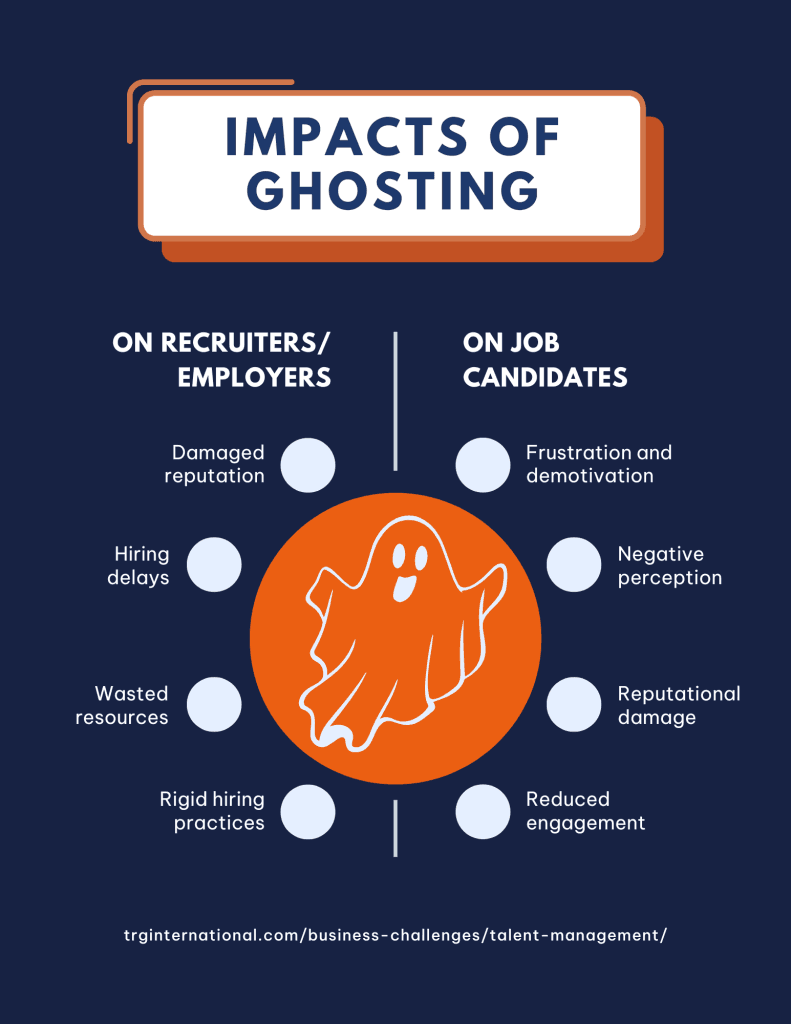
Impacts of employers ghosting candidates
– Frustration and demotivation: A lack of communication from potential employers can lead to job seekers feeling frustrated and less motivated.
– Negative perception: Candidates often develop a negative view of companies that ghost them.
– Reputational damage: Statistics show that 72% of job seekers share their negative experiences online, which can significantly harm a company’s reputation [11]. Platforms like LinkedIn and Glassdoor provide the perfect media for applicants to freely express their thoughts for thousands (or even millions) of people to see.
– Reduced engagement: Nearly 40% of applicants would be hesitant to engage with a company again if they have been ghosted [12]. This not only affects the candidate pool but can also impact customer loyalty and brand perception.
Impacts of candidates ghosting employers
– Damaged reputation: Ghosting directly harms a company’s image, and in today’s interconnected digital world, rebuilding a tarnished reputation can be challenging.
– Hiring delays: When candidates ghost, it causes delays in filling crucial positions, disrupting team productivity and project timelines.
– Wasted resources: Just like candidates, recruiters invest considerable time and resources in reviewing applications, conducting interviews, and extending offers. Ghosting wastes these efforts, frustrates hiring managers, and can lead to missing out on other strong candidates.
– Rigid hiring practices: Repeated ghosting incidents may force companies to adopt more cautious and inflexible hiring processes, negatively affecting the overall candidate experience for future applicants.
Ghosting extends beyond the hiring process, reflecting deeper issues of self-awareness, courtesy, and professionalism. The associated behaviour and decision-making can negatively influence other aspects of a person’s life and jeopardise future opportunities.
Regardless of whether you are a hiring manager, recruiter, or job seeker, it is essential to recognise that your actions (or inactions) can have far-reaching consequences. In an era of permanent digital footprints and interconnected professional networks, ghosting is not an isolated event but a choice that can impact one’s career for years to come.

How to reduce recruitment ghosting, or at least minimise its impact
How to handle a recruiter ghosting you
When a recruiter ghosts you, it can be disheartening, but understanding how to handle it can help you stay motivated in your job search. In the unfortunate circumstance where you have been ghosted, consider these proactive steps:
Clarify the hiring timeline
If you have recently had an interview or submitted your CV but have not heard back from the company, send a follow-up message to enquire about the next steps and the hiring process timeline.
Before sending your message, review past communications and the job posting for any previously mentioned timelines. If a date or timeframe was provided, wait until after that period to follow up.
If you have been communicating via email, ask when you can expect a response. Allow a few days to a week before sending further follow-up emails, giving the recruiter ample time to respond. Keep your messages concise and always express gratitude for the opportunity. Remember, a lack of communication might be due to internal delays rather than a reflection of your qualifications.
If you are past the expected hiring timeline and still receive no contact, it is reasonable to assume the company has chosen another candidate.
Actively pursue other opportunities
To make the most of your time, refine your applications and apply for other positions while waiting for responses. Many companies and recruiters do not inform candidates when they have selected someone else, so it is crucial to continue your job search even if you feel confident about a particular application.
Pro tip: Consider maintaining a spreadsheet to track the positions you have applied to, your status in each hiring process, and contact information for other recruiters. Do be considerate, though, and do not ghost your recruiters if they are late in answering your emails.
How to respond when a candidate ghosts you
By adopting a structured, professional, and empathetic approach to candidate ghosting, you can mitigate its negative impact, maintain your company’s reputation, and even potentially re-engage with candidates who might have simply had a temporary setback. Remember, every interaction, even a non-response, is an opportunity to shape perceptions of your organisation.
Follow up using multiple channels
If a candidate has not responded, recruiters or the person in charge can set up a series of follow-up emails to update their progress and offer assistance. If there is no response within 24 hours of emailing or texting, try reaching out via phone, LinkedIn, Twitter or any other available sources that the candidates provided. Technical issues like spam filters can sometimes prevent messages from being received.
Do avoid emotional responses. Ghosting is not always a personal slight. It is simply a reflection of the current dynamic and highly competitive labour market, not necessarily a judgement against your company or you as a recruiter.
Internally document and move on
It is crucial to keep records of all interactions with a candidate who ghosts you. Save emails and interview notes. This is especially important if you might consider them for future roles. If they ghosted once, they might do so again, and these records will help you make an informed decision.
– Update your system: Mark the candidate’s status as “withdrew (no response)” or similar in your Applicant Tracking System (ATS) or CRM. Include a brief note about the communication attempts. This helps with reporting and prevents future confusion.
– Focus on other candidates: Don’t let a ghosted candidate derail your entire recruitment process. Shift your focus back to other promising candidates in your pipeline.
It can be beneficial to review your recruitment process internally. Are there any bottlenecks, lengthy delays, or communication gaps that might contribute to candidates’ disengagement? This can help build a continuously improved and robust hiring process.
Offer incentives
Businesses can also consider offering incentives for completing the recruitment process. These can include signing bonuses, referral bonuses, or other perks designed to encourage candidates to see the hiring process through to finding the right job.
What are your thoughts on this recruitment ghosting trend? Do you have any solution that yields breakthrough results?
For more up-to-date news on businesses and talent management, don’t forget to subscribe to the TRG newsletter today!

References:
1. https://blog.theinterviewguys.com/the-2025-ghosting-index/
2. https://www.hrdive.com/news/hiring-managers-responsive-applicants/716173/
3. https://resumegenius.com/blog/job-hunting/job-ghosting
4. https://www.cnbc.com/2024/02/29/ghosting-is-getting-more-common-in-the-job-market.html
5. https://www.cnbc.com/2019/01/25/70percent-of-job-seekers-lose-interest-in-a-job-if-they-do-not-hear-back-after-just-one-week-.html
6. https://www.cnbc.com/2019/04/24/employees-are-ghosting-their-job-offers-gen-z-is-leading-the-charge.html
7. https://www.bamboohr.com/resources/data-at-work/data-stories/2024-return-to-office#executives-and-hr-admit-rto-is-meant-to-make-people-quit
8. https://fortune.com/2024/12/11/return-to-office-mandate-employees-study/
9. https://www.kornferry.com/insights/featured-topics/workforce-management/workforce-planning-insights
10. https://press.roberthalf.com/2022-02-16-4-in-10-Employers-Report-a-Rise-in-Candidate-Ghosting,-Robert-Half-Research-Shows
11. https://www.careerarc.com/lp/candidate-experience-study/
12. https://acarasolutions.com/blog/recruiting/recruiter-and-hiring-manager-ghosting-in-the-hiring-process/