

Quick quiz: What do businesses globally generate the most on a daily basis?
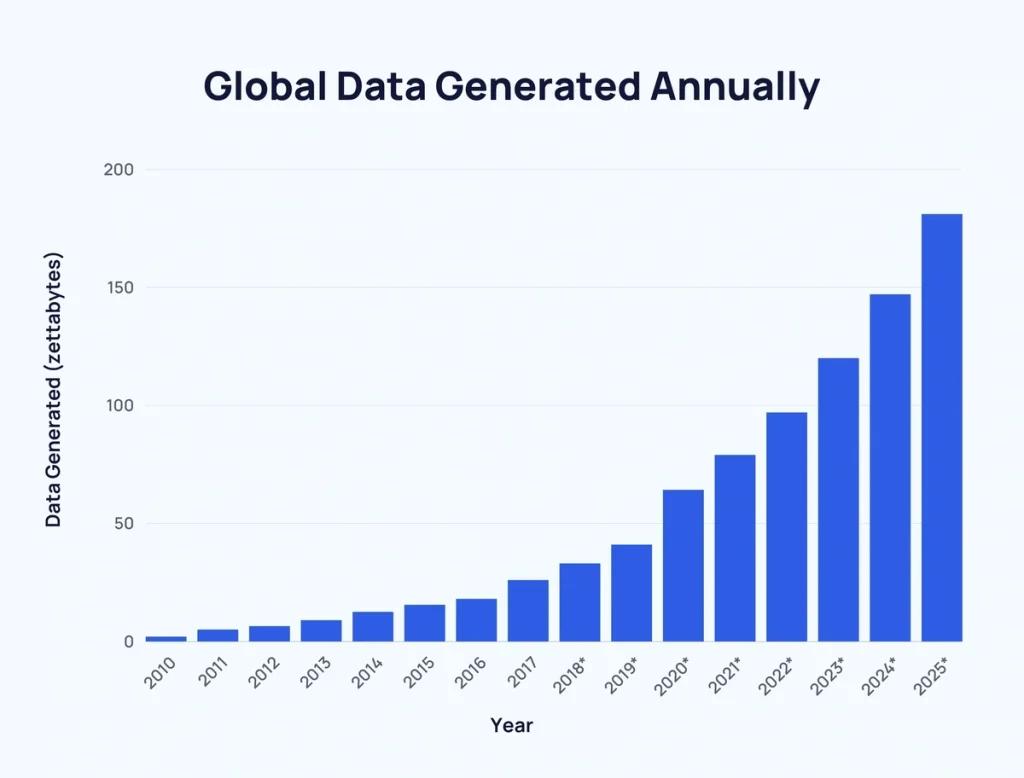
If your guess is documents or data, you are correct! According to Exploding Topics, a trend discovery solution provider, approximately 402.74 million terabytes of data are created each day. 90 per cent of today’s data was formed in the last two years alone. [1]
Check out the insanely huge amount of data generated annually, according to Exploding Topics.
What does the number look like in manufacturing? 1.9 petabytes (or 1,900 terabytes; 1,900,000 gigabytes) of data generated by the industry annually [2]. This makes manufacturing one of the most data-heavy sectors across the globe.
Read more: Tech Tidbits: What is Big Data?
Are manufacturers able to maximise their data use? Unfortunately, very few businesses are capable of making full use of this valuable asset. Many large corporations are pushing for advanced solutions like artificial intelligence, but for most, any investments in new IT solutions require a careful evaluation to avoid disruptions to production.
While having a solution to extract insights from your pool of information is essential, your data and documents are only useful if they are organised, stored, and managed the right way.
So let’s take a step back to first understand the concept of document management, specifically in the manufacturing setting.
Key aspects of document management in manufacturing
Data and document management are sometimes used interchangeably, but these two terms have some distinct characteristics, which, in turn, make them different.
Think of data management as managing a library’s catalogue system (i.e., all book titles, ISBNs, categories, etc.) to ensure that each book’s information is correctly stored and easily searchable.
Document management, on the other hand, is about managing the physical books in the library. To do that, you have to personally sort them and put them on dedicated shelves in a logical order.
Both are important lifeblood of every business, as they hold the key to ensuring compliance and fuel decision-making processes.
Documents in manufacturing can come in many forms, from invoices to device manuals, financial records, standard operating procedures, etc. Effectively managing them requires manufacturers to develop a systematic process to organise, store, manage, and control all documents/information created throughout the product lifecycle.
Read more: How to Tell If Your Enterprise Needs a Document Management System
In recent years, the majority of these have been digitalised, saving manufacturers significant resources and making information more accessible. Modern solutions provide manufacturing businesses with:
– A centralised repository to securely store all documents, eliminating the risks of data silos.
– A logical system to index and organise documents into different categories, making look-up and retrieval easy.
– A system for version control, ensuring everyone is working with the latest documents and a history of changes is well maintained.
– Clear, role-based access control to safeguard sensitive information.
– Streamlined workflows for document reviews, approvals, and distribution, thus reducing delays and manual labour.
– Audit trails with a detailed record of all document activities.
– Capabilities to ensure compliance and adhere to relevant industry regulations.
Download our FREE whitepaper: The How-To Guide to Better Document Management and Higher Productivity ➡️
Effective document management in manufacturing starts with having a centralised repository
Imagine having instant access to needed information. As corny as it sounds, in today’s fast-paced world, time is money! Instead of wasting 2 hours a day searching for documents [3], having access to a single source of the truth at the right time allows employees to be autonomous and focus on more strategic tasks.
Just like building a house, the foundation is the most crucial step to ensure your home is stable and standing strong for years to come. Similarly, a central “digital cabinet” ensures:
– Documents are not scattered and forgotten in individual computers, shared drives, or physical storage.
– Sharing and collaboration among different departments have become easier.
– Better foundation for other best practices, such as workflow automation and version control.
Read more: Don’t Let Your Data Lake Become a Data Swamp – Here’s What You Can Do
Having a central repository also allows manufacturers to enforce stronger security measures and more detailed access controls, guaranteeing information is protected and available to only authorised personnel.
Modern document management solutions also provide businesses with backup and recovery options, eliminating yet another headache for manufacturers and giving them peace of mind. This ability has elevated the power of document management beyond just storing files.
With the help of modern solutions, documents managed in a structured and controlled environment can support operations and foster collaboration while maintaining compliance throughout the entire manufacturing process.
Simplifying document management with solutions dedicated to manufacturing
Implementing a robust document management system is a strategic investment for manufacturing businesses looking to optimise their processes and gain a competitive edge.
Manufacturing businesses have a wide array of document management solutions available today, ranging from standalone systems (e.g., Google Drive and Microsoft SharePoint) to integrated modules within larger enterprise software suites, such as ERP.
What does TRG International recommend? It would be a missed opportunity if we do not mention our solution, Infor Document Management (IDM), an enterprise document management application that allows users to view, edit, create, and store physical files.
As part of Infor’s next-gen operating platform, Infor OS, IDM is tightly integrated with Infor’s manufacturing suite, from Infor SunSystems to CloudSuites, and non-Infor applications. This deep integration provides contextual access to documents, thus eliminating silos and streamlining workflows.
Read more: Infor Document Management Cloud Capture Integrated with Infor OS Multi-tenant
Another neat thing is how IDM integrates with Infor ION, the intelligent engine that drives automation, to build endless necessary automated workflows, such as approvals, reviews, escalating, and more. Ever wanting to immediately notify your manager to approve a purchase request form without having to manually chase them down with back-and-forth emails? Why not automate your process with workflows?
Paper documents can be scanned or captured using OCR technology to be input into IDM, which is particularly useful for processing invoices or quality inspection reports. Moreover, users can tag documents using relevant metadata (defined specifically to their manufacturing processes) to improve searchability.
While Infor IDM offers a strong foundation, manufacturers should evaluate if its specific features align with their unique document management requirements. There might be chances that the business requires integrating IDM with additional third-party solutions.
With that being said, Infor Document Management within Infor OS presents a compelling solution for manufacturing businesses, especially those already invested in the Infor ecosystem. Its tight integration, manufacturing-focused features, and robust capabilities can significantly streamline document management processes.
If you are keen to explore Infor OS and its vast array of capabilities beyond IDM, we encourage you to check out its brochure here!

Sources:
1. https://explodingtopics.com/blog/data-generated-per-day
2. https://www.forbes.com/sites/louiscolumbus/2020/03/29/the-state-of-enterprise-data-integration-2020/
3. https://www.glean.com/resources/guides/hybrid-workplace-habits-hangups