

Most multi-entity businesses do not suffer from a lack of financial reports; they suffer from four connected blind spots.
Numbers sit scattered across local systems, restricted balances inflate available cash, forecasts rely on outdated spreadsheets, and Finance and Treasury make decisions from different numbers. That is why cash visibility fails, even when teams work overtime to pull the numbers together.
Financial visibility isn’t just knowing how much money you have. It’s trusting your numbers, knowing where the cash sits, forecasting what’s coming, and deciding from one shared picture.
For groups with several entities and currencies, that picture is rarely clear. Treasury News Network 2025 found that only 22% of respondents have complete real-time visibility of cash across all entities and regions. Yet 76% already run a dedicated treasury management system. Owning a system isn’t the same as having cash visibility [1].
The problems also are not independent but fall like dominoes: inconsistent data makes your cash position unreliable, an unreliable cash position weakens your forecast, and a weak forecast slows every decision after it.
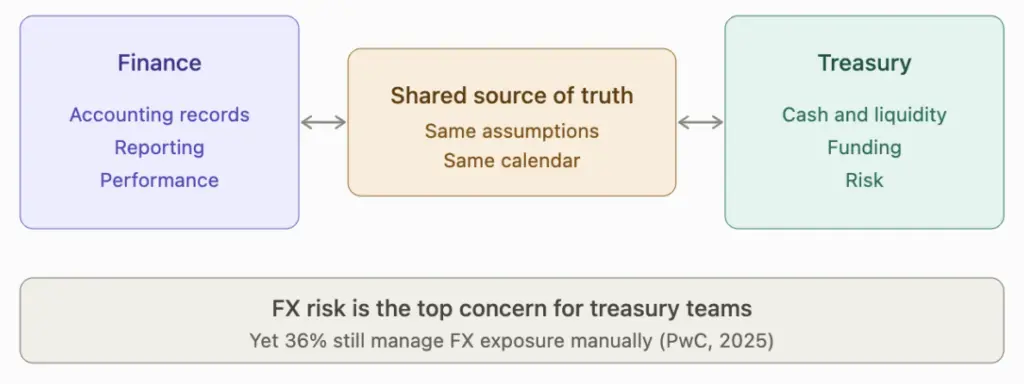
Image: 4 gaps commonly seen in treasury management – Data taken from KPMG, Global Treasury Survey 2025: Focus on structure, technology and ESG (2025)
TRG International also covered all four gaps in our recent webinar “From Financial Visibility to Treasury Control”, and you can register to watch the recording at the end of this article.
Gap 1: The Numbers Don’t Match, So Nothing Else Can Line Up
Everything starts with data. When each entity has its own system, chart of accounts and reporting practices, group-level figures are a patchwork someone consolidates by hand.
Group finance teams have to spend days collecting files and reconciling balances. Nevertheless, reports often arrive late, after the decision is made rather than on time. Add several currencies and local reporting rules, and the month-end close process can quickly turn into a marathon.
KPMG says much of the heavy lifting in finance transformation is data harmonisation, making sure “cash on hand” means the same thing across every ERP and treasury system [2].
How to close this gap
Agreeing on the language, such as a common chart of accounts, shared definitions, and a fixed reporting calendar, removes much of the friction. Then cut how often numbers are typed by hand. A core financial system that standardises records across entities and currencies gives Treasury data it can rely on.
Once your numbers agree, the next question is which of that cash you can actually use.
Read more: Experts Explained: Breaking Down Data Walls with Infor EPM
Gap 2: Even With Matching Numbers, You Can’t Tell Which Cash Is Usable
A bank balance isn’t available liquidity as cash can be restricted, committed to upcoming payments, or trapped in an entity that can’t easily release it. So the on-screen total usually overstates what the business can deploy.
This can lead to one subsidiary holding surplus cash while another borrows externally. Nobody got it wrong; they just couldn’t see each other.
How to close this gap
Ask three questions instead of one: where is the cash, when will it be available, and can the wider group use it? Consolidate bank balances into a single view first. Then connect it to treasury activity such as intercompany loans, cash calls and sweeps, so surplus cash in one entity is deployed internally before anyone turns to external funding.
Curious how treasury teams build that view in practice? TRG International’s webinar “From Financial Visibility to Treasury Control” walks through it, with a CS Lucas treasury specialist on cash visibility and liquidity. Register to watch the recording whenever suits you.
Knowing today’s cash is only half the story. What will you have in six weeks?
Gap 3: Without Usable Cash Data, Your Forecast Becomes a Guess
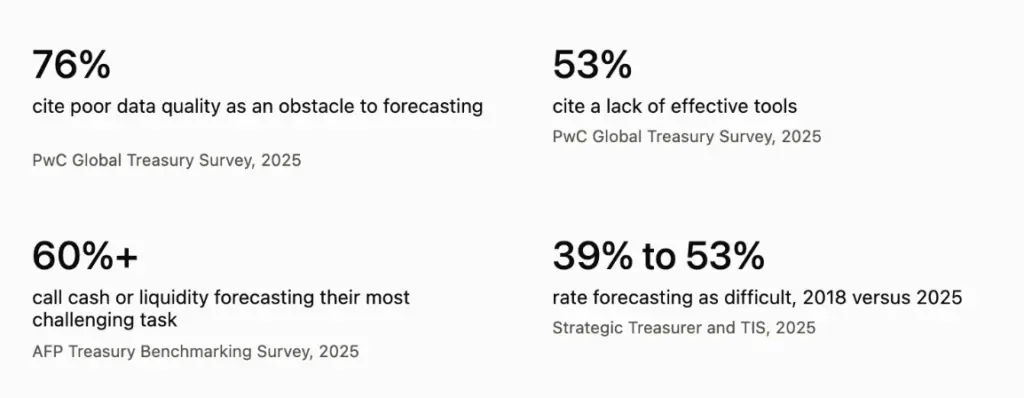
Image: The impact of cash visibility – Data taken from PwC, Association for Financial Professionals, BusinessChief [3, 4, 5]
Cash flow forecasting exists to spot liquidity gaps early. But a forecast built on outdated inputs and merged spreadsheets is mostly an educated guess.
The research agrees. In PwC’s 2025 Global Treasury Survey of 350 treasurers, 76% cite poor data quality as a major obstacle to forecasting, and 53% cite a lack of effective tools [3]. The Association for Financial Professionals (AFP) reports that more than 60% of treasury professionals call cash or liquidity forecasting their most challenging task, even though nearly three-quarters rank cash management and forecasting as their top priority [4].
In Asia Pacific specifically, cash flow forecasting is the biggest liquidity management challenge for 2026, according to J.P. Morgan, quoted in a BusinessChief article [5].
How to close this gap
Fix the inputs before polishing the model. Pull actuals automatically from the financial system, agree on one set of assumptions, and set a fixed update cycle. The payoff is time. Say a forecast flags a funding shortfall in one subsidiary six weeks out (an illustrative case). You can compare options calmly: transfer surplus cash from another entity, arrange external borrowing, or reschedule a planned investment. Without that warning, you’re often left with the costliest option: borrowing at short notice.
Even a forecast you trust can go unused, though. That’s the last gap.
Read more: Answers to Common Executive Questions About Financial Forecasting Tools
Gap 4: Even a Good Forecast Fails When Finance and Treasury Don’t Act Together
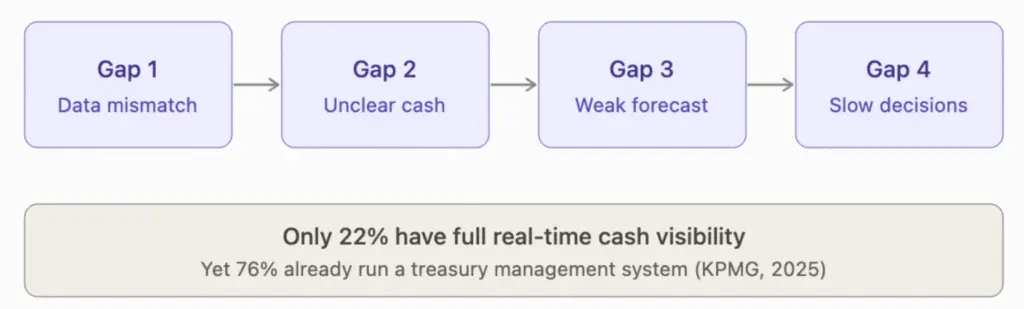
Image: Finance and Treasury working from different sets of information – Data taken from PwC [3]
Finance owns the accounting records and reporting. Treasury owns cash management, funding, financial risk and liquidity. They depend on each other, yet they often own different information.
The result is delayed funding decisions, surplus cash that isn’t weighed against upcoming funding needs, and plans built on different assumptions. Risk suffers too. PwC’s survey shows foreign exchange (FX) risk is the top concern for treasury teams, yet 36% still run FX exposure management manually [3].
How to close this gap
Give both teams one shared source of financial truth and a regular rhythm for using it. Before deciding what to do with an entity’s surplus, check upcoming payment obligations, debt maturities and group-wide funding needs. Before arranging external borrowing for a shortfall, ask whether intercompany funding could cover it.
Read more: Can Your Business Escape The Endless Spreadsheet-And-Email Approval Chain During Budgeting?
Closing the Gaps: From Four Separate Problems to One Connected Treasury with TRG International Solution
Consistent data makes cash visible. Visible cash makes forecasts credible. Credible forecasts speed up joint decisions, and shared decisions bring control. Fixing one gap helps; fixing them as a connected system changes how the whole function works.
For many organisations, the practical route is connecting the finance and treasury systems, and that’s where TRG International can help. Infor SunSystems Cloud can be your core financial system, handling multi-currency transactions and consolidated reporting across entities. CS Lucas, the treasury management system in TRG’s portfolio, supports money market transactions, term loans, FX contracts, bonds, equity, cash calls, and sweeps, giving Treasury one view of cash, risk, and investments.
With TRG’s systems integration services, accounting journals generated from treasury transactions can flow into SunSystems via dedicated API gateways, reducing manual journal posting and keeping records consistent. Integration can run daily, and manual posting stays available where it makes sense.
In our recent webinar, “From Financial Visibility to Treasury Control”, both TRG and CS Lucas experts walk through the CS Lucas-to-SunSystems flow, from initial booking to final redemption.
Technology is only half the answer. The Finance & Treasury Process Assessment, the next step offered at the end of TRG’s “From Financial Visibility to Treasury Control” webinar, is a short follow-up session that benchmarks your current setup, pinpoints manual and spreadsheet-heavy steps, and helps you identify what to fix first.

FAQs
What is financial visibility in treasury management?
Being able to rely on accurate financial data, know where cash is held, anticipate liquidity needs and make decisions from one consistent view of the organisation.
Why is cash flow forecasting so difficult for multinational groups?
Scattered data, manual spreadsheets, and different assumptions in Finance and Treasury.
Is a treasury management system enough to get full cash visibility?
Not on its own. KPMG found 76% of respondents run a dedicated treasury management system, yet only 22% have complete real-time cash visibility. Data quality and integration matter just as much.
Is there a webinar that explains how to connect Finance and Treasury?
Yes. TRG International’s webinar “From Financial Visibility to Treasury Control” covers the four gaps above, shows how CS Lucas and Infor SunSystems connect, and includes a Q&A session. Register to watch the recording.
Sources:
1. https://ctmfile.com/story/treasury-transformation-gains-pace-but-certain-gaps-persist
2. https://kpmg.com/us/en/articles/2026/predictive-cash-forecasting-visibility-kpmg.html
3. https://www.pwc.com/us/en/services/consulting/finance-accounting-transformation/library/2025-global-treasury-survey.html
4. https://www.financialprofessionals.org/about/learn-more/press-releases/Details/survey–significant-gap-exists-between-importance-and-effectiveness-of-communication-in-treasury
5. https://businesschief.com/articles/cfo-real-time-cash-visibility