

Almost every recent corporate survey paints a picture of unprecedented efficiency. Employees report saving hours each week using generative assistants, companies are committing billions to enterprise licenses, and digital work basins are flooding with more text, code, and graphics than at any point in human history.
Yet, if you look at macroeconomic indicators or corporate earnings reports, a puzzling paradox emerges: top-line productivity gains remain remarkably difficult to detect.
If artificial intelligence allows knowledge workers to execute individual tasks in seconds rather than hours, why isn’t organizational productivity rising at the same meteoric pace? The answer lies in a fundamental confusion that has quietly taken hold across executive suites. Organizations are mistaking task efficiency for systemic productivity, and conflating output volume with business value.
To understand why AI investments are not yet delivering their promised yield, business leaders must look past platform activity, examine the hidden human labor maintaining these systems, and dismantle the illusion of activity-driven metrics.
Read more: The Great Hunkering Down: What the Data Actually Shows and Why Leaders Should Care Now
The Rise of “Tokenmaxxing“
This push for raw volume has given rise to a concerning workplace phenomenon: Tokenmaxxing.
“Tokenmaxxing means maximizing AI token usage — and treating that volume as proof of productivity. The term spread in 2026 as companies ranked employees on internal token leaderboards, borrowing the internet “-maxxing” suffix: push one metric as hard as possible, whether or not the outcomes improve. The useful version asks whether accepted work improved alongside the spend.” (Tokenmaxxing, 2026)
In the architecture of Large Language Models, a “token” is the fundamental unit of data processed by the system, roughly 4 characters or 3/4 of a word. When users input prompts or generate responses, they consume tokens.
Originally coined in developer circles to describe pushing context windows and multi-agent systems to their technical limits, tokenmaxxing has evolved into a corporate trend where maximizing AI consumption becomes a proxy for employee performance (Glover, 2026). Driven by executive pressure to demonstrate rapid “AI adoption,” some companies have gamified usage. Internal leaderboards rank employees or departments by their monthly token usage, awarding prizes or status to top consumers (Phạm, 2026). In response, employees adapt to show high platform engagement by:
- Running prompt loops to rewrite routine emails multiple times.
- Using autonomous agents to generate vast software variations without clear architectural intent.
- Consulting AI tools for basic tasks before engaging in independent critical thinking.
- Submitting continuous background requests to ensure high standing on internal activity dashboards.
Tokenmaxxing creates a dangerous illusion of productivity. It rewards computational spend and platform engagement rather than analytical rigor or strategic impact. When organizations measure the adoption of a technology by how much of it is consumed rather than what it achieves, they subsidize digital busywork at the expense of genuine value creation.
Read more: Should You Be Afraid of AI-Powered Apps and ChatGPT?
AI is Undeniably Making Tasks Faster
To evaluate AI’s true economic impact, we must first acknowledge where its value is undeniable. At the micro-level, generative AI is an extraordinary capability multiplier. Consider the daily routine of a mid-level professional. Writing a preliminary project proposal that once required a full afternoon can now be drafted in three minutes.
Software engineers use pair-programming agents to write boilerplate code, autocomplete functions, and catch syntax bugs in real time. Customer support representatives use specialized models to summarize long conversation histories instantly, dramatically shortening call resolution times.
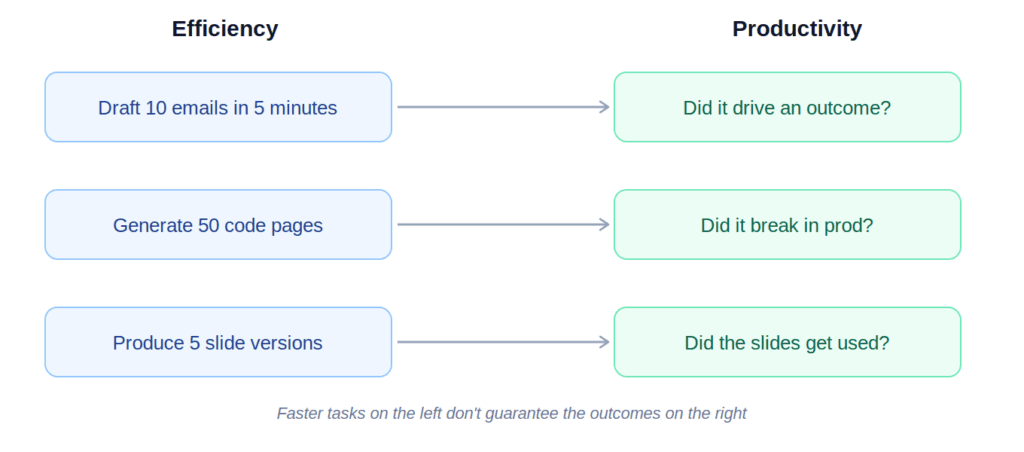
These micro-efficiency gains are genuine. They save time, lower the barrier to entry for complex tasks, and eliminate routine cognitive friction. However, accelerating the execution of an isolated task only creates enterprise value if that task directly contributes to a meaningful result. Speeding up a broken or unnecessary process simply produces noise at a faster rate.
Output Is Not the Same as Productivity
The central flaw in modern AI strategy is the assumption that higher output automatically equals higher productivity.
In a traditional workplace, productivity is defined as the ratio of meaningful output to input or how effectively capital and labor are converted into economic value. Today, however, AI tools have reduced the marginal cost of producing digital content to near zero. As a consequence, workplaces are experiencing an era of unprecedented output inflation.
Read more: Why Are We Procrastinating At Work?
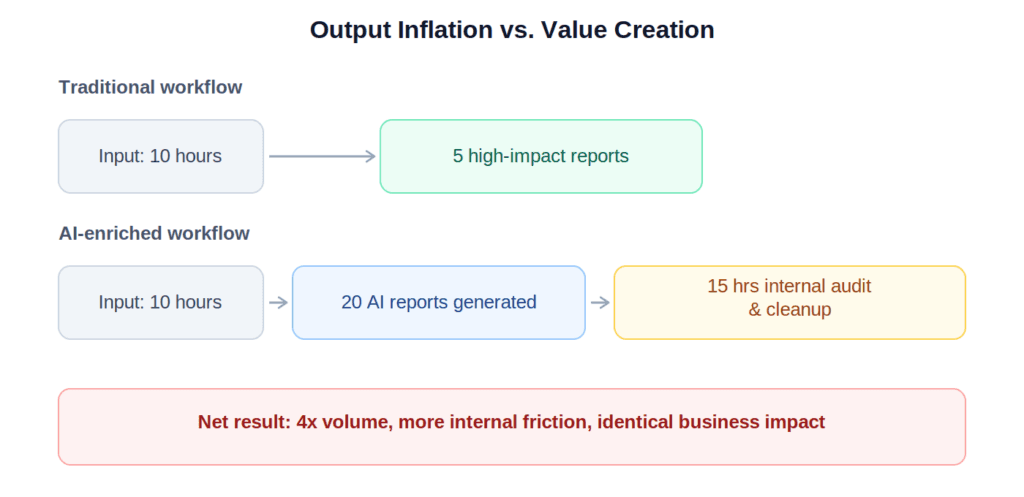
Imagine a strategy consultant who manually writes five detailed client reports a week. With generative AI, that same consultant can produce twenty reports in the same timeframe.
On paper, output has quadrupled. But critical questions remain:
- Were all twenty reports necessary, or did the low cost of generation encourage low-value work?
- Are decision-makers capable of digesting four times as much documentation?
- Did the additional fifteen reports drive stronger revenue, higher client retention, or better strategic alignment?
If the extra volume merely creates information overload for colleagues and clients, productivity has not increased. In fact, due to the cognitive overhead required to review, verify, and filter that extra content, net organizational productivity may actually decline.

AI Creates Hidden Work That Goes Unmeasured
Another reason AI productivity gains appear elusive is that generative tools do not eliminate human labor; they often shift it into unmeasured, secondary workflows.
Generative models operate on probabilistic patterns rather than actual comprehension. Consequently, their output requires rigorous human oversight, including:
- Verification and Fact-Checking: Auditing hallucinations, false citations, and flawed logic.
- Refinement and Formatting: Stripping out repetitive phrasing and aligning tone with corporate standards.
- Systemic Integration: Testing AI-generated code for hidden security vulnerabilities or integration conflicts.
This hidden human layer is well illustrated by Amazon’s experience with its “Just Walk Out” checkout-free shopping technology. Marketed as an advanced AI system capable of tracking items and charging consumers seamlessly via computer vision, subsequent investigative reports revealed that the system relied heavily on a team of around 1,000 workers in India to manually review and annotate video feeds to ensure transaction accuracy (Palmer, 2024).
Amazon later clarified its operational model, explaining that human review was an intentional component designed to continuously train machine learning algorithms and handle edge cases where camera occlusion made automated detection uncertain (Amazon, 2024).
The takeaway for corporate leaders is not that automated systems are inauthentic, but that automated intelligence almost always relies on invisible human labor.
Read more: Gen Z and Gen AI: The New Digital Mentorship Revolution
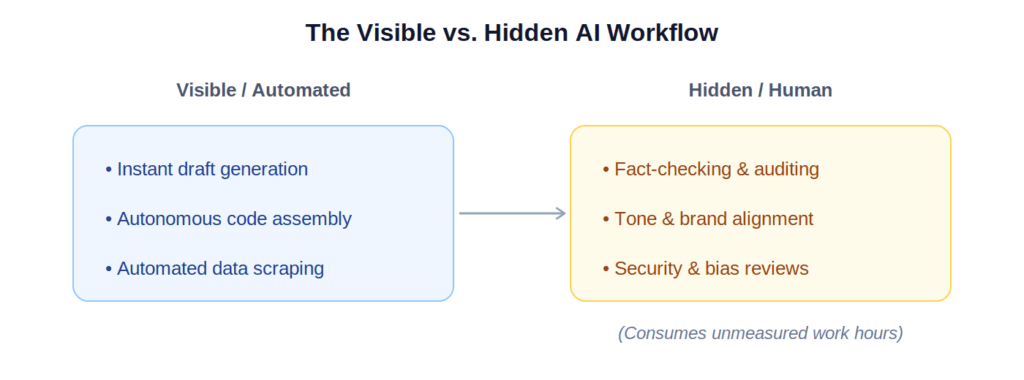
In the corporate enterprise, when an employee uses an AI agent to draft a 30-page market analysis in seconds, the labor hasn’t vanished—it has simply shifted to the three executives who must spend hours verifying facts, cross-checking sources, and editing errors. The initial step was fast; the downstream validation remains slow and costly.
Read more: The Truth About AI: Separating Fact from Fiction and Harnessing Its Power
Why Macroeconomic Productivity Data Remains Mixed
The disconnect between technology deployment and productivity gains is not unique to generative AI. Economists have observed this pattern across major technological shifts over the past century.
According to research from Australia’s national science agency, the Commonwealth Scientific and Industrial Research Organization (CSIRO, 2025), empirical evidence regarding generative AI’s impact on broad-scale productivity remains mixed, with studies showing variable outcomes depending on sector, organizational readiness, and task complexity.
Historically, transformative general-purpose technologies such as electricity, the personal computer, and the internet did not yield immediate, economy-wide productivity spikes. Nobel laureate Robert Solow famously quipped during the computer revolution of the late 1980s: “You can see the computer age everywhere but in the productivity statistics.”
Productivity lags occur because introducing a new technology into old workflows rarely yields significant returns. Electric motors did not revolutionize manufacturing simply by replacing steam engines in existing factories; true productivity gains emerged decades later when factories were physically redesigned around distributed electrical wiring.
Similarly, simply dropping generative AI into legacy corporate hierarchies creates more activity, not higher performance. Real productivity gains require organizations to rethink process architecture, redefine job descriptions, and eliminate legacy workflows that AI has made obsolete.
Better Productivity Indicators to Track
If measuring token consumption, platform logins, or generated draft volume offers little insight into true performance, what should business leaders track instead?
To build a framework for measuring AI’s real impact, leaders must distinguish between three distinct concepts that are frequently confused.
Read more: Unlock Your Hiring Potential: Discover Great People Inside (GPI)
| Metric Dimension | Core Focus | Typical AI Example | Business Impact |
| Efficiency | Task Speed (Doing things quickly) | Generating an initial blog post or coding module in 3 minutes instead of 2 hours. | Variable: Lowers execution cost, but risks generating low-value work if unmanaged. |
| Productivity | Output Ratio (Doing things effectively) | Producing 5 fully verified, high-converting marketing campaigns instead of 2. | Moderate: Increases output capacity per employee, provided market demand exists. |
| Business Value | Outcome & Margin (Doing the right things) | Shortening the sales cycle by 20% or raising customer retention by 15% via targeted AI insights. | High: Directly improves operating margins, top-line revenue, and competitive advantage. |
Organizations must replace activity-based metrics with outcome-oriented indicators categorized across four core domains.
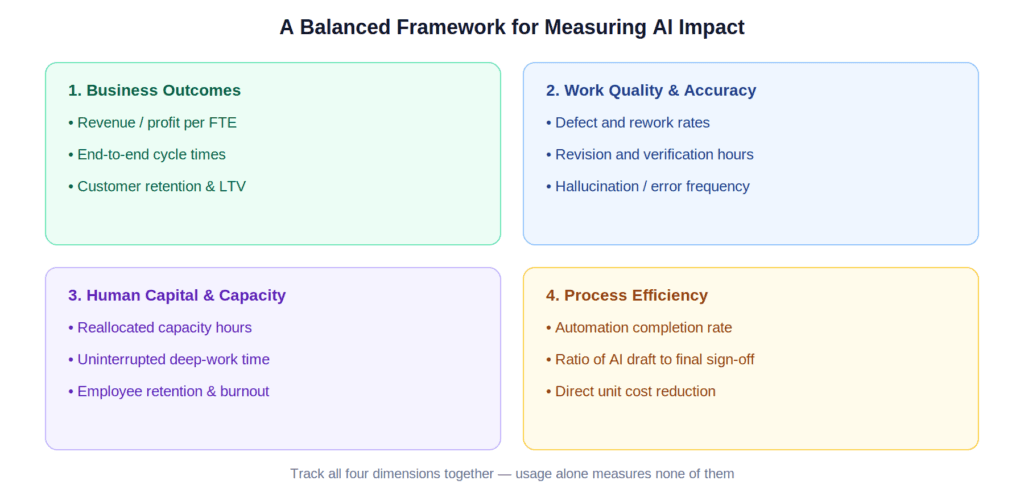
1. Business Outcome Indicators
Stop measuring how much AI is used; measure how operational metrics shift as a result.
- Revenue and Profit per Employee: Is total output generating higher revenue without proportional increases in headcount costs?
- End-to-End Cycle Time Reduction: Are core operational workflows—such as closing monthly accounts, resolving support escalations, or shipping software patches—moving faster from start to finish?
- Customer Lifetime Value (LTV) and Retention: Is AI-assisted service improving client satisfaction and retention, or are automated interactions driving customers away?
2. Work Quality and Accuracy Indicators
Speed means little if the resulting output requires extensive correction downstream.
- Rework and Defect Rates: What percentage of AI-generated deliverables require significant human revision before client delivery?
- Verification Costs: How many hours do senior staff spend checking, editing, and auditing AI-assisted work compared to traditional methods?
- Compliance and Security Audit Issues: Are automated drafts increasing compliance errors or security vulnerabilities in production environments?
3. Human Capital Impact
AI should expand strategic bandwidth rather than create constant digital friction.
- Reallocated Capacity: When an AI tool saves an employee five hours a week, where are those five hours spent? Are they redirected toward strategic client meetings, deep analytical work, or simply consumed by more administrative messaging?
- Deep Work vs. Context-Switching: Are employees gaining long stretches of uninterrupted strategic focus, or are they managing continuous prompt-and-edit cycles that worsen decision fatigue?
- Skill Acquisition and Onboarding Time: Are junior team members learning core competencies faster with AI assistance, or are they using automated outputs as a crutch that hinders foundational skill development?
4. AI Effectiveness and Operational ROI
Focus metrics on the functional ROI of AI implementations rather than platform adoption rates.
- Completion Rate without Human Intervention: For targeted automation, what percentage of routine tasks are fully resolved without manual intervention?
- Cost per Outcome: What is the total cost, including software licenses, API consumption fees, and human oversight time, per completed, high-quality business output?
Actionable Recommendations for Executive Leadership
To escape the tokenmaxxing trap and harvest tangible ROI from artificial intelligence, business leaders should execute five strategic shifts:
- Shift from Activity Targets to Outcome SLAs: Immediately eliminate internal leaderboards, usage tracking dashboards, or performance reviews that reward raw token spend, prompt counts, or platform login hours. Define success strictly by business outcomes, delivery speed, and final work quality.
- Audit the ‘Verification Overhead’ in Key Workflows: Conduct a process audit across high-usage departments to measure how much time employees spend on prompting, fact-checking, and fixing AI-generated material. Identify where automated assistance saves time and where it simply shifts work downstream.
- Redesign Processes Before Adding Technology: Avoid integrating generative AI tools into legacy process architectures. Instead, map out end-to-end workflows, strip away steps made obsolete by automation, and restructure roles around high-value decision-making and critical thinking.
- Establish Clear Protocols for ‘Acceptable Draft Quality’: Define clear operational boundaries for when AI tools should be used for initial drafting and when tasks require original human composition from the start. Standardize verification procedures to ensure quality control without creating redundant review loops.
- Track Capacity Reallocation Explicitly: When deploying AI tools designed to save time, establish clear expectations for how that saved time should be reinvested, whether into business development, customer-facing interactions, strategic research, or skill development.
So, Does AI Really Make Us More Productive?
The answer is: sometimes, but only when paired with intentional workflow redesign and clear human accountability.
The enterprise value of artificial intelligence does not stem from its ability to generate endless paragraphs of text, millions of tokens, or infinite variations of code on demand. It stems from its ability to eliminate routine friction so that human beings can engage in high-value analysis, strategic judgment, and creative problem-solving.
The future workplace will not reward the professionals or organizations that produce the highest volume of AI output. It will reward those who use AI with judgment and critical thinking to deliver measurable business outcomes.
In the AI era, true productivity is not measured by how many prompts we send, but by what those prompts ultimately help us achieve.

Sources:
- Amazon. (2024, April 17). An update on Amazon’s plans for Just Walk Out and checkout-free technology. About Amazon. https://www.aboutamazon.com/news/retail/amazon-just-walk-out-dash-cart-grocery-shopping-checkout-stores
- Commonwealth Scientific and Industrial Research Organisation. (2025, July 15). Does AI actually boost productivity? The evidence is murky. CSIRO News & Articles. https://www.csiro.au/en/news/All/Articles/2025/July/Does-AI-actually-boost-productivity-the-evidence-is-murky
- Glover, E. (2026, April 22). What is tokenmaxxing? The AI workplace trend explained. Built In. https://builtin.com/articles/ai-tokenmaxxing
- Palmer, A. (2024, April 3). Amazon’s Just Walk Out technology relies on hundreds of workers in India watching you shop. Business Insider. https://www.businessinsider.com/amazons-just-walk-out-actually-1-000-people-in-india-2024-4
- Phạm, H. (2026). Tokenmaxxing: Dùng AI nhiều có thật sự làm ta năng suất hơn? [Tokenmaxxing: Does using AI more actually make us more productive?]. Vietcetera. https://vietcetera.com/vn/tokenmaxxing-dung-ai-nhieu-co-that-su-lam-ta-nang-suat-hon
- Tokenmaxxing. (2026, May 18). Tokenmaxxing: Plain-English Definition, Origin & What It Means. Tokenmaxxing.Com; Tokenmaxxing. https://tokenmaxxing.com/guides/what-is-tokenmaxxing