


Turnover is down. Retention is up. If you are judging your workforce solely by headcount stability, the dashboard probably looks fine.
Ask a manager how their team is performing, and you will often hear something different: slower output, less initiative, people who technically stayed but don’t seem entirely there anymore.
That gap has a name: the Great Hunkering Down. It describes a workforce staying in place out of caution, not confidence; employees riding out a tighter job market rather than committing to their roles, because leaving feels riskier right now than staying does. However, this does not necessarily equate to “employee loyalty”.
Gallup’s 2026 global workplace data already confirms that this phenomenon is happening [1]. The real question is what a “hunkering down” workforce is costing you, and what to do about it before it becomes a much bigger problem.
Read more: 6 Strategies to Attract, Engage, and Retain Remote Teams
Why employees are hunkering down
Coined by the Financial Times, the term “the Great Hunkering Down” refers, as mentioned above, to a wave of workers today being cautious about their decisions to leave their current positions [2]. They are, in other words, clinging to their jobs despite deteriorating benefits and widespread cost-cutting.
Hunkering down can be perceived as a response to a specific set of conditions, and understanding those conditions matters more than the label itself.
The market has stopped rewarding movement
Gallup also tracks how employees perceive the job market itself, and the same report shows perceptions have recovered somewhat since the pandemic but remain below their peak: the share of employees globally who say it’s a good time to find a job rose from 29% in 2009 to a high of 55% in 2019, dipped during COVID, and now sits at 52%.
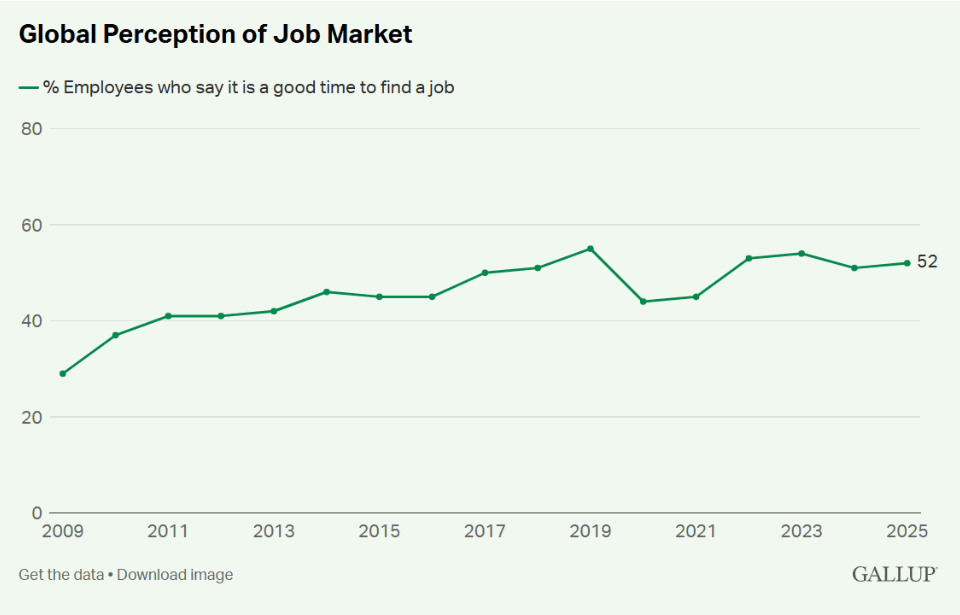
That’s a market where people feel somewhat more mobile than in 2020, but, per Gallup, still cautious enough that they aren’t acting on it.
At the same time, job openings have thinned out, and there are fewer options on the table (which we will discuss in later parts of this article). As a result, employees have less leverage to negotiate pay, flexibility, or better roles than they had two or three years ago. When switching jobs stops being a realistic upgrade, staying is the only move left.
Read more: Why Are We Procrastinating At Work?
The perks that made switching attractive are disappearing
Employers spent the Great Resignation years competing on flexibility, remote work, and extras to win talent. Much of that is now being quietly rolled back. For instance, return-to-office mandates are continuously on the rise, and roles offering the flexibility people have grown accustomed to are harder to find. That erodes one of the biggest reasons people used to leave (besides salary): a better offer elsewhere, but not being able to replicate what they already have.
AI has turned “stay quiet” into a survival strategy
For a growing share of employees, the calculation has shifted from “will I get promoted” to “will my role still exist.”
According to Gallup’s Q1 2026 data, 18% of U.S. employees said it was very or somewhat likely their job would be eliminated within five years due to automation or AI. That figure rose to 23% among employees at organizations where AI has already been implemented, and Gallup found it climbs past 30% specifically in finance, insurance, and technology.
In the same report, nearly a fifth of U.S. employees now say it’s likely their job will be eliminated by automation or AI within five years. That fear climbs even higher in companies that have already started adopting AI into their workflows.
Under such uncertainty, drawing attention to yourself, asking for a stretch project, pushing back on a decision, and raising your hand for something risky stop feeling worth it. Hunkering down then becomes a rational response to feeling replaceable.
Read more: Gen Z and Gen AI: The New Digital Mentorship Revolution

Career risk has replaced career ambition as the dominant mindset
Internal mobility, the ability to move up or sideways without leaving the company, normally gives ambitious employees a reason to stay engaged even when the external market is weak. But when hiring freezes hit internal roles too, and organizations slow down promotions to manage costs, that release valve closes. Employees are stuck both externally and internally, which is a much harder problem to paper over with a good retention number.
Put together, these certainly do not paint a “low turnover” picture that needs celebrating. It hides a nuanced reality that the current workforce is present, employed, but is quietly waiting for conditions to change.
Read more: Why Do Your Employees Quit? 5 Typical Causes of High Turnover Rate
The Hunkering Down effect: What the data shows
Engagement is falling, even as people stay put
According to Gallup’s State of the Global Workplace 2026 report, global employee engagement, tracked annually since 2009, rose steadily for over a decade, peaked at 23% in 2022, and has now fallen for two straight years. Gallup notes this is the first time global engagement has declined for two consecutive years since it began measuring.
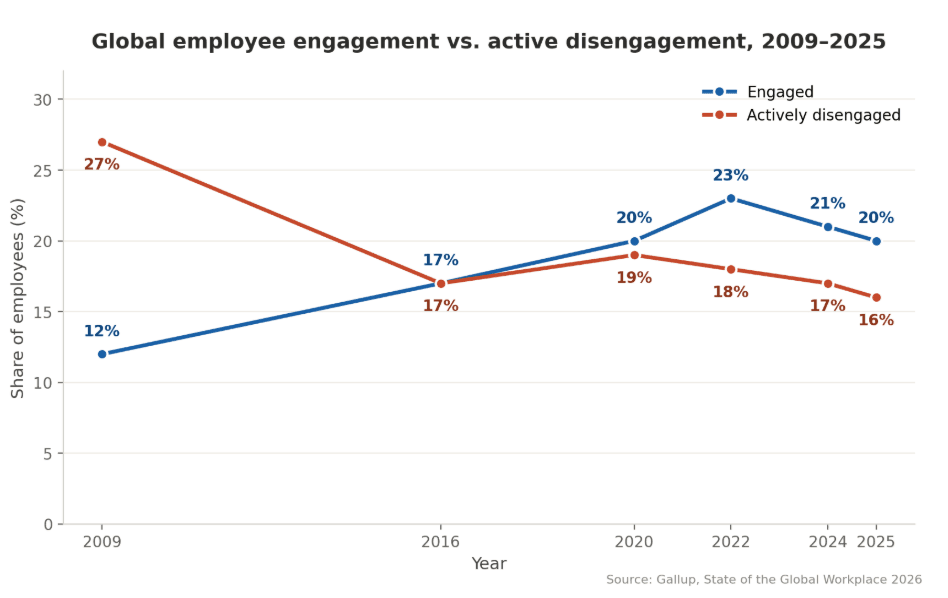
By 2025, Gallup found engagement had fallen to 20% globally, its lowest level since 2020, a decline the report estimates is costing the world economy roughly $10 trillion a year in lost productivity. Gallup also flags that no region increased engagement over the past year, which rules out this being a localized or one-off dip.
The drop is coming from managers, not the rank and file
This is the single most important number in the report if you’re trying to understand the “hunkering down” phenomenon.
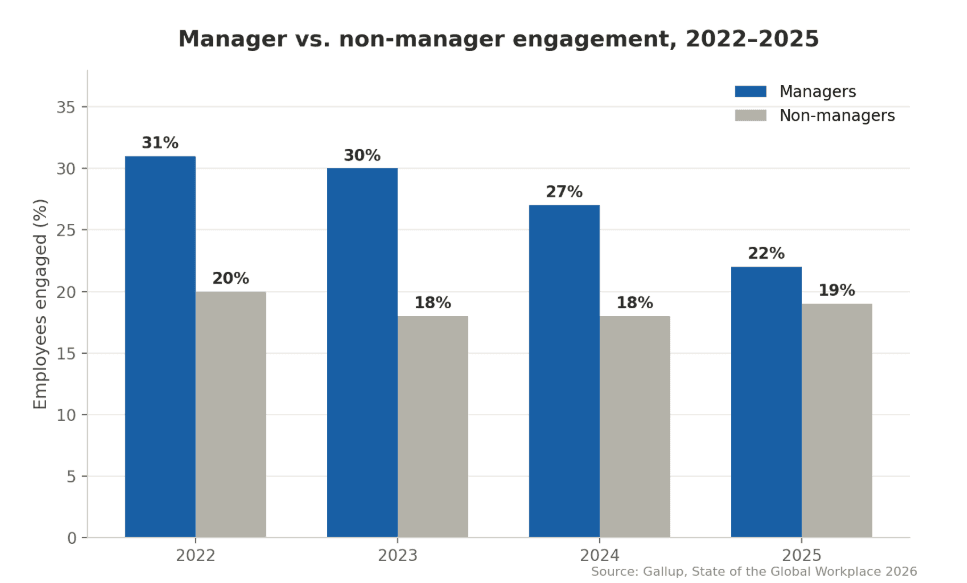
Gallup reports that managers used to hold a meaningful “engagement premium” over the people they lead, but that gap has nearly closed. In the same report, manager engagement dropped nine points since 2022, with the steepest single-year decline between 2024 and 2025 alone, falling from 27% to 22%. Individual contributor engagement, by contrast, stayed roughly flat over the same stretch (20% in 2022 to 19% in 2025).
This could mean that employees aren’t quitting and aren’t becoming noticeably more disengaged either. However, the people leading them are burning out fast, and since managers drive most of team-level engagement, that decline is highly likely to spill over to other layers of the org chart.
Not every organization is stuck in this trend. Gallup’s data shows a clear exception: within organizations it classifies as “best practice,” 79% of managers were engaged in 2025, nearly four times the global average. That gap is the strongest evidence in the report that this decline is a leadership and management-design problem, not an unavoidable market condition.
The job market itself is confirming the freeze
According to Andy Challenger, labor and workplace expert and Chief Revenue Officer of Challenger, Gray & Christmas, citing federal JOLTS data, notes that open positions have declined, leaving workers with less negotiating leverage and less incentive to leave jobs they might otherwise have quit [3].
It also reports on new research from career-tool company Kickresume, which independently landed on the same “Great Hunkering Down” label, describing a labor market where perks are disappearing and remote roles are harder to find, keeping employees in place longer than they might otherwise choose to stay.
That same reporting adds a sharper edge to the AI story. Citing Challenger, Gray & Christmas data, it found U.S. employers announced more than 97,000 job cuts in May 2026, the highest total for that month since 2020, with the technology sector accounting for more than a third of them. Challenger’s own labor market expert, Andy Challenger, said AI is now the leading reason companies cite for job cuts. Read against Gallup’s finding that most companies are not yet seeing measurable productivity returns from AI, that is a signal that some of today’s headcount decisions may be running ahead of the actual payoff.
Read more: Gen Z’s Expectations for Leadership Are Reshaping Modern Workplaces
Why leaders should care now
Disengagement is already showing up as a real, measurable cost
The 20% rate in employee engagement, according to Gallup, is costing companies $10 trillion in lost productivity, or roughly 9% of GDP. That cost is accruing right now, within organizations that look completely stable on a headcount report.
Retention is quietly masking a flight risk, not solving one
As mentioned above, the perceptions of job market opportunities have partially recovered since the pandemic (from 29% in 2009 to 52% today), even as engagement keeps falling. This could translate to more people thinking they could leave, but layered on top of that is a declining engagement rate. This is a lagging indicator, not a stable one.
Therefore, leaders who read today’s low turnover as loyalty risk being caught flat-footed the moment conditions loosen further.
AI investment depends on the exact thing that’s declining
AI adoption lives or dies by manager support. Gallup’s data show a massive gap in the frequency of AI use between employees who feel supported by their managers (79%) and those who do not (46%).
Read more: New Hires Are Set Up to Fail and Here’s Why
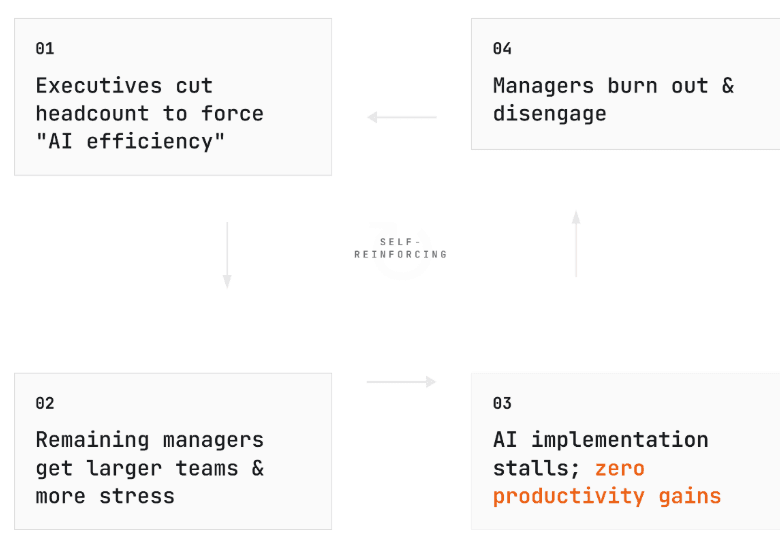
Yet expecting managers to champion this transition right now is like asking them to pour from an empty cup, since many are currently disengaging. They are sandwiched between the demands for lower costs and higher efficiency from the Board and the “unsure what the future holds” from the team members below. A disengaged, exhausted manager does not have the capacity to learn new AI tools, redesign workflows, or coach their teams through a technological shift. They are just trying to survive the week.
This manager disengagement is the friction point behind the productivity paradox noted in the same Gallup study, where 89% reported no measurable impact of AI on labor productivity over the past three years, which has triggered more layoffs. But by reducing headcount, organizations will just layer more and more out-of-scope work for these managers. Thus, creating a paradoxical and vicious cycle of AI adoption.
Fortunately, leadership engagement and technological adaptation can be amplified with the right training.
Read more: Unlock Your Hiring Potential: Discover Great People Inside (GPI)
Don’t make a fixable problem worse
Top-performing organizations aren’t hitting 79% manager engagement by accident. The gap Gallup found between the global average and these companies emphasizes that the root cause lies in management and culture choices. Leaders who treat stable headcounts as “problem solved” will miss the window to fix what’s actually breaking. In a market where staying is driven by caution rather than commitment, retention numbers alone tell leaders almost nothing about whether their organization is actually healthy.
Leaders who dig into engagement, especially at the manager level, have a clear, evidence-based path to close that gap before it costs them productivity or people. AI is a useful tool, but companies can’t automate their way out of poor leadership decisions.
Until organizations invest in re-engaging their managers and giving them ample room to lead, AI will remain an expensive line item that drives layoffs, destroys morale, and delivers absolutely zero return on investment.
Sources:
1. https://www.gallup.com/workplace/349484/state-of-the-global-workplace.aspx
2. https://www.ft.com/content/77ab3a01-35b3-49d5-b297-0408e1850bc0?syn-25a6b1a6=1
3. https://finance.yahoo.com/economy/articles/desperate-job-seekers-face-challenge-153300780.html