


For many insurance finance teams, adopting IFRS 17 felt like the finish line. Sorry to burst your bubble, but it was not.
Not only does IFRS 17 ask for a restructuring of your financial statements, but it also requires you and the finance team to consistently produce granular, contract-level financial data for every reporting period. That means fulfilment cash flows, risk adjustments, Contractual Service Margin (CSM) roll-forwards, and measurement model outputs must all be traceable back to their sources.
That reality is where most legacy financial systems begin to break down.
Read more: Top 3 Insurance Accounting Aspects Most Impacted by IFRS 17
IFRS 17 further reading:
The IFRS 17 data problem: Why legacy systems fall short
The standard requires insurers to capture extremely granular information:
- Contract groupings must be measured individually
- Fulfilment cash flows must be calculated using current estimates and discount rates
- The deferred profit embedded in each group of insurance contracts must be tracked, adjusted for changes in estimates, and systematically released as services are delivered.
Every number must be audit-ready. Legacy financial systems simply cannot meet the demand for this level of detail.
A 2026 post-implementation survey conducted by the Actuaries Institute across 22 life insurers/ reinsurers in Australia and New Zealand found that the CSM was among the top challenges in interpreting IFRS 17. The same survey revealed that fewer than 10 per cent of participating organisations had achieved a fully automated IFRS 17 solution, with nearly 50 per cent still indicating that significant manual intervention is required in their processes.
Interestingly, these organisations do not fail to implement IFRS 17, but they manage its ongoing burden through routine procedures and legacy infrastructure that were not built for it.
The underlying causes of this burden are predictable: siloed ledgers stemming from the general ledger, sub-ledgers, actuarial outputs, and claims systems that exist as separate environments. This turns every reporting cycle into a reconciliation exercise, and each interface between systems becomes a potential source of error and a gap in the audit trail.
Moreover, the CSM cannot be calculated solely from financial data. It requires actuarial model outputs (i.e., updated assumptions, expected cash flows, and risk adjustments) to be fed into the general ledger. Where this transfer is manual, the risks of version-control failures, data mismatches, and delayed close cycles compound each month.
Read more: Strategic Approaches to Addressing the Challenges of IFRS 17 Adoption
The question for insurance finance leaders is not whether their current systems can produce an IFRS 17-compliant report under ideal conditions but whether they can do so sustainably, accurately, and with full auditability every reporting period, as the business grows and as regulatory scrutiny increases.
How does Infor SunSystems Cloud support IFRS 17 compliance?
Infor SunSystems Cloud offers a unified ledger structure, granular transaction data capture, and flexible multi-dimensional reporting. In other words, this venerable financial management solution addresses the insurance reporting standard’s requirements at the platform level.
A single, unified ledger
When information resides in different ledgers, it can create gaps and silos that hinder reconciliation under IFRS 17. Infor SunSystems Cloud eliminates this risk by design. From the general ledger to accounts payable, fixed assets, and other financial processes, all are posted once, simultaneously, to a single unified data set. There is no reconciliation step between the general ledger and the management accounts because they are the same underlying data.
This unified ledger combines the functionality of multiple ledgers into a single system, providing more efficient and effective account reconciliation, audit trails, and reporting capabilities, as well as real-time financial transaction processing. This means every transaction is immediately visible, traceable, and consistent across all reporting outputs.
Read more: Scaling Your Business With Infor SunSystems Cloud
Contract-level data capture
IFRS 17 changes how financial data must be structured from the moment a transaction is recorded. The standard requires insurers to group contracts by product type, issue year, and profitability category (profitable, onerous, or no significant possibility of becoming onerous). If those dimensions are not embedded in how transactions are stored, the only way to produce contract-group reporting is through manual classification outside the system, which is both slow and tedious.
Additionally, the CSM calculation also depends on downstream classification, at the contract-group level across every reporting period. Regulators expect to be able to drill from a reported figure directly to its originating transactions without reconstruction.
Infor SunSystems Cloud meets this requirement at the point of data entry. Every transaction is captured with its full set of analysis dimensions. From policy type, business unit, and distribution channel to legal entity, geographic region, and line of business, all of which are embedded in the data structure itself.
This means contract-group classifications are consistent from the moment a transaction is posted, the CSM roll-forward draws from dimensionally tagged source data, and any reported figure can be interrogated back to its origin within the system. When an auditor queries a number, the answer is a drill-down, not a spreadsheet.
Multi-entity posting for insurance groups
Running two books at the same time, like Vietnam Accounting Standards Circular 99 and IFRS 17, is a ticking time bomb. Under normal conditions, finance teams barely make the month-end closing on time at best, or chase numbers, risking compliance with neither framework at worst.
Currency translation adds another layer of complexity. IFRS 17 requires discount rates and fulfilment cash flows to be measured in the functional currency of the underlying contract group before consolidation, not converted at a period-end rate applied to the ledger.
A regional group with subsidiaries reporting in VND, SGD, or PHP cannot rely on a system that performs currency conversion at the ledger level and expect its IFRS 17 outputs to withstand regulatory scrutiny.
Infor SunSystems Cloud addresses both problems through a single shared data environment that supports an unlimited number of legal entities, each with its own local chart of accounts, functional currency, and regulatory reporting rules, without requiring separate system instances.
Multiple books per entity allow local VAS/PSAK 74/GAAP and IFRS 17 reporting to run in parallel as controlled entries rather than manual spreadsheet overlays. Currency conversion occurs at the time transactions are posted, in up to 4 currencies simultaneously, preserving the measurement integrity IFRS 17 demands.
Group consolidation draws directly from entity-level data, with full drill-down from any consolidated figure back to its originating transaction in any subsidiary, without the need for exports, aggregation outside the system, or reconciliation between environments.
Read more: Rebuilding Financial Resilience with Infor SunSystems Cloud for Insurance
Measurement model support: GMM, PAA, and VFA
IFRS 17 permits three measurement models, and most insurance organisations apply more than one depending on contract type: The
- The General Measurement Model (GMM) applies to most long-term life insurance contracts. It requires the most intensive data capture at each reporting date.
- The Premium Allocation Approach (PAA) is a simplified model available for short-duration contracts with a coverage period of 12 months or less, or for which the PAA is a reasonable approximation to the GMM.
- The Variable Fee Approach (VFA) applies to insurance contracts with direct participation features, in which the insurer shares in the investment returns of underlying assets.
Infor SunSystems Cloud’s flexible transaction and analysis architecture supports the distinct data structures and reporting outputs required across all three models, without requiring separate system environments for different contract populations.
Measurement model designations can be mapped as analysis dimensions, enabling finance teams to produce model-specific reporting from a single data set.
Actuarial-to-finance integration
The CSM cannot be maintained solely in the general ledger. It requires a continuous, accurate feed of actuarial outputs, updated cash flow assumptions, risk adjustments, and coverage units, all of which must be applied to contract group records in the GL at each reporting date.
When this transfer happens manually, through spreadsheet exports and human rekeying, the wrong model version can feed into the wrong reporting period, assumptions diverge between the actuarial and finance environments, and the audit trail between the two breaks down precisely at the point regulators are most likely to probe.
Infor SunSystems Cloud integrates with actuarial systems via Infor OS, thus streamlining and ensuring an uninterrupted data flow between platforms.
Infor OS is Infor’s cloud integration and intelligence platform. It creates a governed, automated data pipeline between the actuarial system and Infor SunSystems. Actuarial model outputs flow directly into the GL via a logged, timestamped, version-controlled transfer, ensuring a clear, auditable record of which actuarial run produced which GL entries. The GL always works from the same assumptions as the measurement models, not from a version that was current three days ago when someone last updated the spreadsheet.
Critically, Infor OS is not limited to other Infor products. It provides the API and middleware needed to connect specialist actuarial platforms and similar tools that most insurers already rely on and have no intention of replacing. The integration extends SunSystems’ reach, giving finance teams more power and linear inputs to financial reports without requiring the business to rebuild its actuarial infrastructure.
For reinsurance operations, the same integration architecture supports the distinct data flows required for reinsurance contracts held, including the cedant-level granularity needed to accurately reflect IFRS 17’s separate presentation requirements for reinsurance.

Audit trail and regulatory disclosure
The audit trail in an IFRS 17 environment is only as strong as the controls governing how data enters it. A manual journal that adjusts a CSM figure without a documented approver, an actuarial data file accepted into the GL without formal sign-off, a period left open after close because someone needed to make a late adjustment, each of these is a control failure that an auditor will find and a regulator will question.
Infor SunSystems Cloud enforces control at each of these points. Manual journal entries require structured approval before posting, creating a documented record of who authorised every adjustment to an IFRS 17 figure and why.
Actuarial data received via Infor OS can be routed through an acceptance workflow before it triggers downstream postings, ensuring finance has formally validated the inputs before they become part of the reported numbers. Periods are locked on close, with escalated approval required for any post-period entry, and where post-period adjustments do occur, SunSystems distinguishes them correctly as the standard requires, rather than silently restating a prior period.
How TRG International implements Infor SunSystems Cloud for Insurance businesses
TRG International is an Infor Gold Channel Partner and has been implementing Infor SunSystems for more than 30 years across APAC. That depth of experience means TRG’s insurance implementations are not generic SunSystems deployments adapted for insurance. We develop business use cases based on the data structures, regulatory frameworks, and reporting requirements that insurance finance teams operate within.
TRG International’s insurance implementation methodology follows 5 structured phases:
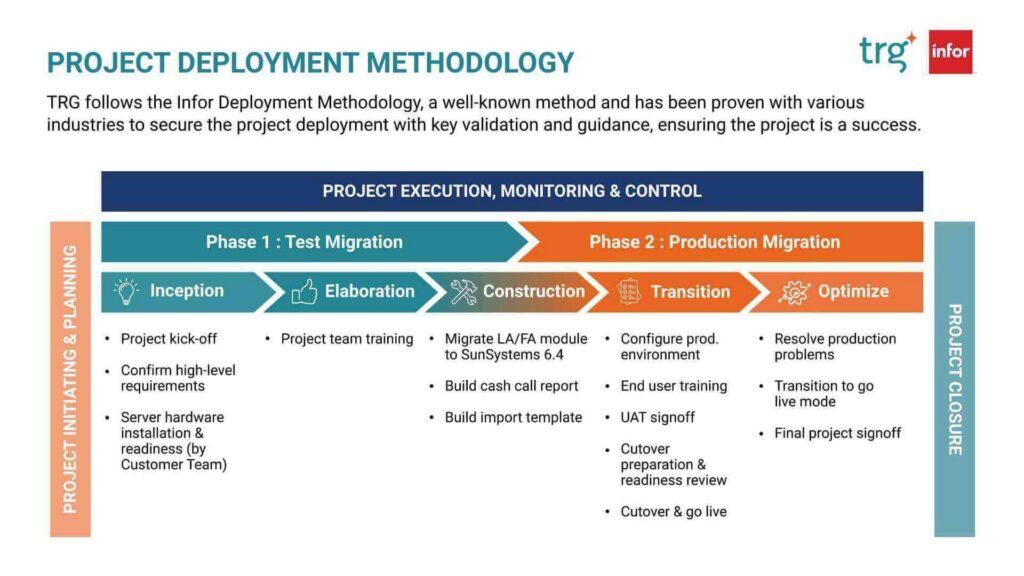
TRG’s insurance experience in APAC spans organisations including Global Insurance Corporation (GIC), a major player in Vietnam’s financial services sector, which has successfully migrated from a legacy on-premise financial platform to Infor SunSystems Cloud to streamline its multi-branch operations and build the financial foundation required for an increasingly compliance-intensive operating environment. The project marks seven years of continuous collaboration between GIC and TRG International.
Read the full story: From Legacy to Cloud: How Global Insurance Corporation Mitigates End-of-Life System Challenge
Is your financial system built to sustain IFRS 17?
The question is not whether your organisation has implemented IFRS 17. It is whether the system running beneath your IFRS 17 reporting is built to sustain it accurately, efficiently, and at scale as your business grows and as regulatory expectations deepen.
Speak to TRG International’s finance specialists to assess your IFRS 17 system readiness.