


Where is eSports on the map right now?
Electronic sports, also known as eSports, refers to competitive online gaming, which attracts both amateur and professional players.
Big-name game developers now sponsor major tournaments for titles like League of Legends, Dota 2, Counter-Strike, Valorant, and Overwatch, along with fighting games like Street Fighter and Super Smash Bros. These competitions span multiple genres, from Multiplayer Online Battle Arena Video Games (MOBAs, like League) to first-person shooters (e.g., CS:GO) to battle royales (e.g., PUBG) and real-time strategy games (e.g., StarCraft).
While gaming tournaments have been around for decades, not many countries acknowledge eSports as a full-fledged industry. The most popular game in the world, League of Legends: Season 1, only had their first World Championship in 2011.
The rise of eSports
The eSports market is witnessed a steady climb, fueled by digital tech innovation with the increase in fan engagement (not only playing but willing the purchase related merchandise), and the ease of streaming.
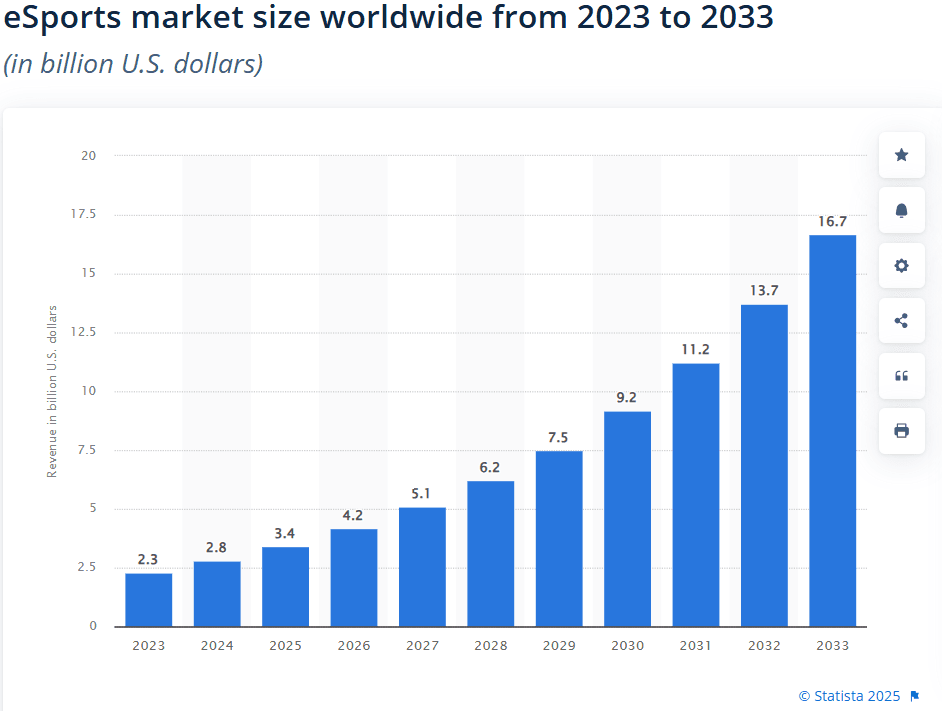
eSports market size worldwide from 2023 to 2033 (Statista)
In 2024, the global eSports streaming market hit $2.8 billion and is projected to grow to nearly $16.7 billion by 2033—a 22% annual growth rate. So where does the revenue come from? It is generated from different streams including game sales, in-game purchases, sponsorships, media rights, and even ticket sales for tournaments. (1)
Read more: Strategies for Hotels to Capitalize the Rise of Concert Tourism
What’s driving the boom?
Macro trends play a big role: strong economies and government support (like in China and South Korea) accelerate growth. South Korea, for example, treats eSports like a national sport, with top-tier players, corporate backing, and country-funded privileges like other major sports. The ASIAD winners in eSports will not have to do compulsory military service.
Younger audiences, especially Millennials, are showing more interest in gaming, turning eSports into a significant cultural and economic contributor. More and more fans are paying to see eSports tournaments (CS:GO, DOTA 2, LoL Worlds, The International, etc.) in real life to cheer for their favourite teams, thus further increasing this special sport’s popularity.
Meanwhile, emerging scenes—like Vietnam — are starting to make waves globally with their own professional eSports team (e.g.GAM Esports, which competes in League of Legends), or Team Flash, which has established its PUBG Mobile division in Vietnam.
Why hospitality should pay attention to eSports fans
According to data from Deloitte Study (2) “Let’s Play! 2022 The European esports market”(2022). Here is the breakdown of age groups watching eSports and attending tournaments:
– Millennials (25-41 years old) – 50%
– Gen Z (16-24 years old) – 26%
– Generation X (42-56 years old) – 20%
– Baby Boomers (57+) – 4%
It should also be noted that 63% of eSports viewers identify as male.
The fact that the majority of eSports fans are both young enough to still enjoy spending their money on hobbies and interests and old enough to have a career and their own money is what makes esports such a great focus for brands trying to reach younger consumers.
Compared with other generations, Gen Z has grown up completely immersed in digital technology and online experiences. They are willing to accept products or services related to digital entertainment, such as digital copies, in-game purchases, and subscription services.
Given that Millennials are a popular audience for esports and have certain financial resources, they have great potential for participating in esports consumption in the hospitality industry. Die-hard fans tend to spend lots of money on tournament tickets, merchandise and travelling to watch their favorite teams/ star members compete. That’s why hospitality should not overlook these potential customers.
Read more: Sports, Music, Wellness Tourism – What’s the Next Big Niche?
How hospitality can stay on top of the eSports growing wave
A recently published study by Zhang et al. in the International Journal of Hospitality Management (2), examining how integrating esports elements in hotels affects Generation Z’s consumption intentions in China, found that:
– Hotels with eSports elements evoke coolness, innovative perception, and higher patronage intention among Gen Z.
– Individuals with high novelty-seeking traits and strong subjective esports knowledge respond more positively.
– eSports-themed rooms, equipment in public areas can attract Gen Z.
– Using “electronic word of mouth” strategies (e.g., social media rewards) to amplify reach, as these guests are the most familiar with technology and social networks.
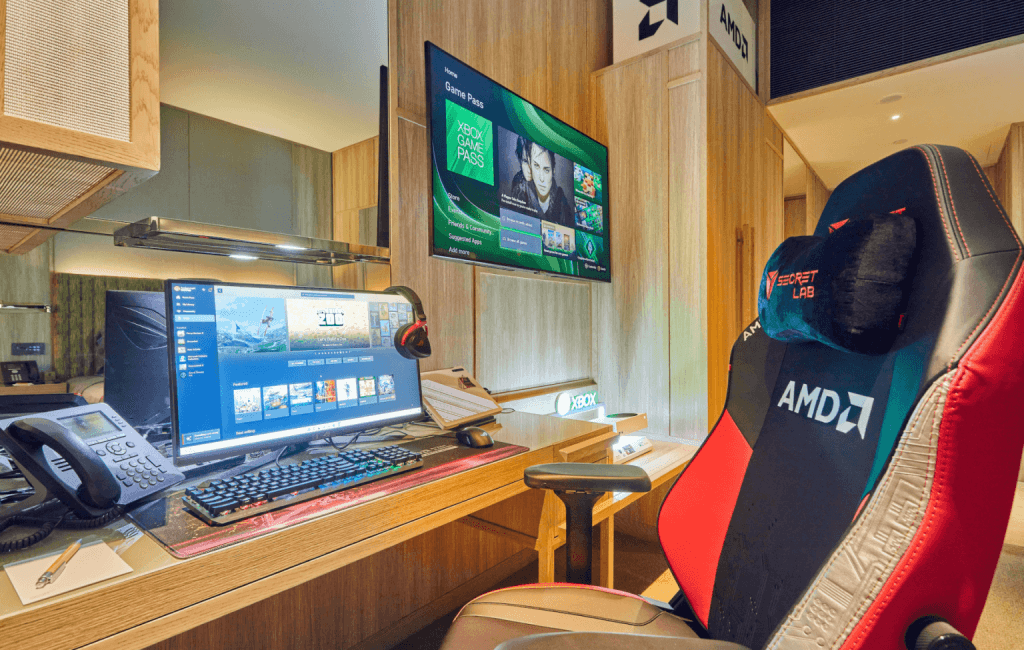
Integrating esports elements in hotels
According to eSports Insider (3), hotels are increasingly tapping into the eSports industry by hosting major tournaments, like the ESL Pro League at InterContinental Malta or Red Bull’s Apex Legends event in Chicago, while also catering to travelling fans. Not only does the hotel get to rent out its space and accommodate players, but tournament organisers get somewhat of an all-in-one solution logistically.
Beyond just venues, hotels are creating gamer-friendly experiences, such as PARKROYAL COLLECTION Pickering’s eSports suite or Marriott Bonvoy’s exclusive packages. China leads the trend with over 20,000 dedicated eSports hotels. Brands like NIP Group are also partnering with hospitality chains to offer immersive gaming stays.
However, eSports popularity in Western countries is a bit more subdued, which might be a missed opportunity for hospitality businesses in these markets. Think about the potential surge in demands and revenue for major sports and concert events in the areas—eSports is a booming industry, and together with hospitality, the two sectors can grow strong together.
Read more: Why Indian Tourists are a Gold Mine for Global Tourism
Local special circumstances
In South Korea and China, eSports isn’t just a hobby—it’s a national sensation. These two countries are leading the games, with governments having fully embraced eSports, backing the industry with infrastructure, funding, and high-profile tournaments supported by major corporations. The result? A thriving, ultra-competitive scene with massive fanbases and a well-established pro circuit.
Vietnam’s eSports scene is making waves on the global stage. On March 10, Vietnam’s Culture Minister Nguyễn Văn Hùng met with Hollywood producers from Riot Studios and Indochina Productions to discuss filming a League of Legends TV series in Cát Bà (Hải Phòng) by late 2025. The minister pitched Vietnam’s scenic beauty and growing film industry while stressing legal compliance, environmental care for the UNESCO site, and cultural respect. Visa exemptions into Vietnam were offered as a form of support, hoping the project would boost tourism and global exposure. Both sides reaffirmed commitments under the 2024 U.S.-Vietnam tourism-film partnership, calling it a win for cultural ties (4).
Read more: Sleep Tourism – Finding Rest in a Restless World
Conclusion
With the growth of eSports, which revenue is expected to reach 16.7 billion USD by 2033, and the exceptional characteristics of its fans, who are willing to pay and travel to see the game in person, there is a good chance that this niche demand can bring a significant revenue stream for hospitality businesses. Major brands like InterContinental, Radisson, and Marriott have already the wave. Hotels can leverage eWOM strategies, such as social media rewards, to reach tech-savvy guests.
China and South Korea are leading the global eSports industry with support from both governments and a strategic plan for its growth. In Vietnam, the government is open to eSports, and hopefully, the market will grow stronger in the next few years.
Looking for a solution that streamlines the operation of your hotel? Here it is:
 hbspt.cta.load(125873, ‘eca22fe9-fe87-4d36-af56-1feb01a12761’, {“useNewLoader”:”true”,”region”:”na1″});
References:
- https://www.statista.com/statistics/1256162/global-esports-market-size/
- Minyi Zhang, Jun (Justin) Li, Xi Li, Can esports help with hospitality marketing for Generation Z? The interaction of esports, novelty seeking, and subjective knowledge, International Journal of Hospitality Management, Volume 124, 2025, 103963, ISSN 0278-4319, https://doi.org/10.1016/j.ijhm.2024.103963.
- https://esportsinsider.com/2024/12/staying-power-hotels-esports-benefits
- https://www.facebook.com/share/p/1Bx6pGEBbj/