

Ask your Chief Financial Officer what should be the simplest question in finance: “How much do we currently owe our suppliers?” In most finance functions, the honest answer takes time to produce, not because the number is hard to calculate, but because it is scattered across inboxes, spreadsheets, and paper files.
If your team still retypes invoice data from email into Excel and then again into your accounting system, you already know how quickly a simple question turns complicated. A supplier calling about an overdue invoice sends someone digging through their inbox. Two colleagues approving the same invoice in two different email threads results in a duplicate payment that nobody notices until much later.
The thing is, none of this is a people problem. It is what happens when a single financial transaction has to pass through too many disconnected manual steps before it becomes a number anyone can trust.
Read more: Expenses and Invoice Management: Did Your Business Do It Right?
The ever-increasing manual burden on Accounts Payable teams
The pressure on manual accounts payable (AP) processes is well documented, and it is compounding for several reasons that finance leaders across Vietnam and the wider APAC region will recognise.
- Manual data entry is still the norm: Industry research shows that 66 per cent of AP teams still manually key invoice data into their accounting system, a six-point increase on the previous year [1].
- The late payment epidemic across the region: A Vietnam-focused survey found that 39 per cent of B2B invoices in Vietnam are currently overdue, mainly due to customer liquidity issues [2]. The picture is consistent across the wider region as a survey covering China, Hong Kong, India, Indonesia, Japan, Singapore, Taiwan and Vietnam found that overdue invoices affect an average of 44 per cent of B2B credit sales across Asia [3].
- Fraud and duplicate payments are incredibly common and costlier than expected: Fraud research on the Asia-Pacific region found that 52 per cent of organisations reported a rise in fraud over the previous 12 months, and that every dollar lost to fraud costs the business between 3.07 and 4.59 times that value to recover once labour, legal, and recovery costs are included [4]. Separately, invoice-processing data found that 1.29 per cent of invoices processed by small and mid-size businesses are duplicates, each valued at an average of US$2,034 [8]. Two people approving the same invoice in two different email threads is not a rare exception; it is a measurable, recurring cost.
- Transaction volume and compliance pressure are both rising: Vietnam’s e-commerce market has been growing at roughly 25 per cent year on year [5]. More sales volume means more invoices for finance to process, regardless of sector. Looking ahead, the wider Asia-Pacific e-commerce market is forecast to keep growing at a 9 to 11 per cent compound annual rate through the end of the decade [6], so this is not a one-year spike finance teams can wait out.
- Compliance is tightening at the same time: Under Vietnam’s Decree No. 310/2025/ND-CP, which amends Decree No. 125/2020/ND-CP and takes effect on 16 January 2026, administrative fines for tax and invoice violations in Vietnam now range from 500,000 to 80,000,000 VND (roughly US$19 to US$3,042) depending on the violation [7]. Vietnam’s tax authorities are also increasingly cross-checking e-invoice data automatically, which puts additional pressure on finance teams to get every detail right the first time.
Adding headcount to a manual process does not resolve any of this. An invoice arriving as a PDF attachment in an email still needs a person to review it and key it into the accounting system by hand, and that single step is where most hours, and most errors, are lost.
Why now is the time to automate the Accounts Payable function?
First, let’s understand what end-to-end AP automation is.
End-to-end AP automation means one continuous, connected path from the moment someone requests a purchase to the moment that transaction is correctly recorded in the general ledger, with no manual handoff in between. It essentially means no printing, no re-typing, or no emailing a spreadsheet to the next person in the chain.
Practically, this covers two connected halves of the accounts payable cycle:
- Procurement to ledger, covering the purchase requisition, approval, purchase order, goods receipt, invoice matching, and posting.
- Ledger to bank and back, covering the outgoing payment file, the bank transfer itself, and the incoming bank statement used for reconciliation.
Watch Now: Modernising Accounts Payable with End-To-End Automation
1. Removing the manual touchpoints from procurement to ledger
In a connected workflow, anyone in any department can raise a purchase requisition directly in the system, attach supporting documents (such as an expense justification or budget reference), and select the correct account and expense code at the point of request.
From there:
- The head of department checks whether the business genuinely needs the purchase
- Finance checks the budget and the coding
- Once approved, the system automatically generates the purchase order
- Nobody drafts an approval notice or purchase order by hand or risks re-entering the same information twice
When goods arrive, the requester confirms receipt with a single click, which acts as the checkpoint verifying the transaction actually happened before any money leaves the business.
Modern AP automation solutions typically have a built-in artificial intelligence engine that reads the invoice, extracting the total amount, invoice number, date, and tax code, and matches it against the purchase order using either a two-way or a three-way match.
If everything lines up, the transaction proceeds automatically. If something does not, such as a missing amount, the system flags it for manual review rather than posting it blind. Invoices that do not match any purchase order or expense claim can be routed to a separate exception path for review.
Once approved, procurement data posts directly into the company’s financial management solution, such as Infor SunSystems Cloud, correct and balanced in real time, without anyone re-entering it. Finance can then check the ledger at any time, which makes “how much do we owe our suppliers?” a five-second answer rather than a half-day investigation.
Automation here does not remove the human control; rather, it reinforces it. Every request is checked against budget the moment it is raised, every approval step carries a full audit trail, and nothing posts to the ledger until the matching step has passed.
Read more: Comparing Top Accounts Payable Automation Solutions
2. Closing the ledger-bank payment loop
Once an invoice is approved and ready to pay, somebody still has to move the money.
Without automation, that typically means exporting a payment file from the finance system, logging into an online banking portal, uploading the file by hand, and waiting. Days later, another person downloads a bank statement and checks it line by line against what was actually paid.
A connected payment workflow closes this gap through two technical mechanisms:
- Host-to-host connectivity, where the accounting system and the bank “talk” directly and automatically with no person in the middle.
- Secure File Transfer Protocol (SFTP), the encrypted, private channel through which that data moves, ensuring information stays protected the entire way.
Another critical factor to emphasise is that every bank requires its own file format, regardless of whether they are local or international institutions. A payment file accepted by one Vietnamese bank is not accepted by another, nor is it the format required by an international bank. Finance teams making payments across several countries or accounts have traditionally spent significant time reformatting files for each individual bank.
In an automated workflow with a payment processing tool, that mapping happens automatically:
- Outbound (payment leaving the business): Raw payment data is extracted from the business’ finance system, converted into the format each specific bank requires, and encrypted before it is sent. The file transfers automatically to the bank via SFTP. Once processed, the bank returns an acknowledgement file so the payment tool can confirm the payment status.
- Inbound (confirmation returning to the business): The bank returns a statement in SWIFT MT940 format and an e-remittance advice to each supplier, either in real time or on a scheduled basis. Statement data is decrypted, read, and fed straight back into the ledger, ready for reconciliation.
Reconciliation is usually the part finance teams enjoy least, and it is also where most manual errors originate. With MT940 statements processed automatically on a daily or scheduled basis, finance gets an updated, correct number in their systems when needed.
What does TRG think about AP automation?
Automating an AP workflow is not to automate for its own sake. It is to answer, with confidence and in real time, exactly how much your organisation owes its suppliers today, protect cash flow, and free up the time your finance and procurement teams currently lose to manual handling.
Stepping back, an end-to-end automated AP workflow delivers two distinct types of value:
- Operational efficiency as purchase orders are no longer created manually, invoice matching happens automatically, data posts directly to the ledger, and finance and procurement teams recover time previously spent on data entry and can redirect it toward analysis and decision-making.
- Control and compliance as every purchase is checked against budget before money is committed. Every payment file is encrypted. Reconciliation happens automatically rather than through manual line-by-line checking, keeping human intervention to a minimum and focused only on checkpoints that genuinely require judgement.
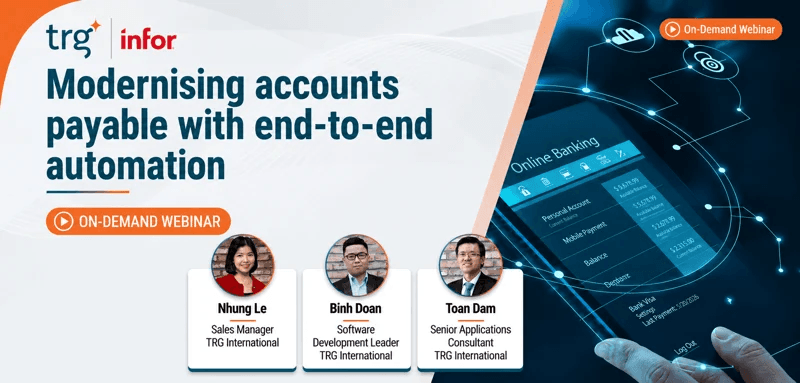
Our experts at TRG International discussed AP automation and possible solutions in detail in our recent webinar, “Modernising AP Process with End-to-End Automated Workflow”. The webinar is now available completely free and on-demand. For more insights on how our experts solve disparate systems, overwhelming data, and manual AP management, check out the webinar today!
Sources:
- https://www.concur.com/blog/article/2025-accounts-payable-automation-trends-report-key-takeaways
- https://atradiuscollections.com/us/knowledge-and-research/reports/b2b-payment-practices-trends-vietnam-2025
- https://atradiuscollections.com/us/knowledge-and-research/reports/b2b-payment-practices-trends-asia-2025 (also summarised at https://www.malaymail.com/news/money/mediaoutreach/2025/08/11/asian-firms-divided-on-insolvency-outlook-amid-ongoing-trade-challenges/400990)
- https://risk.lexisnexis.com/global/en/insights-resources/research/apac-true-cost-of-fraud-study
- https://www.vietnam-briefing.com/news/vietnam-e-commerce-sector-2026.html/
- https://www.mordorintelligence.com/industry-reports/asia-pacific-ecommerce-market; https://www.researchandmarkets.com/report/asia-pacific-e-commerce-market
- https://www.vietnam-briefing.com/news/administrative-penalties-for-tax-and-invoice-violations-key-amendments-and-business-implications.html/
- https://www.avidxchange.com/blog/duplicate-payments-ap-processing-guide/