

During times of uncertainty, businesses are operating in an environment where regulatory frameworks are continuously shifting. Therefore, staying compliant with evolving financial and tax regulations has become more critical than ever.
Southeast Asia’s finance: Key regulatory updates
In 2025, several countries in Southeast Asia—including Vietnam, Malaysia, Cambodia, Thailand, Indonesia, and Singapore—introduced significant regulatory changes or already started to apply changes that impact every business’ accounting, tax reporting, and financial management practices.
It’s time for organizations to pay more attention to their financial health and operational structure to help accounting departments determine which processes should be removed, improved, or modified based on regulatory guidance. A proactive approach will not only safeguard compliance but also strengthen resilience amid uncertainty.
| Country | Circular / Regulation | Scope & Key changes | Reference |
| Vietnam | Circular 99/2025/TT-BTC (effective 1 Jan 2026) | Overhaul chart of accounts, adopt IFRS-style formats (biological assets, etc.) Enable foreign currency accounting Implement electronic documents, companies can design their own templates under internal regulations | [1] |
| Thailand | Emergency Decree on Top-up Tax B.E 2567 | Establishes jurisdictional top‑up tax Integrate Income Inclusion Rules (IIR), the Undertaxed Payment Rules (UTPR) and Domestic Minimum Top-Up Tax (DMTT) filings | [2] |
| Cambodia | Prakas 039 FSA.Prk (CRFRF & DFRP) | Launch Digital Financial Reporting Platform for mandatory digital filing Introduce the Cambodian Reduced Financial Reporting Framework (CRFRF) aligned to CIFRS for SMEs | [3] |
| Singapore | Amendments to FRS 109/107 & New FRS 118 | Revise financial instruments classification (electronic payments, ESG-linked features) and disclosure Introduce framework (IFRS 18 equivalent) | [4] |
| Indonesia | SAK EP (effective 1 Jan 2025) & PP 43/2025 (PBPK) | SAK EP replaces SAK ETAP for entities without public accountability, simplifying recognition/measurement/disclosure aligned with IFRS for SMEs PP 43/2025 creates Platform Bersama Pelaporan Keuangan (PBPK) to mandate standardized reporting | [5] [6] |
| Malaysia | MFRS Amendments (MFRS 121, 9/7, 18 & 19) + National e-Invoicing (MyInvois) | Foreign exchange accounting: assess exchangeability & spot rates under MFRS 121 updates Clarifications on derecognition via electronic payments, ESG‑linked features, and nature‑dependent electricity contracts E‑Invoicing with clearance model via MyInvois through QR/ UIN (Unique Identification Number) | [7] [8] [9] |
Disclaimer:The information uses AI for summarization and may not align with current regulatory requirements at the time of your review.
These updates aim to enhance transparency and reach the two goals at the same time: align with global standards and support regional economic growth. For organizations operating in multiple markets, understanding these changes is essential to ensure smooth operations, avoid compliance risks, and heavy penalties.
While change and transition are necessary, it becomes more and more complicated for businesses with accounting teams that are still stuck with manual, labor-intensive processes to adapt in a timely manner.
Furthermore, the effort from the accounting team alone may not be enough when dealing with highly technical aspects, such as e-invoice systems, digital reporting systems, and data security, etc., as these areas are out of their control. Definitely, successful adaptation also requires close collaboration with the technical team to make sure the whole process carries out smoothly and seamlessly.
Read more: Future of Financial Consolidation: Faster, Clearer, Connected
When a localized solution is needed
Much time has gone by since globalization was considered to be the only goal. The reason is that requiring every country to operate under the same standards is impossible due to differences in economic potential, political systems, and development orientations.
As mentioned, new circulars and regulations are released to support each country based on its specific conditions. E-invoices are becoming mandatory in Malaysia, while Vietnam is adopting IFRS-style formats known as Circular 99 as a stepping-stone. Thailand and Singapore are reclassifying credit and debit entities to improve transparency. Additionally, many tax reforms are being introduced to foster economic growth and stability.
This is why businesses need a localized accounting system tailored to each market. A localized accounting system is designed to meet the specific accounting requirements of a particular region, such as Vietnam or Thailand. By adapting to local practices, the system improves financial efficiency and reduces the risk of errors. Here are some key points:
- Multi-language support: Facilitates navigation and usability. While English is widely used, it’s also essential to have, for instance, Vietnamese for local users in Vietnam.
- Multi-currency capability: Critical for businesses operating internationally or dealing with customers and suppliers in different currencies – for example, a headquarters in Singapore with branch offices in Vietnam.
- Regulatory compliance: Ensures businesses can generate reports and manage financial transactions in accordance with local laws, such as VAS (Vietnamese Accounting Standards), TFRS (Thai Financial Reporting Standards), etc.
- Third-party integration: Enables seamless processing e-invoices in various formats, open banking connections (both national and international banks) to instantaneously connect with company bank account then bank reconciliations for the daily quick check.
Read more:Signs That Say Your Accounting Software Implementation Is Going Wrong
From global to local – An accounting system for every market
Infor SunSystems Cloud brings trusted financial management capabilities combined with the flexibility and performance of the cloud. Backed byInfor OS, it offers high availability, enterprise-grade security, and seamless integration with your business-critical applications – anytime, anywhere.
With features like global analysis, multi-currency, real-time integration, and powerful reporting tools, SunSystems Cloud helps your teams work smarter and faster. Whether you’re expanding across regions or upgrading outdated systems, this is the future-ready platform designed to grow with your business.
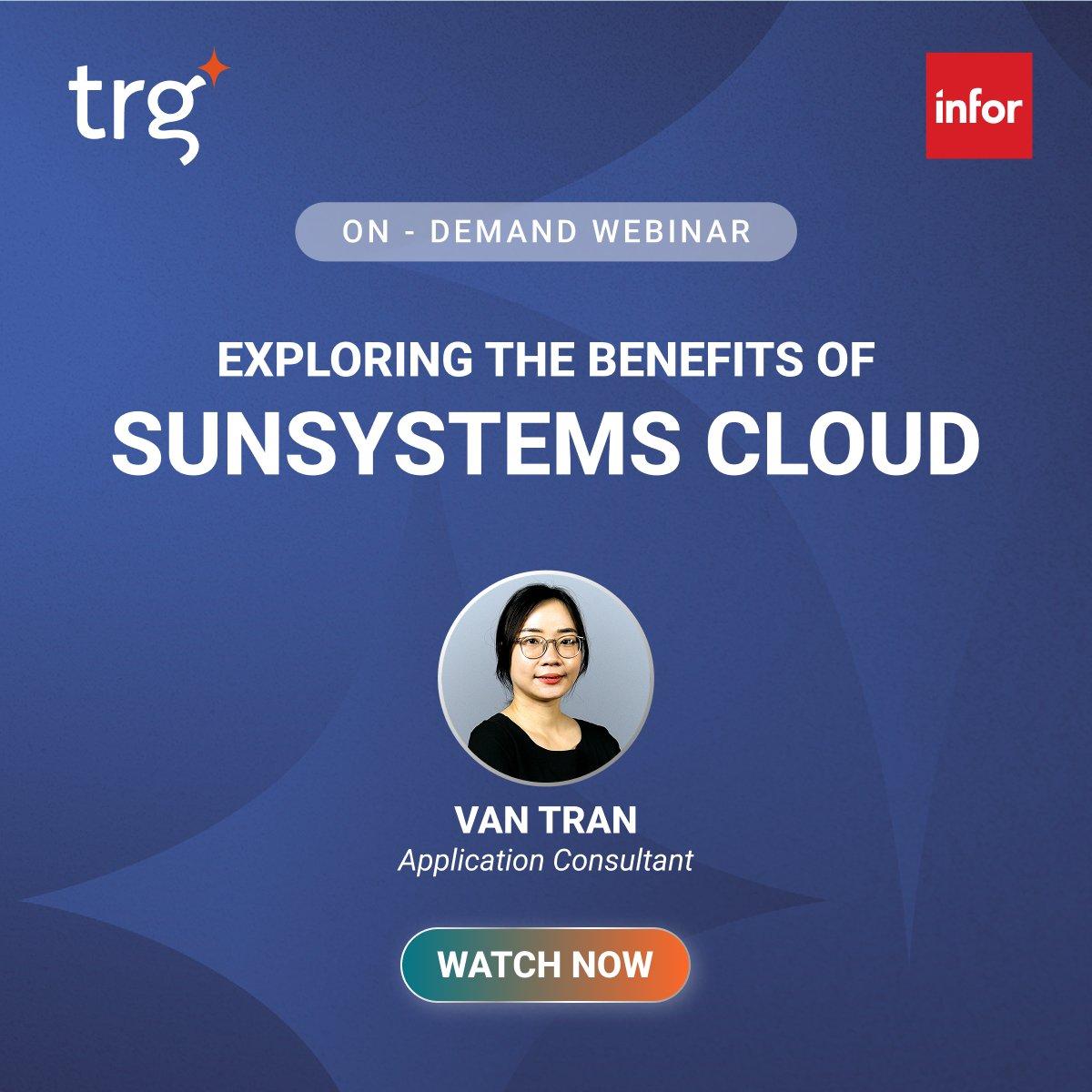
For the Vietnamese market, we’re currently offering VAS 99 on Infor SunSystems Cloud– a package designed to help businesses comply with Circular 99, effective January 2026. Circular 99 is not a minor revision, it redefines several core aspects of how accounting is organized and executed in Vietnamese enterprises.
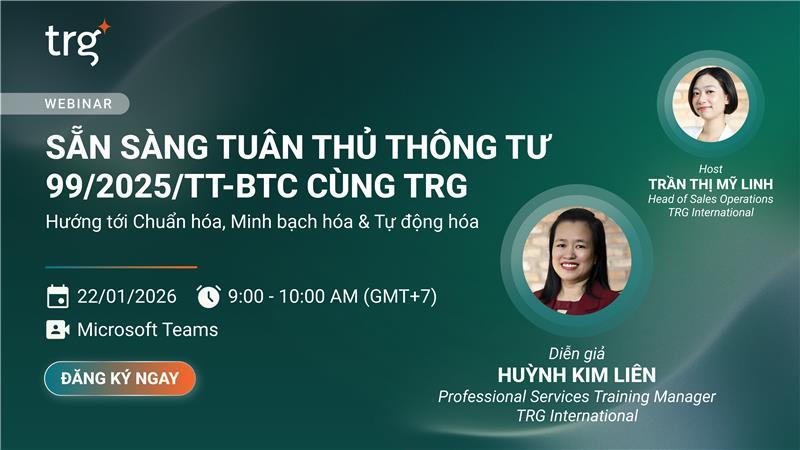
Additionally, our upcoming webinar (conducted in Vietnamese) is well designed to help businesses operating in Vietnam stay informed about key insights/ changes from new circular. Our primary goal is to support your business in developing a roadmap for applying Circular 99 and uncovering opportunities it may bring.
Don’t forget to register now!
Contact us today for a localized accounting system that meets your specific needs!
Explore more case studies to see how TRG International supports clients across the SEA region:
References:
[1] https://trginternational.com/blog/circular-99-vas-ifrs-accounting-solution/
[3] https://kpmg.com/kh/en/home/insights/2025/07/technical-update-in-july.html
[5] https://www.invensis.net/blog/indonesia-accounting-standards
[8] https://www.hasil.gov.my/media/fzagbaj2/irbm-e-invoice-guideline.pdf
[9] https://www.hasil.gov.my/en/e-invoice/myinvois-portal/