

Dashboards, financial reports, and spreadsheets are everywhere, yet when leaders ask the questions that matter most: Why is cash flow tightening? Where is performance slipping? What should we do now?
That concern exists because traditional reporting explains what happened, not why it happened, or what to do next. Organisations don’t lack data. They lack clarity.
You might also like:Regaining Cash Flow Control in Renewable Energy Businesses
What is OLAP?
Financial numbers don’t explain themselves. When margins change or cash comes under pressure, leaders need to understand why and not just see the result.
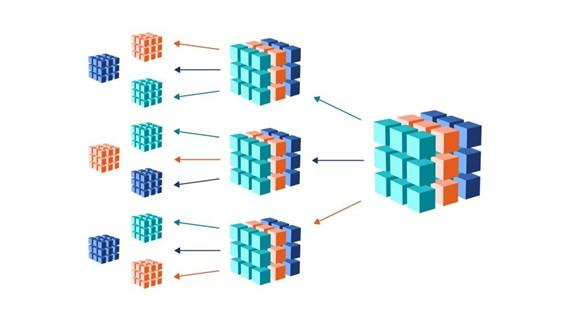
Online Analytical Processing (OLAP) closes that gap by letting people work with data the way they naturally think by exploring it from different angles.
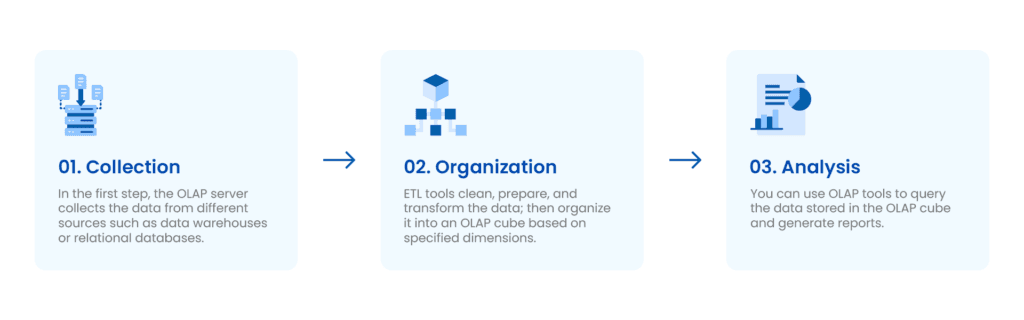
How do OLAP systems work by Astera
Traditional reports show what happened, but OLAP allows finance teams to explore what’s driving those results across entities, projects, customers, and scenarios, without rebuilding reports each time.
It supports:
- Budgeting
- Forecasting
- Consolidation
- Performance analysis
All while keeping data consistent, controlled, and auditable, something spreadsheets struggle to maintain as complexity grows. Teams can look across time, locations, products, customers, or scenarios, follow patterns as they start to form, and quickly see what’s really influencing performance, without waiting for another report cycle.
Read more:7 Worst Financial Fiascos caused by Excel errors
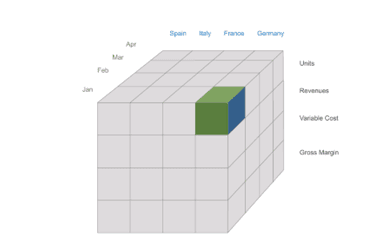
Example of an OLAP cube
Accordingly, teams spend less time chasing figures or correcting mistakes and more time comprehending what the data is saying to them, providing leaders with the clarity and confidence to act when it is most critical.
When OLAP is built into industry-specific platforms like Infor Enterprise Performance Management (EPM), analytics stop being a backward-looking exercise and become part of everyday decision-making. This is why organisations across hospitality, finance, energy, education, and logistics are using OLAP to move from reviewing data to acting on it.
The business implications of OLAP
In Renewable Energy: OLAP connects operations to financial reality
Energy organisations make decisions that play out over long timelines, across dispersed assets and capital-intensive projects. What’s decided today can affect financial performance for years. Yet insight often breaks down when operational data and financial data sit in separate systems, making it harder to see what’s really driving results or where risks are building.
OLAP helps close that gap by bringing operational and financial perspectives together. Production volumes, asset performance, project costs, and financial outcomes can be analyses side by side across time, locations, and scenarios.
In Education: Turning institutional data into action
From enrollment and admissions to personnel, academic achievement, and daily operations, educational institutions have access to a variety of data. The issue is not a shortage of information, but rather how often it is kept hidden. When information is contained in static reports produced on a set schedule, leaders are stuck reacting to yesterday’s reality that is written on paper rather than what is happening right now.
OLAP changes letting administrators and academic leaders explore data as questions come up. Shifts in enrollment, changes in retention, or the impact of different funding scenarios can be examined across programs, cohorts, departments, and time periods without waiting for the next report cycle. That earlier visibility helps institutions spot risks sooner and act on opportunities while there’s still time to make a difference.
Read more:Experts Explained: Breaking Down Data Walls with Infor EPM
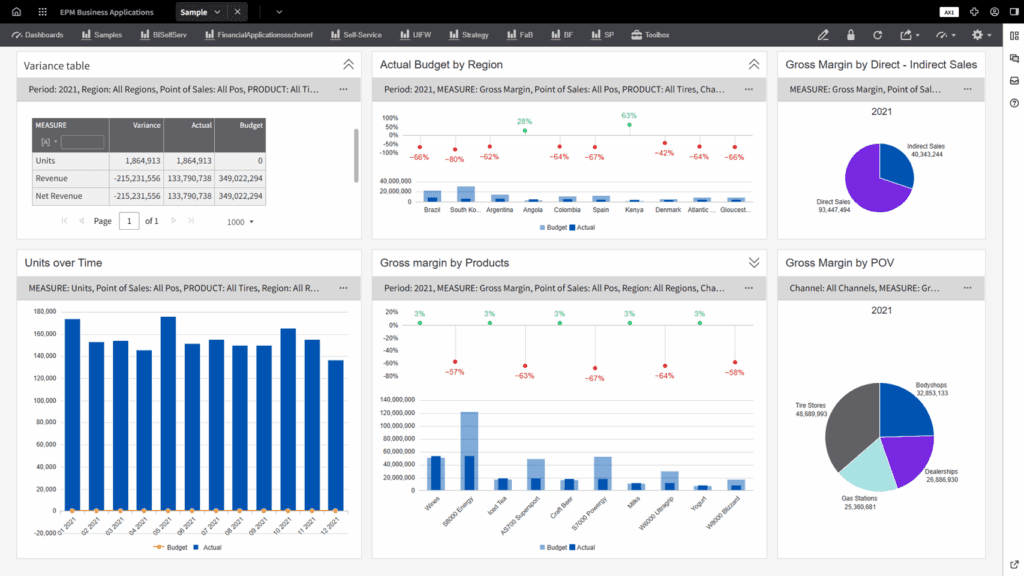
A sample dashboard built on Infor EPM, BARC
Beyond analysis, school leaders can also use the what-if scenario planning capabilities in Infor EPM to plan more proactively, test various enrollment and financing assumptions, and allocate resources where they will have the largest impact. Combining operational and financial data helps make more informed decisions that align with the school’s long-term financial stability and academic priorities. Data begins to bring tangible, forward-looking values rather than just being a picture of the past.
In Logistics and Supply Chain: Seeing the network clearly
Inventory coming in and going out, cars on the road, suppliers delivering, and consumers waiting are all part of the continuous action that logistics and supply chain teams must supervise. Due to the numerous moving components across complex networks, even minor blind spots can quickly result in increased expenses, delayed delivery, and dissatisfied customers.
OLAP analyses delivery efficiency, inventory movement, and cost drivers across routes, regions, customers. Instead of reviewing static information, teams may identify trends and concerns that would otherwise go undetected, ranging from repeated delays to inefficiencies in certain lanes or suppliers.
As a result, obstacles are identified; trade-offs between service levels and cost are evident, and disruptions are responding more quickly. Clarity is not just beneficial in today’s constantly evolving supply chains: it also has a direct impact on dependability, profitability, and customer experience.

OLAP is built into Infor EPM
OLAP delivers insight, but its real impact depends on how well it connects to the systems around it. OLAP is built into Infor EPM, an enterprise performance management solution designed to sit at the centre of the finance ecosystem, integrating seamlessly with Infor applications such as SunSystems, as well as non-Infor ERP, CRM, and operational systems.
Read more:Nucleus Reports Infor EPM Improves Financial Productivity by 20 Per Cent
By pulling data from multiple sources into a single analytical layer, EPM provides a unified view of performance across the organisation. Finance teams can analyse results by entity, business unit, project, or scenario while working from one consistent, controlled set of numbers.
This removes the need for offline reconciliations and manual data stitching that often undermine trust in reporting. Since EPM shares a common data model and governance framework with Infor solutions and remains open to external systems, insight is no longer trapped in silos. Leaders gain clearer visibility into what is happening across the business, how different areas are connected, and where action is needed, all without sacrificing control or auditability.
Let’s get one thing straight:Don’t Buy EPM Software Until You Read This Guide!
Clarity is a competitive advantage
OLAP supports this deeper understanding by allowing organisations to explore data freely across multiple dimensions, ask better questions as situations change, and respond faster using consistent, governed information [3]. Instead of waiting for the next reporting cycle, teams can identify patterns early, test assumptions, and act while there is still time to influence results.
Decision-makers have a deep awareness of performance factors and emerging threats because of the connections between financial and operational data that represent how a company operates [2]. Insight becomes closer to those who need it the most, minimising dependency on spreadsheets and laborious workarounds.
In fast-paced, data-rich contexts, this level of clarity has a direct impact on how rapidly firms adapt, handle uncertainty, and remain competitive.
Are you ready to move beyond static reports and delayed insights with OLAP? Connect with us to see how this approach can deliver clearer visibility, stronger control, and better decisions across your organisation!