


Implementing a new accounting system is meant to be a game-changer: faster month-end closes, accurate statutory reporting, fewer manual journals, and real-time numbers the business can actually trust.
Yet for far too many growing companies, what started as a promising cloud accounting project quietly turns into an expensive nightmare. According to recent studies by Panorama Consulting and Gartner, more than half of all accounting software implementations exceed budget, miss deadlines, or simply fail to deliver the expected benefits [1][2].
The truly frightening part is this: most finance leaders only realise the project is in serious trouble after go-live, when remediation costs are five to ten times higher than they would have been during testing.
And this article is your emergency brake. Below are the clearest, most unmistakable warning signs that your accounting software implementation is going wrong, grouped into three categories: technical issues with the system itself, problems with your implementation partner, and the damage already showing inside your own finance team. If you recognise three or more of the high-severity signs described here, stop everything and call an urgent steering-committee meeting this week.
Read more:What is Stopping Your Organisation from Adopting Continuous Close?
Early intervention matters
A failing accounting software implementation does more than exceed budget, it creates knock-on effects that can take significant time and effort to resolve.
Escalating costs are often the first visible sign. Projects that initially appear manageable frequently expand well beyond their original scope once change requests, extended timelines, and unplanned remediation work are factored in.
Over time, the impact typically extends beyond cost alone. As issues persist, they begin to affect day-to-day operations, management reporting, and compliance:
- Operational disruption: Finance teams may be forced to run parallel systems, re-enter data manually, or spend additional hours closing the books.
- Reporting inaccuracies and decision risk: When management reports, VAT filings, or intercompany reconciliations contain errors, leadership decisions may be based on incomplete or unreliable information.
- Audit and compliance exposure: Weak audit trails, inadequate segregation of duties, or inaccurate statutory reporting can increase the likelihood of audit findings, tax adjustments, or regulatory scrutiny.
Read more:The Use of Spreadsheets and Modern Cloud Adoption in Businesses
Experience consistently shows that addressing these issues after go-live is significantly more expensive than resolving them during design, testing, or user-acceptance phases, often by a factor of five to ten. Earlier intervention also preserves leverage, as final approval and outstanding payments have not yet been released. After go-live, that leverage naturally diminishes as business continuity becomes the priority.
In practice, most struggling implementations show visible warning signs well before cutover. These signals tend to fall into three broad categories:
- Technical problems with the system itself
- Red flags coming from your implementation partner (the vendor)
- Real-world damage already appearing inside your finance team and broader business
Recognising these three categories early lets you act decisively while you still can. The following sections lay out the clearest, most reliable signs in each group, so you can diagnose the situation fast and decide whether to fix, pause, or walk away.
Technical Red Flags: When The System Itself Is Not Ready
Technical issues at this stage are not minor inconveniences, they are early warnings that the foundation of your financial control environment may be unstable.
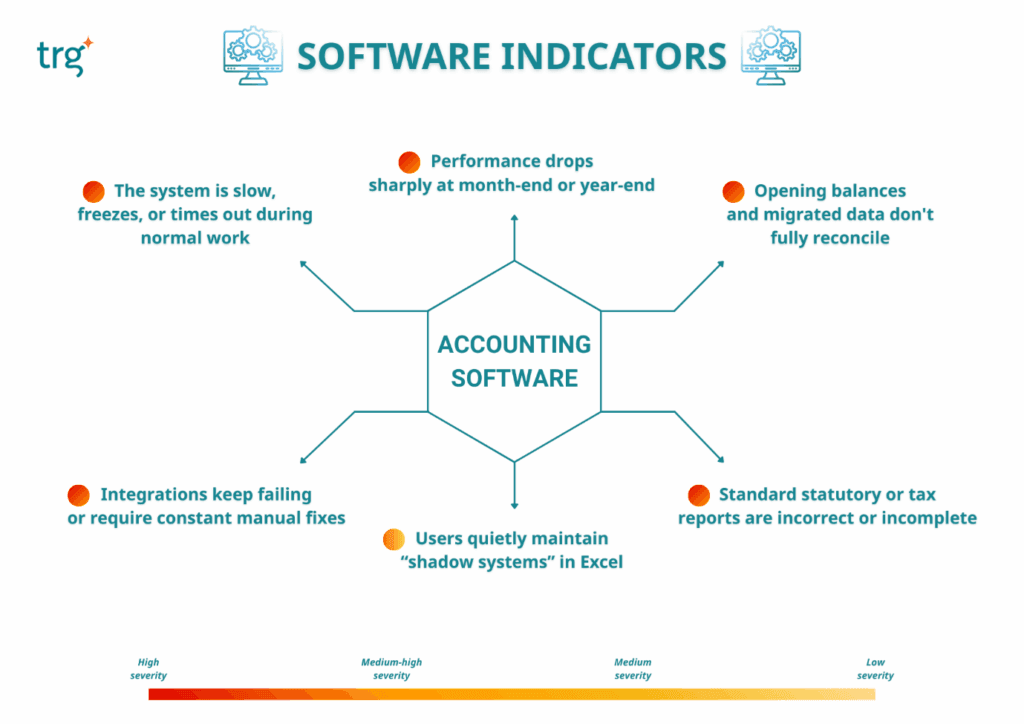
The signs below help finance leaders assess whether the system itself is ready for real-world use, or already failing under production-level demands:
- The system is slow, freezes, or times out during normal work: If basic tasks like posting journals, running reports, or closing periods regularly lag or crash, the system has not been properly tested or sized for your actual transaction volumes.
- Performance drops sharply at month-end or year-end: A system that works “fine” mid-month but collapses during peak periods is a serious warning sign. This usually points to weak architecture, poor configuration, or underestimated data volumes.
- Opening balances and migrated data do not fully reconcile: If trial balances, control accounts, or subledgers do not match after migration, you are not dealing with minor issues, you are dealing with unreliable financial data.
- Integrations keep failing or require constant manual fixes: Bank feeds, payroll, billing, or expense integrations that frequently break defeat the entire purpose of automation and push work back into Excel and email.
- Standard statutory or tax reports are incorrect or incomplete: When VAT, tax, or statutory reports cannot be produced accurately without heavy manual adjustment, compliance risk rises immediately.
- Users quietly maintain “shadow systems” in Excel: When finance teams continue running parallel spreadsheets to get work done, it is a clear signal they do not trust the system. This is one of the strongest early indicators of failure.
Read more:10 Questions to Consider for Successful Financial Management Implementation

Vendor Indicators: When Your Implementation Partner Becomes the Risk
Not every failing implementation is caused by broken software. In many cases, the technology itself is sound, but the delivery partner is not. If an implementation partner starts missing commitments, deflecting responsibility, or losing control of the project, even a good accounting system can quickly turn into a failed implementation. At a higher level, these are often more dangerous than technical bugs, because they quietly remove your leverage while problems continue to accumulate.
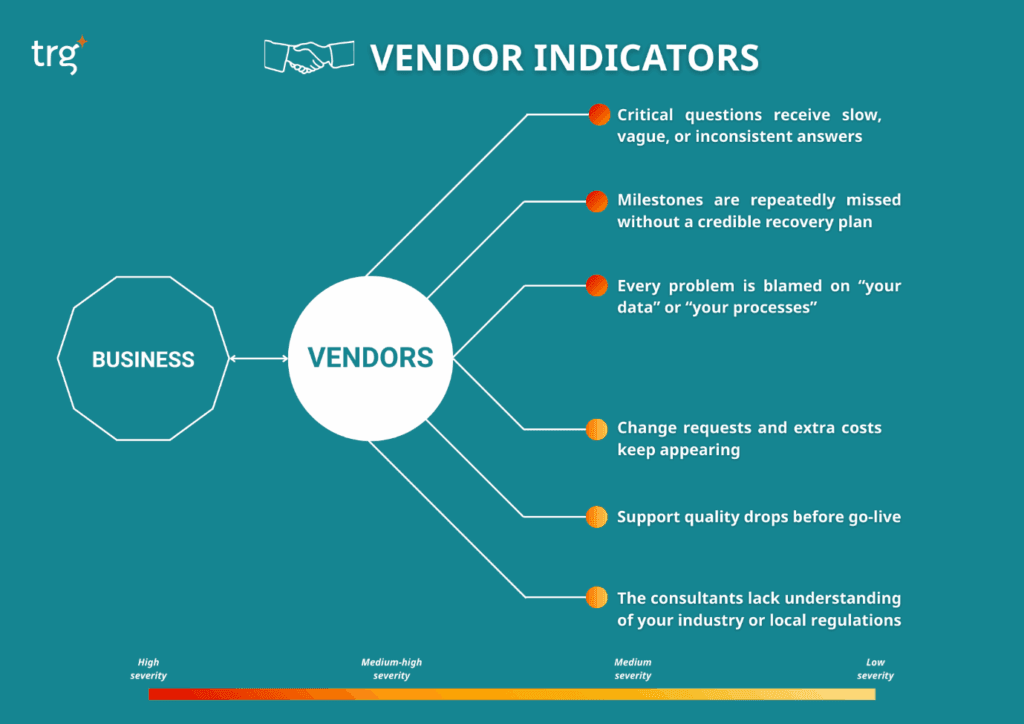
The warning signs below help finance leaders recognise when the partner relationship itself is becoming a threat to the project’s success:
- Critical questions receive slow, vague, or inconsistent answers: When responses become evasive or delayed, it usually means the vendor is overwhelmed or de-prioritising your project.
- Milestones are repeatedly missed without a credible recovery plan: Slipping timelines with no clear corrective action point to weak project governance and loss of control.
- Every problem is blamed on “your data” or “your processes”: While some data issues are real, constant blame-shifting is a classic sign the vendor is avoiding responsibility.
- Change requests and extra costs keep appearing: Frequent surprise charges often indicate a poorly defined scope or an implementation partner relying on change orders to stay profitable.
- Support quality drops before go-live: If response times are already slow during testing or UAT, post–go-live support is unlikely to improve when the business is under real pressure.
- The consultants lack understanding of your industry or local regulations: Generic configurations that ignore statutory, tax, or industry-specific requirements almost always fail under audit or regulatory review.
Read more:Expert Advice on Choosing the Best SunSystems Implementation Partner
Business & Finance Team Indicators: When the Damage Is Already Visible Inside the Business
By the time issues reach this stage, the damage is no longer theoretical, because it signals that the impact of the implementation has moved beyond the system and into the organisation, where internal teams are struggling on a daily basis.
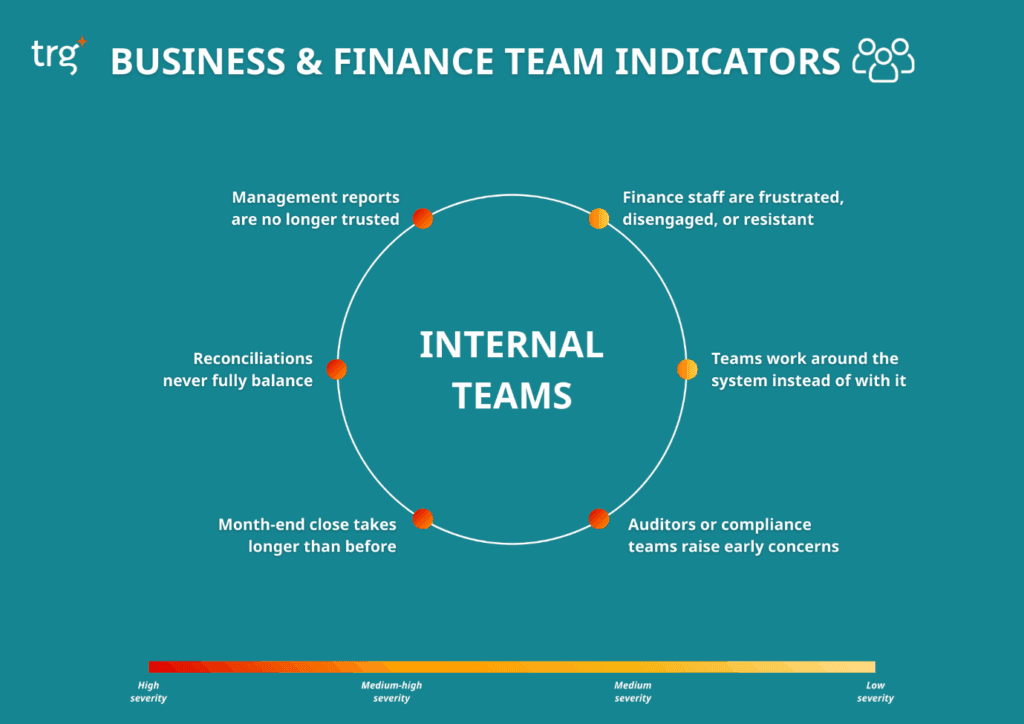
The following indicators show up directly inside your finance team and daily operations. When these business-level symptoms appear, the project is no longer “at risk”, it is actively harming productivity, decision-making, and compliance.
- Month-end close takes significantly longer than before: If closing the books now takes more time than it did on the old system, the project has already failed to deliver its core promise.
- Reconciliations never fully balance: Ongoing issues with bank reconciliations, intercompany balances, or control accounts increase the risk of material misstatements.
- Management reports are no longer trusted: When leaders question the numbers or ask for manual “double-checks,” confidence in the system is already broken.
- Finance staff are frustrated, disengaged, or resistant: High stress, rising sick leave, or key team members wanting to leave are strong signals of adoption failure.
- Teams work around the system instead of with it: Manual trackers, offline approvals, and email-based processes indicate the system is not supporting real workflows.
- Auditors or compliance teams raise early concerns: Issues with audit trails, approvals, or segregation of duties should never be ignored, they often escalate quickly into formal findings.
When These Signs Are Spotted: Leaders Pause, Fix, or Walk Away?
Seeing one red flag in isolation doesn’t automatically mean failure. Seeing several, especially across software, vendor, and business categories, means leadership decisions can no longer be postponed.
At this point, experienced finance leaders stop asking “Can we push through?” and start asking a harder, more important question: Is this system still salvageable, and at what cost? The right choice depends on the type and severity of the problems you’re facing.
Here’s the practical decision framework that experienced finance leaders use to protect their company and their own position:
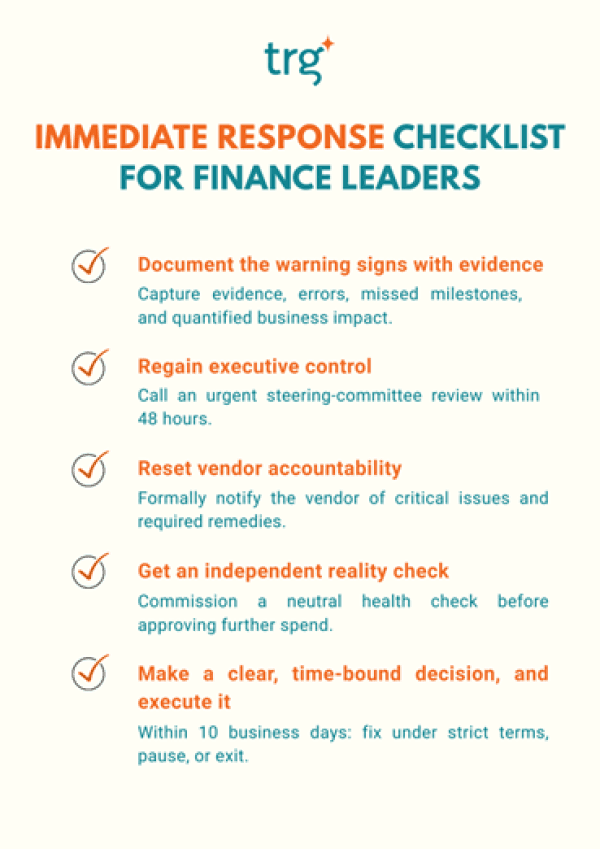
- If three or more high-severity red flags have appeared in the last two to three weeks, act decisively: pause the cutover immediately. Do not go live under any circumstances until an independent health check has been completed. This buys you time, preserves leverage with the vendor, and prevents irreversible damage.
- If the majority of high-severity issues are vendor-related — poor communication, repeated delays, blame-shifting, or endless change orders — the problem is fundamentally the partner, not just the project. Escalate immediately to your executive sponsor and involve procurement and legal teams. Start preparing the termination-for-convenience (or for-cause) clause in the contract. It’s far better to exit early than to inherit a broken system with a partner who has already shown they won’t stand behind their work.
- If the issues are primarily technical but appear fixable (e.g., configuration errors, incomplete data migration, or missing interfaces) and the vendor fully accepts responsibility, there may still be a path forward. Demand a formal, signed remediation plan that includes clear deliverables, daily progress tracking, and meaningful financial penalties or credits for further slippage. Make acceptance of this plan a non-negotiable condition for continuing.
- If the realistic cost of fixing the current implementation exceeds 40–50 % of the cost of a full replacement (including a new platform and fresh implementation), it’s time to seriously evaluate walking away entirely. Rip-and-replace sounds drastic, but many companies discover that starting over with a better-fit modern accounting platform is actually faster, cheaper, and less risky in the long run than trying to salvage a fatally compromised project.
Whatever path you choose, move quickly. Delaying the decision only increases cost, stress, and risk.
Spotting these warning signs early is uncomfortable, but ignoring them is far more dangerous.
Once multiple red flags appear, “wait and see” is no longer a neutral option, it is a decision to accept higher cost, higher risk, and reduced control.
At that point, the most rational move for finance leaders is to pause and get an objective view of the situation before the business drifts any further.
Before the next steering-committee meeting, many finance leaders choose to step back and get an independent, off-the-record assessment of their situation. Not a sales pitch. Not a system demo. But a clear-eyed view of whether the current implementation can realistically be fixed, safely paused, or exited altogether.
Book a confidential 30-minute diagnostic call with TRG International’s accounting system experts to get clear, impartial advice on whether your current implementation can be saved and what your realistic options are.


References
[1] https://www.gartner.com/en/newsroom/press-releases/2024-02-21-gartner-survey-shows-that-a-third-of-accountants-make-several-error-per-weeo-due-to-capacity-constraints
[2] https://www.panorama-consulting.com/challenges-and-risks-of-replacing-legacy-accounting-software