

Hybrid work is a blend of in-office andremote work. It evolved into a variety of types that businesses could adopt appropriately for their operation and management that best reflects their culture, goals, and employee preferences. Among them, office-first and preference-based hybrid achieves the highest satisfaction rate from employees.
Office-first and preference-based hybrid models are emerging as the most effective and employee-satisfying approaches.
- Office-first hybrid keeps the office or headquarters as the primary workplace while providing greater flexibility for remote work — a clear step forward from traditional fully office-based policies.
- Preference-based hybrid goes further by empowering employees to choose the work location that best suits them on an ongoing basis.
According to recent research, 35% of companies adopting hybrid models have selected the preference-based approach, making it one of the most popular and successful strategies currently in use [1].
This article will then elaborate on the meaning of ‘Hybrid Work’ while unlocking key drivers and barriers behind this rise, and provide a ‘Work From Anywhere’ Playbook to address potential gaps in this flexibility in businesses.
Read more: Incoming: the 4-Day Workweek. Are You Ready?
What Is ‘Hybrid Work’ Actually Means?
In the modern era, hybrid work is no longer a temporary compromise born out of necessity; it has evolved into a deliberate operating model that blends location flexibility, time autonomy, and outcome-focused measurement.
At its core, employees gain the freedom to choose where they work – whether at home, in the office, at your parents’ house, or even in Norway while watching the aurora borealis – based on the nature of the task at hand.
This is paired with time flexibility, where teams agree on core collaboration hours for real-time interaction while granting full async autonomy outside those windows. Finally, success is judged purely by deliverables and impact, not by hours logged or physical presence, shifting the entire accountability framework from input to output.
Read more:The Future of Work from Gen Z & Millennials’ POV: What Numbers Tell Us.
Hybrid work Vs. Remote work
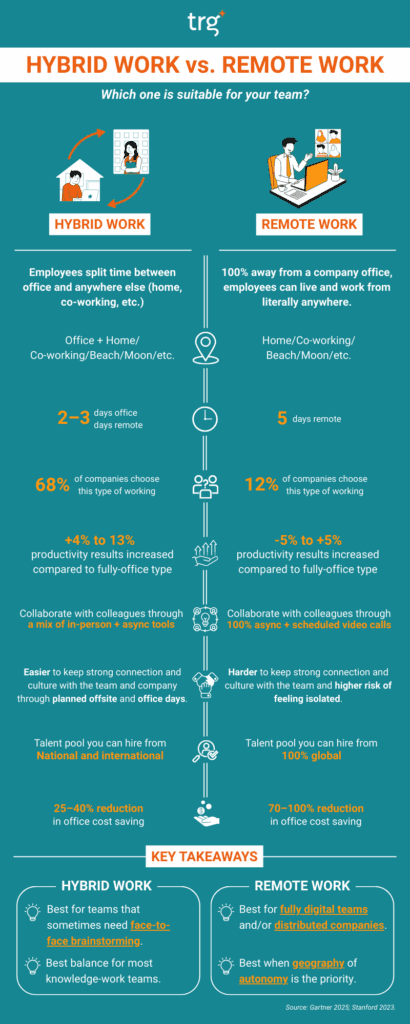
Hybrid work is sometimes mistaken with Remote work, which is 100% working from anywhere you want. See the infographic below for more details about the difference between Hybrid work and Remote work and choose the best that fits your business goals and cultures.
Spotify exemplifies this model with its “Work from Anywhere” policy, allowing employees to select their base country and work from virtually any location within it. The company automatically adjusts compensation, benefits, and tax compliance to local standards, ensuring fairness without forcing relocation. By decoupling geography from productivity, Spotify has built a system where engineers in Stockholm collaborate seamlessly with marketers in Singapore, all measured by the same output metrics rather than office attendance.
Read more:Move Aside Work-From-Home, It’s The Work-From-Anywhere Era
The two hybrid work models
The practice of hybrid work has been settled into two approaches that consistently deliver the highest employee satisfaction and best business results.
- Office-First Hybrid: The office remains the primary workplace, typically 2-4 days a week, but remote work is genuinely supported rather than just tolerated. It gives teams the structure and spontaneous collaboration that many still need, especially for onboarding, creative sessions, or relationship-building, while removing the old “five days in the office” mandate. It helps organizations move away from fully office-based policies, making it easier to maintain existing team dynamics and access to shared resources like labs or client sites. It’s particularly well-suited for industries such as manufacturing or consulting, where in-person presence supports hands-on tasks without forcing a complete overhaul.
- Preference-Based Hybrid: Currently the most popular with employees. This approach has no fixed office requirement at all. People decide week by week – or even day by day – where they will work best (home, office, mountain, beach, or elsewhere) and simply book a desk when they want to come in. This approach empowers individuals to align their schedule with personal needs, such as family commitments or peak focus times, fostering a deeper sense of trust and autonomy that enhances overall engagement. It shines in knowledge-based fields like tech or marketing, where varied workflows benefit from tailored environments, and it naturally supports global teams by prioritizing productivity over location.
As your business decides the best fit approaches, understanding core benefits and gaps of hybrid work is then crucial to identify suitable working frameworks and culture that every worker can adapt effectively. True hybrid demands intentional design – rewriting policies, tools, and norms – so that flexibility becomes a performance multiplier rather than an administrative headache.
The Unstoppable Drivers Behind The Rise
Talent Acquisition and Retention
Hybrid work significantly expands talent acquisition by removing geographic barriers, letting companies hire the best people from anywhere instead of just local commuters. Candidates now actively prioritize flexibility on job seeking, while time-to-hire drops by days and diversity improves noticeably. In short, offering hybrid isn’t just a perk; it’s one of the fastest, cheapest ways to attract stronger, more varied talent in today’s market.
Employee retention follows the same logic as the higher authority they have in deciding where they work, the lower possibilities they seek for new jobs. Gallup reported that hybrid workers have a lower turnover rate compared to their full-time office counterparts thanks to work-life balance and overall wellbeing [3]. Every percentage point saved transformed directly to millions in rehiring and onboarding costs.
Cost Efficiency
Cost savings emerge as the main and most compelling driver behind this shift in business operations, clearly seen as real-estate, operation, and utilities expenses cut-down. JLL’s 2024 Hybrid Workplace Report estimates a considerable reduction in office space needs for mature hybrid models, replacing by conference room technology and IT alternatives [4]. Likewise, cost-saving is also applied for employees when 20-80% commuting cost and 50-60% food cost of workers might be decrease thanks to work-from-home.
Read more:Diversity, Equity, Inclusion, and Belonging: Why Good Intentions Aren’t Enough
Productivity
Productivity is not an outlier for this operation system growth. A hybrid worker will have more space for fewer distractions and deep focusing, allowing them to be proactive in their task management that produces high-qualified outcomes. A Stanford study tested 1,600 people from Trip.com, revealing that workers in hybrid mode are as productive as full-time in the office, and the biggest wins came on tasks that need deep attention, such as writing code, drafting reports, or analyzing data.
Read more: Why Are We Procastinating At Work?
Potential Gaps In Its Flexibility
Employee Wellbeing
In a traditional office, work usually ends when people leave the building and physical separation creates a natural boundary. In hybrid setups, the home becomes the workplace, devices stay within reach, and there is no clear “off” signal. Without explicit rules, many employees feel pressure to stay available outside normal hours, leading to longer actual working time and reduced recovery periods.
Possible scenarios:
- Employees respond to messages in the evening or on weekends because they see notifications at home.
- Time-zone overlap encourages people in earlier or later zones to shift their personal schedules.
- Vacation days go unused because workers stay connected “just in case” something urgent comes up.
Read more:Are We Overvaluing Employee Satisfaction?
Culture Erosion
Team spirit once formed effortlessly through casual daily interactions, such as lunch breaks, coffee chats, or after-work drinks. In a hybrid or remote setup, those casual interactions rarely happen on their own. Without deliberate new ways to stay connected, employees can quickly feel isolated and drift away from the team.
Possible scenarios:
- A new employee leaves after just two months because they say, “I never got to know my teammates or the company culture.”
- The office team shares fun photos from a pizza lunch on social media, while remote workers scroll past and feel like they don’t belong.
- The company’s mission statement sits unused in a slide deck because no one experiences it through daily interactions anymore.
Proximity Bias
In traditional office environments, managers directly observe employees’ daily efforts and engagement, which unconsciously influences performance evaluations and career advancement decisions. In hybrid or remote settings, such visibility is significantly reduced. Consequently, even when remote employees demonstrate equal or superior results, their contributions may receive less recognition during informal discussions, calibration meetings, or promotion cycles, as human recall tends to favor physically present individuals.
Possible scenarios:
- An in-office junior gets invited to a last-minute strategy session with the CEO, while a remote senior only receives the summary email days later.
- During promotion discussions, leaders talk about “who showed real energy in meetings,” ignoring strong written contributions from remote staff.
Technology Reliance
When everyone works from different locations, teams start using more tools to stay connected: Zoom for video, email for updates, Google Drive for files, and WhatsApp or Microsoft for quick messages. Over time, these separate tools create confusion and waste a lot of time.
Possible scenarios:
- Someone asks “Where is the latest budget file?” and spends 10 minutes searching across email, Drive, and Slack before finding it.
- Important meeting notes are saved only on one person’s laptop, and that person is out sick, so no one can access them.
- The IT team gets constant tickets about “I can’t find the document” instead of handling bigger security or system issues.
The Hybrid Culture Playbook
Managers build the foundation system
Hybrid culture is built from the top. Employees shouldn’t have to invent rules or fight the system. The company, through its leaders, HR, and managers, must deliver a clear, fair framework that turns flexibility into a real advantage.
- Leadership & HR
- Define and communicate the official hybrid model, including core hours, anchor days, and async rules.
- Invest in the right tools: Slack/Teams, Notion, Loom, Donut, etc.
- Provide intentional in-person moments such as quarterly offsites, or micro-budget for local team lunches.
- Measure and openly share key equity metrics every quarter, including promotion rates by location, belonging survey scores, utilization data.
- Team Managers
- Default to async: write updates, record meetings, post summaries.
- Protect deep-work time and enforce quiet hours.
- Shift evaluation from presence to measurable outcomes and deliver feedback in writing every week.
- Complete short, practical hybrid leadership training and coaching their peers.
When leaders and managers consistently deliver this structure, employees are freed to focus on great work instead of navigating chaos. The system does the heavy lifting, then people just bring their talent.
Read more: Why is Collaborative Leadership Important?
While workers bring the habits
The company builds the system; employees make it come alive. A handful of consistent, everyday habits from every single person is what transforms solid policies into a culture that feels connected, fair, and energetic.
- Be an async pro: Write clear, complete updates in threads or docs, over-communicate context and next steps, and ask questions the moment they appear instead of waiting for a meeting.
- Respect everyone’s time and life: Honor core hours for real-time work, use “schedule send” outside them, and fully disconnect on evenings, weekends, and holidays.
- Stay human and visible: Turn on your camera for team rituals, share one small personal story in monthly show-and-tell, and say yes to random coffee chats.
- Speak up early and kindly: Flag too many meetings, unfair patterns, or early burnout signs in pulse surveys or 1-on-1s so the team can fix things fast.
When every person brings these habits, trust deepens overnight, collaboration feels effortless, and the whole team performs at its best. Hybrid only works when we all play our part.
Today, more than one in four workdays happen outside the traditional office, and most professionals now see flexibility as a standard part of any good job. Companies that embrace it are attracting stronger talent, keeping their teams’ spirit, saving costs, and often seeing better results. When teams feel trusted and supported, everyone wins: employees, managers, and the company itself. The future of work is flexible, and it’s ready whenever you are.
What do you think about this new operating system of Hybrid Work? Do you have any specific initiatives to make this approach more effective and welcoming?
References:
[1] https://hubblehq.com/blog/hybrid-working-ultimate-guide
[2] https://www.lifeatspotify.com/being-here/work-from-anywhere
[3] https://www.gallup.com/workplace/547283/workplace-trends-leaders-watch-2024.aspx
[4] https://www.jll.com/en-us/newsroom/jll-report-uncovers-path-forward-for-global-occupancy-planning
[5] https://hybo.app/en/blog/is-hybrid-work-cost-effective
[6] https://startups.co.uk/news/hybrid-working-promotions
[7] https://news.stanford.edu/stories/2024/06/hybrid-work-is-a-win-win-win-for-companies-workers