


Procrastination debate: Is it all bad? Have you ever considered what factors lead to a high frequency of active procrastination in the workplace? Explore the dual nature of procrastination and when it might actually lead to creative breakthroughs at work.
What is workplace procrastination?
Procrastination is common these days, when most people are concerned about it, ranting this term on social media every single day. Simply put, this is the act of intentionally delaying task progress or completion of an assigned task, and would, ultimately, be costly in the long run.
It happens not just in schools but also a lot in workplaces. Here, it refers to the behaviour of an employee who postpones their work task, often getting caught up in non-work-related activities instead. Procrastination is occasionally used in a positive sense (1). Sometimes, it is just a way to escape the pressure of deadlines, enjoying moments without the intention of harming the benefits of the organisation or letting down coworkers or customers.
The results of Jia-Min Li et al.’s research (2) reveal that about 15% to 20% of adults across different cultures struggle with procrastination. Even more concerning, a recent survey (3) of over 2,000 employees from one organisation mentioned that more than 80% of them felt they were procrastinating at work.
Read more:Will Work-Life Integration Be A Better Strategy Than Work-Life Balance?
Factors Leading to Workplace Procrastination
Work environment
There is no doubt that work environment ranks first among the factors that cause procrastination. A work environment is a space — physical and emotional — in which employees perform their daily tasks. Here are three key elements that define a work environment:
– Physical environment: This means how the office is set up, including items like desk space, lighting, and location. For remote workers, it includes software, tools, and equipment they use.
– Working conditions: These are the terms of employment, like compensation and benefits, reporting structure, and safety regulations or hygiene standards.
– Company culture: This begins with leadership. When the company’s values match employees’ personal beliefs, drives, and needs, it results in a thriving organisation. Company culture also includes cultural and social norms that define what is encouraged, discouraged, accepted, or rejected. Some aspects are more formal, like a company’s mission statement or an open communication policy.
So, when an environment lacks the necessary resources or has too many demands, it can lead to boredom and disengagement. Last but not least, toxic unwritten culture ultimately pushes employees toward procrastination or even an ignorant attitude.
Read more:Gen Z’s Expectations for Leadership Are Reshaping Modern Workplaces

The Influence of Human-AI Interaction
With the dominance of AI (artificial intelligence) in the workplace, human-AI interactions are also a matter of concern. Questions are raised: Can AI help businesses thrive, or is it hurting growth? The study “How does human-AI interaction affect employees’ workplace procrastination?” (2) provided a clear answer. When AI is able to support repetitive tasks and give answers to a variety of questions, employees are not inclined to work on these tasks until the very last minute.
Read more: A CFO’s Guide to Making Generative A.I. Work
Distractions from Mobile Devices
Mobile devices are unavoidable for many at work. While these tools can enhance our productivity, they can also become huge distractions (4).
Employees can easily get lost in social media, taking them away from their main tasks. This escape results in unfinished work and, unfortunately, creates a vicious cycle of procrastination every time they need to refocus.
That’s why some companies block distracting websites to help employees focus better.
Personal factors
Not everyone procrastinates for the same reasons. Studies show that certain personality traits can influence procrastination. Based on the basic core of the Big Five personality traits (agreeableness, conscientiousness, neuroticism, extraversion, openness), Amy Shaw et al’s study (5) reveals that:
- Active procrastinators tend to be emotionally stable extroverts.
- Emotional stability also provides significant signs of procrastination tendencies.
- Interestingly, more agreeable individuals tend to procrastinate less.
Additionally, lack of sleep, mental health issues such as depression or anxiety, and even ADHD can all give a hand. It’s understandable if your members or colleagues are tortured by these sicknesses; then the best advice comes from their doctors and therapists.
Read more:Why the MBTI Personality Test Is as Useful as Astrology
Negative impacts of procrastination on business
While procrastination is sometimes used positively, procrastinators unintentionally affect individuals; it can seriously harm company profits and overall performance even when people don’t mean to do it. Research (6) shows a clear connection between procrastination and non-work-related presenteeism, where employees come to work but are distracted by personal issues. This lower productivity and quality of work finally cost businesses money and resources.

A procrastinator knows what needs doing but struggles to motivate themselves to complete tasks on time. This not only adds stress to their plate but can also create tension among teammates, leading to mistrust and broken bonding within the team.
Read more:Giving Performance Reviews to Your Most Difficult Employees
Can procrastination be a good thing?
You might wonder if there is a silver lining to procrastination. Unfortunately, the literature overwhelmingly suggests there is not. Most research sees it as a self-defeating behaviour linked to poor self-regulation. It is often linked to worse task performance and negatively impacts health and well-being, as they need to work during their spare time to get the tasks done in time.
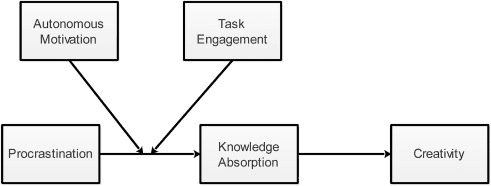
Ahmad Adeel et al. When procrastination pays off: Role of knowledge sharing ability, autonomous motivation, and task involvement for employee creativity
However, there are times when procrastination pays off. This diagram from Ahmad Adeel et al’s research (7) demonstrates the interplay where motivation and engagement can mitigate procrastination, fostering better knowledge absorption, which in turn enhances creativity. So, it is worth considering that procrastination sometimes can bring fresh ideas to the table.
Remember, excessive procrastination can cause unclear goals and a rushed approach to problem-solving. The pressure of a looming deadline can lead to quicker completion times, especially for routine tasks. Plus, it can serve as a temporary relief from stress and provide a short moment for an uplifting mood.
How to beat procrastination at the workplace
Improve work environment
Obviously, company culture takes time to be set from CxO levels and embedded into the ADN of each employee of all levels. So, looking for newcomers, recruiters also consider culture-added or culture-fit to mitigate the resistance to the working styles.
Don’t forget to remind employees that keeping their desks tidy, getting enough sunlight, or adding images to their workspace can maximise productivity and avoid procrastination.
Publish proper guidelines on how to use AI effectively
Companies should see AI tools as helpful resources to boost productivity, keeping in mind that AI-generated content can carry biases and errors. So, which should be included in AI guidelines?
– Always check and edit AI-generated content.
– Avoid using content written entirely by AI.
– Prioritise human creativity and judgement.
– Remove AI-generated images or videos of people.
– Safeguard sensitive information carefully.
Using AI responsibly and ethically benefits both the company and employees.
Combat social media distractions
Implement time blocking techniques like the Pomodoro Technique, and limit your access to distracting sites with apps such as Freedom or StayFocusd.
Creating a dedicated workspace and practicing mindfulness can help maintain focus, while accountability systems with coworkers will keep you motivated. Establish a reward system for completing tasks, engage in non-distracting activities during breaks, and adjust your notification settings to minimize interruptions.
Sharing session or training workshop
As the mentioned study has revealed about the Big Five personality traits, everyone has a different degree of procrastination.
So, sharing sessions or training workshops that focus on mental health/wellbeing are essential; they could act as a distraction from daily work but still help them gain something new.
Additionally, employees with emotional intelligence tend to perform better and stay committed, helping them manage stress and navigate workplace challenges.
Team collaboration
To tackle procrastination effectively, Anujit Chakraborty et al. stated that teamwork plays a vital role (8). Team-based incentives—whether competitive or cooperative—can significantly decrease procrastination and enhance productivity compared to those that reward individuals alone. In this study, they also show that cooperative incentives lead to more completed tasks than when employees work independently.
When teams collaborate, tasks become more enjoyable, creating a sense of shared responsibility and motivation to get things done. Also, letting team members see each other’s productivity can promote accountability.
Love these tips? Share this post with your team!

References:
- Steel, Piers. (2007). The nature of procrastination: a meta-analytic and theoretical review of quintessential self-regulatory failure. Psychol Bull 133: 65-94. Psychological bulletin. 133. 65-94. 10.1037/0033-2909.133.1.65.
- Jia-Min Li, Lan-Xia Zhang, Meng-Yu Mao, How does human-AI interaction affect employees’ workplace procrastination?, Technological Forecasting and Social Change, Volume 212, 2025, 123951, ISSN 0040-1625, https://doi.org/10.1016/j.techfore.2024.123951.
- Work from home or bring home the work? Burnout and procrastination in Brazilian workers during the COVID-19 pandemic, J. Occup. Environ. Med.(2022)
- Nidhi Gupta, Pitfalls in the use of mobile wireless devices in healthcare: Distraction, errors, procrastination, and burnout, American Journal of Medicine Open, Volume 7, 2022, 100010, ISSN 2667-0364, https://doi.org/10.1016/j.ajmo.2022.100010.
- Amy Shaw, Jay Choi, Big Five personality traits predicting active procrastination at work: When self- and supervisor-ratings tell different stories, Journal of Research in Personality, Volume 99, 2022, 104261, ISSN 0092-6566, https://doi.org/10.1016/j.jrp.2022.104261.
- Howe Chern Wan, Luke A. Downey, Con Stough, Understanding non-work presenteeism: Relationships between emotional intelligence, boredom, procrastination and job stress, Personality and Individual Differences, Volume 65, 2014, Pages 86-90, ISSN 0191-8869, https://doi.org/10.1016/j.paid.2014.01.018
- Ahmad Adeel, Samad Sarminah, Li Jie, Daisy Mui Hung Kee, Yahya Qasim Daghriri, Rsha Ali Alghafes, When procrastination pays off: Role of knowledge sharing ability, autonomous motivation, and task involvement for employee creativity, Heliyon, Volume 9, Issue 10, 2023, e19398, ISSN 2405-8440, https://doi.org/10.1016/j.heliyon.2023.e19398.
- Anujit Chakraborty, Guidon Fenig, From me to we: Beating procrastination in teams, Journal of Economic Behavior & Organization, Volume 231, 2025, 106900, ISSN 0167-2681, https://doi.org/10.1016/j.jebo.2025.106900.