

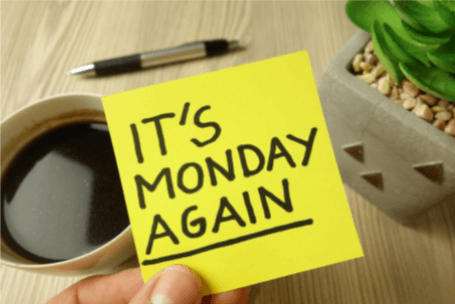
Have you ever felt stressed, unwilling to go to work at the beginning of the week? It is suggested that employees experience Mondays differently from Fridays, as workdays are not created equal. And if you do feel like you don’t want to go to work on Monday, a syndrome called “Monday Blues” describes this phenomenon.
What Are The Monday Blues?
Dragging yourself back to work after a two-day break gives you a headache. Some people admit that Monday is the most stressful day of the week, even more dreadful if you’re unhappy with your current job.
But why do we see lowperformance on Monday?
When our minds still linger about the comforts of the weekend, it’s hard to concentrate on work immediately and combat loads of tasks. Naturally, you’re resistant to turning on work mode. That’s when Monday Blues comes onto the stage. No worries, as mood improves over the course of the workweek (1).
So where did the term “Monday Blues” come from? Long ago, in German contexts, a Monday that people choose not to work, usually for a celebration or because they have overindulged over the weekend, dates back to the 1790s, and “Blue” refers to a mood of sadness implying a temporary emotional state (2).
Disclaimer: According to PsyCentral (3), it isn’t a medical term and doesn’t describe a specific condition that can be diagnosed. As such, it’s not in the Diagnostic and Statistical Manual of Mental Disorders, 5th edition, text revision (DSM-5-TR) .
But if you’re wondering whether Monday Blues are a real thing, clearly, those mentioned studies already indicate that the answer is yes.
Read more:Why Are We Procrastinating At Work?
What Are The Causes & Signals Of Monday Blues?
While some are eager to start a new week, others are not. What causes them to be in a bad mood? In this paper (4), Pindek et al. focus on two things:
The first factor is job satisfaction, which reflects the individual’s work adjustment and work well-being. Therefore, the person who is unhappy at work appears to be lacking motivation and is reluctant to start a new week.
Another significant factor is perceived job stressors, which include two components:
– Perceived incivility is an interpersonal stressor that refers to a mild form of mistreatment, with ambiguous intent to harm, that can negatively impact an employee’s mental health.
– Perceived organizational constraints are defined as work conditions that limit employees’ ability to complete job tasks.
There is a correlation between job satisfaction and these two job stressors. Early in the week, as opposed to later, they become more severe and have a bigger effect on job satisfaction.

However, simply put, “Monday Blues” is a casual term describing a set of symptoms that occurs on Monday morning. When you’re attacked by the blues, you can feel:
– Elevated blood pressure
– Headache / Stomach
– Muscle tension
– Changes in appetite
– Difficulty breathing
Although its symptoms can overlap with those of depression, anxiety disorders, or other mental illnesses, keep in mind that they are not severe and that we still have control over them because they only appear on Monday morning (5).
Read more:Will Work-Life Integration Be A Better Strategy Than Work-Life Balance?
The Dark Side Of Monday Blues
Not going to scare you, but Monday Blues do show negative impacts on individuals.
A case study (6) of 188,601 suicides in Korea, which was published in 2018, indicates that the frequency of suicide was highest on Monday and decreased throughout the week until Saturday. The so-called Monday Blues effect is real, especially for people in their 20s and working ages.
The authors explain that when the Korean government reform their labor system under practices that emphasize a productivity-first atmosphere, many of their workers are more likely to contemplate, attempt, and commit suicide.
Furthermore, the other article (7) shows that the number of suicide deaths has continued to be high and is a social problem in Japan. This study revealed that the suicide death ratio among Japanese men on Mondays was found to be significantly high at 1.49 (95% CI*: 1.04-2.14), and the ratios were found to drop down throughout the week. This suggests that the structure of the work week may possibly influence the decision to commit suicide.
*CI: confidence interval
Read more:The Dark Side of High EQ in the Workplace & How to Mitigate It
How To Beat The Monday Blues Individually?
To prevent the Monday Blues from getting worse and leading to clinical conditions, such as anxiety, stress, and depression, each individual should start by solving their internal factors. Several self-care strategies that may help alleviate negative impacts:
– Journaling or documenting your feelings in a diary
This is a good way to track the mood board and release negative energy.
– Practicing meditation and breathing exercises
This helps to reduce anxiety and promote relaxation both in the mind and in physical muscles.
– Maintaining positive social relationships
Strong social connections can provide emotional support, which can potentially improve your mental state. Moreover, strong and healthy relationships can help enhance self-confidence and prevent anxiety and depression.
– Engaging in enjoyable activities on Monday
Enjoy dinner with friends or a post-work salon visit will be a good choice to take care of yourself, have more time to relax after work.
– Getting sufficient sleep
Sleep is important to prevent a range of health issues, including heart disease and depression.

How To Help Your Colleagues Overcome Monday Blues?
Consider these tips to help your team member beat the effects, wake up and stay concentrated:
– Boost your team to complete Monday morning tasks on Friday.
Finishing tasks on Friday, before the weekend, is a helpful tip for avoiding Monday blues. That means your team doesn’t have to sprint to complete relevant tasks on Monday morning.
– Have a Monday evening plan.
As a leader, if your members appear to be underperforming in the morning, suggest that they plan for the evening to complete their tasks. Things must be easier now that their mood has improved and they get back to the grind.
– Start a Monday morning ritual
Do not rush into long meetings that may leave everyone exhausted. First, grab a cup of coffee and gather around to talk about our lives outside of work, which can boost spirits and strengthen bonds among teammates.
– Send out a positive Sunday message.
Wishing everybody the best of luck on Sunday – a day off before returning to work would help a lot. No one can refuse a warm, heartfelt message, and you could make their day.
 hbspt.cta.load(125873, '834bd885-96f2-449b-9a5c-721decfc3813', {"useNewLoader":"true","region":"na1"});
References:
- Ilies R, Judge TA (2002) Understanding the dynamic relationships among personality, mood, and job satisfaction: A field experience sampling study. Organizational Behavior and Human Decision Processes 89(2): 1119–1139.
- https://www.oed.com/dictionary/blue-monday_n
- https://psychcentral.com/depression/monday-blues
- Pindek, S., Zhou, Z. E., Kessler, S. R., Krajcevska, A., & Spector, P. E. (2020). Workdays are not created equal: Job satisfaction and job stressors across the workweek. Human Relations, 74(9), 1447-1472. https://doi.org/10.1177/0018726720924444
- https://www.siloamhospitals.com/en/informasi-siloam/artikel/monday-blues-causes-symptoms-and-how-to-overcome-them
- Kim, E., Cho, S.-E., Na, K.-S., Jung, H.-Y., Lee, K.-J., Cho, S.-J., & Han, D.-G. (2018). Blue Monday Is Real for Suicide: A Case-Control Study of 188,601 Suicides. Suicide and Life-Threatening Behavior. doi:10.1111/sltb.12429
- Ohtsu, T., Kokaze, A., Osaki, Y., Kaneita, Y., Shirasawa, T., Ito, T., Sekii, H., Kawamoto, T., Hashimoto, M., & Ohida, T. (2009). Blue Monday phenomenon among men: suicide deaths in Japan. Acta medica Okayama, 63 5, 231-6 .