


Application Programming Interfaces (or APIs) power almost every digital interaction in our lives. They work behind the scenes when you order food online, check maps in your favourite app, or sign in with your social media account. These quiet workhorses of modern technology have grown tremendously, yet many still find them puzzling, too technical and difficult to understand.
This piece breaks down APIs, how they work, and why they are important in both our daily and professional lives in clear, straightforward terms for you.
Read more:Fundamentals of Cloud | Public v Private, SaaS v Hosted, Multitenancy
What is an API?
According to IBM, an API (Application Programming Interface) is a set of rules that lets different software applications “talk” to each other. You can think of them like “special digital” translators for several different systems. What for? To exchange information, features, and functionalities in a standardised way, just as humans use languages to communicate.
APIs serve many vital purposes, mainly to improve business operations through:
1. Integration: New applications connect with existing software systems without rebuilding functionality from scratch
2.Automation: Automatic data syncing and workflows, e.g., gallery images backing up to cloud storage automatically
3. Innovation: Businesses respond quickly to market changes by making adjustments at the API level
4. Expansion: Meet clients’ needs across different platforms and devices
APIs are powerful and versatile tools to connect disparate applications, software, or platforms. In addition to letting data flow more freely and smoothly, APIs also allow developers to add features or functions to their existing software without the need to invest resources and time into building them from scratch. Moreover, organisations can also use sophisticated features without developing specialised applications.

How do APIs look in our everyday lives?
Google Maps
Google Maps is probably one of the most common examples of APIs in today’s modern life. Thousands of apps connect to Google’s mapping services through APIs instead of building their own systems from scratch to access its detailed maps, live traffic updates, and reliable routes, which then offer turn-by-turn directions for you to drive, walk, bike, or even take public transport.
Weather forecast
Your phone’s weather app is another great example of APIs. The app does not collect weather data itself, but rather it connects to the weather bureau’s database through an API that sends updated forecasts to your device. The API takes requests from your app, processes them at the weather service, and sends back relevant information.
Social login
Those “Sign in with Google” or “Continue with Facebook” buttons you see everywhere show how APIs make digital life simpler. Social Login enables users to access third-party websites using their social network accounts, thereby solving a big headache – creating new accounts on every single website. Social login gives you one-click access without the need to remember another set of login details.
These examples show how APIs consistently act as bridges between different software systems. This basic principle powers countless digital interactions we use every day without thinking twice.
Read more:Drop the Grid to Modernise Your Treasury Management
How do APIs work behind the scenes?
APIs work through a request-response cycle between clients and servers. The client (like a mobile app) is the one that submits the request and asks the server for specific information. Being the “bridge” connecting the two, the API processes that request, “talks” to the server, and returns the response—usually as structured data in a standard format—to the client. The real magic here is that this process happens in milliseconds, creating the feeling of instant interaction for users.
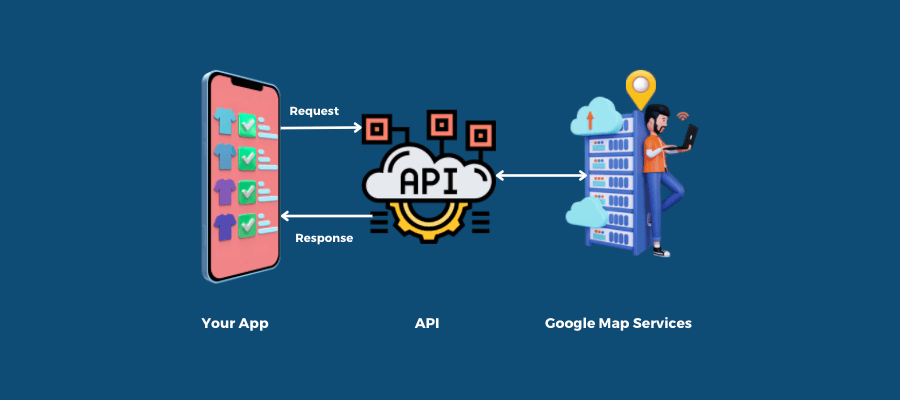
Image credit: Satyam Chaudhary
Picture a restaurant: you (the client) sit at a table with menu choices, and the kitchen (the server) prepares your order. The waiter—the API—stands between you and the kitchen. They take your request, deliver it to the kitchen, and return with your trays of food and drinks.
Read more:How Companies Can Blend Tech and Touch in Mentorship for Gen Z and Beyond
Or think of the last time you booked an accommodation online. Your mobile application (the hotel’s owned app, booking.com, or Airbnb, etc.) sends a request to the hotel’s server through an API to get room availability and pricing details. The request sent contains all the necessary information, such as check-in/ out dates, number of guests, location, etc.
Once the hotel’s API receives the client’s request, it then queries the hotel’s database (the server) to obtain relevant information, like available stocks, pricing, amenities, and more, and sends them back to the app. It does not allow third-party apps to directly access the hotel’s entire database because it could pose a serious security risk. The mobile app receives the response and right away shows you all the details.
In both examples, the purpose of APIs is to ensure that you do not have to go all the way to the kitchen or the hotel’s lobby to raise a simple inquiry.
What are the different types of APIs?
There are four common types of APIs:
– Public APIs (or open/ external APIs): These are open and available to the public, i.e., practically any external developers or businesses can use them.
– Partner APIs: These are only available to selected authorised partners, developers, and businesses; no external developers can access without permission. As such, this type of API is generally more secure. For example, HubSpot connects with SurveyMonkey platforms to automatically send emails based on a predefined cadence.
– Private APIs (or internal APIs): Unlike public APIs, these are intended for use within the business only. Thus, no external or outside developers can access them.
– Composite APIs: Two or more APIs are combined for a sequence of operations to address specific, complex needs.
A brief rundown of common API protocols and architectures
As mentioned earlier, APIs communicate through different protocols, just like we humans have our own communication styles. Understanding these protocols will enable you to choose the right one for your projects.
Today, there are three categories of API protocols or architectures: REST, RPC, and SOAP.
REST
The representational state transfer (REST) architecture, sometimes referred to as RESTful APIs, is one of the most common approaches to building APIs due to its uses of less bandwidth as well as its ease of understanding and implementation, making REST more efficient.
These APIs are commonly used in mobile and web-based applications to access and exchange data on remote systems across the Internet. Some of their most popular implications are:
– Ride-sharing apps such as Grab or Uber use REST APIs to access maps and schedule rides
– Banking apps use REST APIs to access account data and support transactions
– Streaming services like Spotify or Netflix use REST APIs to access media from remote servers
– Social media platforms, such as X and Facebook, use REST APIs to make and manage posts as well as integrate with other applications
RPC
The remote procedure call (RPC) protocol is a simple means to send multiple parameters, i.e., the client makes a remote function call (method or procedure) on a server to invoke actions or processes as a result.
Some common examples of RPC APIs are:
– Taking a picture using a remote device’s camera
– Leveraging machine learning on the server to identify fraud
– Restart a server remotely
SOAP
Simple Object Access Protocol (SOAP) is a messaging protocol that provides standardisation when different applications exchange data, regardless of what programming language or operating system is being used.
Every SOAP API request and response comes neatly wrapped in an XML envelope, in which you can find data like the header, body information, error messages, etc.
SOAP is often used for:
– Business environments with complex security requirements
– Operations that need guaranteed delivery (e.g., stock trading, airline reservations)
– Integration with legacy systems that already use SOAP
What about GraphQL?
Meta (formerly Facebook) created GraphQL in 2012 and made it open source in 2015. This query language provides yet another way to build APIs by allowing clients to pull exactly the data they need, solving many problems that REST APIs cannot handle well.
Although REST and SOAP have been solidifying their dominance in the API world for years, GraphQL is gaining popularity because:
– Accurate data fetching: You get exactly what you ask for, no more, no less
– Single request efficiency: One query does the work of multiple REST calls
– Strong typing: Schema definitions keep data structure safe throughout development
– Schema flexibility: You can update schemas without breaking existing apps
Despite being “younger” and seemingly more promising, it is not always sunshine and rainbows. GraphQL adds another layer of complexity to the server, requiring it to process and query more dynamically to return more precise results. This translates to more work to be done behind the scenes.
GraphQL shows that APIs will become even more vital as digital systems grow more interconnected. They make development simpler, integration easier, and speed up innovation.
Did we miss anything in this piece? What other tech terms should TRG break down next?
If you like this article, don’t forget to also check out our other posts in the series:
– Tech Tidbits: What is Big Data?
– Tech Tidbits: Vertical vs Horizontal SaaS, What You Need to Know
– Tech Tidbits: What is Accounts Payable Automation?
– Tech Tidbits: What Is Hotel Management Software?

Sources:
https://www.ibm.com/think/topics/api
https://www.techtarget.com/searchapparchitecture/definition/application-program-interface-API
https://www.techtarget.com/searchapparchitecture/definition/RESTful-API
https://aws.amazon.com/compare/the-difference-between-rpc-and-rest/
https://zapier.com/blog/soap-vs-rest/