

In most organizations, leaders proudly swear they have cracked the code: “We’re a high-performance culture and a learning organization.” In practice, the moment you look under the hood, you see the damage of trying to ride two horses at once. The two modes are fundamentally incompatible in the short term, and pretending otherwise creates confusion, wasted effort, and mediocre outcomes. The solution is simpler than it seems: consciously choose one dominant focus at any given time and align everything: metrics, communication, time allocation, and leadership behavior, around that choice.
Choose Learning or Performance
Most leaders believe they are already doing both, yet when examined closely, their organizations oscillate inconsistently or send contradictory signals. Prioritizing one does not mean abandoning the other forever; it means deliberately elevating one while accepting that the other will temporarily take a secondary role.
Read more:High Potential vs. High Performing Employees: What Are the Differences?
A learning-focused mode is not a feel-good slogan. It is defined by experimentation, acceptance of mistakes, a deliberately slower pace in certain areas, and systematic long-term capability building. This can be seen in heavy investment in training, regular coaching cycles, explicit tolerance for thoughtful failure, and protected time for reflection and skill development.
Just like Amazon did in its early to mid-2000s phase: Jeff Bezos openly funded expensive experiments such as Amazon Auctions, the Fire Phone, endless marketplace tests, because the company was in capability-building mode [1]. Short-term profits were secondary to discovering what actually worked at internet scale.
A performance-focused mode is the opposite posture. It is speed, measurable output, clear KPIs, strong accountability, and reliable short-term delivery. The signals are equally visible: targets take precedence over exploration, execution outweighs prolonged reflection, and consistency is valued above bold experimentation.
Toyota provides one of the clearest real-world examples. After the 2011 recall crisis, Toyota shifted decisively into performance mode: sales of eight models were halted, new launches slowed, and quality teams gained absolute veto power. Bold innovation and training took a back seat, flawless execution became the only priority. The result was a dramatic drop in defects, restored customer trust, and record profits by 2015 [2]. Same company, same people, different seasons, different rules.
Read more:Sustainable Growth and Higher Team Performance Start Here
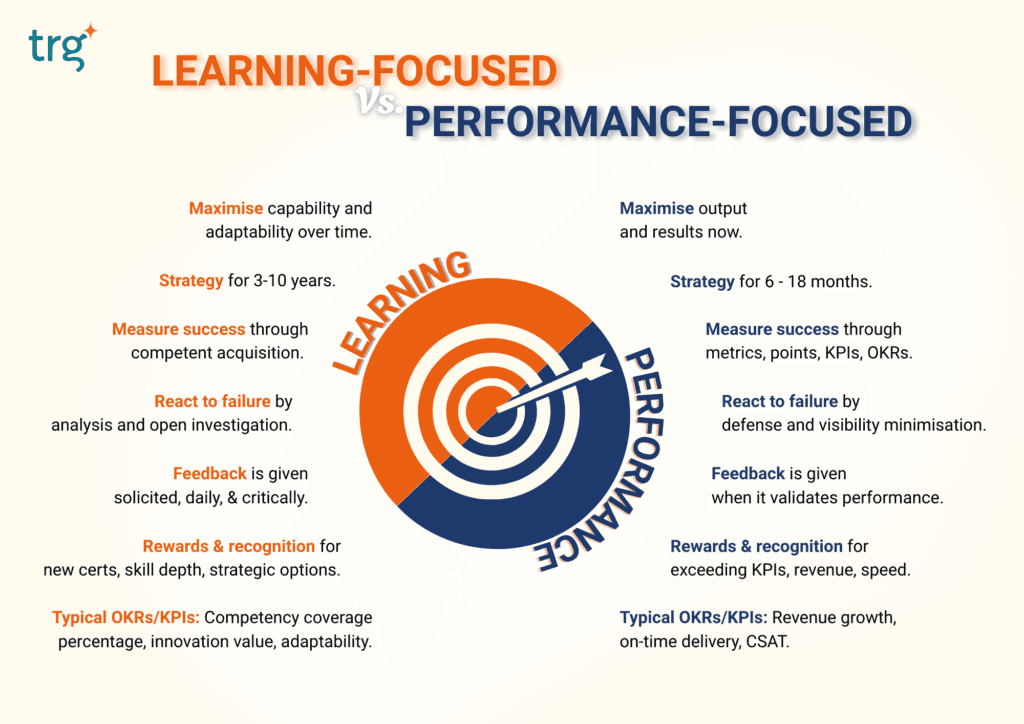
The key difference is in the daily actions each requires: learning encourages exploring unknowns and learning from setbacks, while performance demands sticking to proven methods and avoiding errors. These cannot easily share the spotlight because time, energy, and team mindset are limited. Push both equally, and you risk trade-offs that hurt progress.
Contrarily, an organization without learning is an organization that faces skill shortages, outdated methods, and eventual slowdowns. Likewise, without performance, the organization gets low drive, delayed results, and unmet goals. Both matter, but the challenge is they work best when one leads the way at a time.

Why Teams Cannot Excel At Both At The Same Time?
People have limited mental energy, they cannot fully embrace a “try-and-learn” mindset while under pressure to deliver without flaws. This split focus drains motivation and clouds decisions. Resources also add to the strain: hours spent on training or reviews are hours pulled from deadlines and deliverables. More critically, the behaviors clash: learning needs room for errors to gather insights, but performance views errors as failures to fix fast.
Consider mountain climbers attempting a difficult summit. They cannot simultaneously move at maximum speed and maintain perfect safety protocols. Pushing hard for the summit requires accepting higher risk; prioritizing absolute safety requires slower and more cautious progress. Teams face the same constraint, there is only one primary strategy at any moment [3].
Read more:Is Microlearning the Future of On-Demand Development?
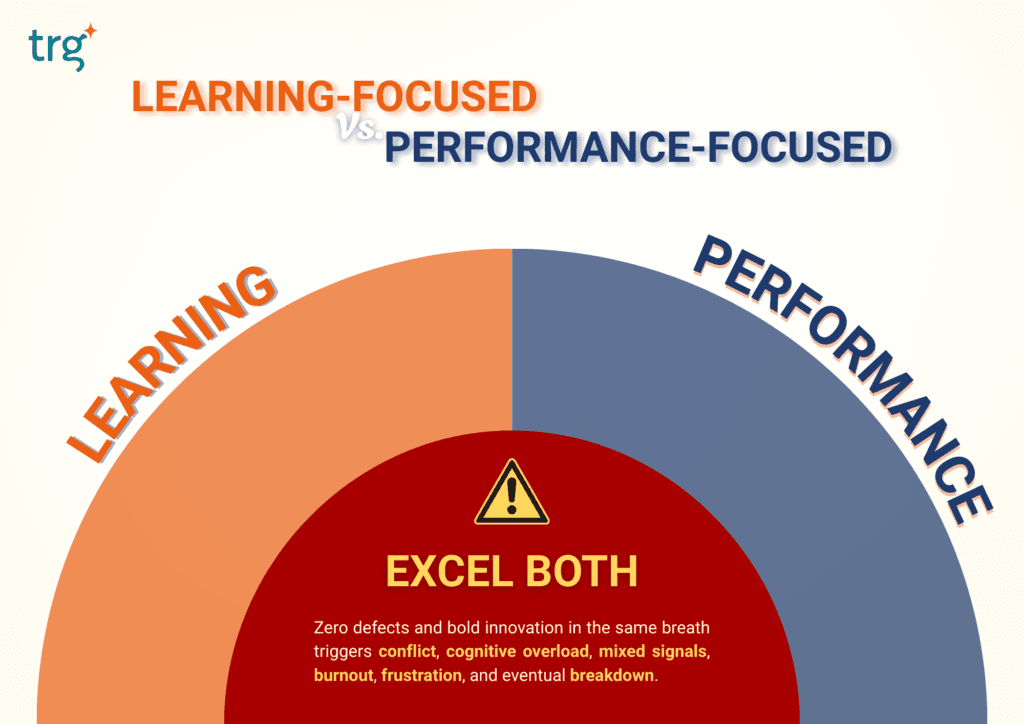
General Electric and Google excelled both and was criticized by their employees
When leaders demand both learning and performance without choosing a clear dominant mode, they send mixed signals that undermine everything. Employees freeze, unsure whether to experiment or to deliver flawlessly. The organization ends up with neither bold innovation nor reliable execution, just confusion, burnout, and mediocrity.
A prime case is General Electric under Jeff Immelt. From 2001 to 2017, GE famously tried to be both the ultimate execution machine and the world’s most innovative company. It kept Six Sigma “zero-defect” belts while simultaneously mandating that every business derive 20–30% of revenue from products less than three years old. The mismatch led to shortcuts, faked progress, and massive value loss, which is a clear warning of divided priorities [4].
Google in 2022–2023 acted as the same painful example. Leadership publicly declared a “productivity and focus” push while simultaneously rolling out mandatory AI training and 20% time revival experiments. Engineers consequently complained openly about whiplash, layoffs hit both high and low performers with no clear logic, and the stock suffered its longest stagnation in over a decade. Mixed signals produced neither breakthrough AI products nor restored margins [5].
Read more:Examining HiPos Working at Tech Giants Apple, Netflix and Google
Leaders Are Responsible For The Right Direction
Effective leaders assess the situation: is it time to build skills during growth or deliver reliably in a tough market? From there, pick one focus accordingly. To sharpen that call, run a quick test on your task’s demands: Does the problem feel routine with a clear playbook (favor performance), or fuzzy and novel (lean learning)? Is the environment stable, or full of curveballs? Are goals laser-focused, or pulling in multiple directions? These factors will cut through the fog. Commit fully by matching metrics, rewards, and daily guidance to that choice [6].
Read more:Emotional Intelligence for Leaders
Below are the most important points that leaders should necessarily transmit through their chosen direction.
- Make the message direct and consistent: explain the expected behaviors, why this focus now, and how it fits the bigger picture. For instance, say, “We’re in performance mode for the next year to hit key targets, learning will be focused and brief to avoid pulling us off track.”
- Cut out contradictions: in learning mode, ease up on strict metrics; in performance mode, limit broad training or side projects. Leaders must offer patience and guidance in learning phases, or firm direction and quick feedback in performance ones.
Satya Nadella at Microsoft nailed this in 2014 by ending stack ranking and starting with a “growth mindset” learning phase, where high complexity in cloud tech demanded knowledge reconfiguration over routine execution, accepting some short-term dips to rebuild cloud skills. Once ready, he pivoted to performance, making Azure’s reliability a top measure and restoring discipline. The company transformed as a result [7].
Read more: Training and Development Programs are Essential for Productivity
Choosing one dominant mode is not a compromise, it is the only way to achieve excellence in either. When the season naturally shifts, make a new clear choice and realign everything again. Teams that master this disciplined oscillation between focused learning and focused performance ultimately outperform those that vainly chase both at once.
The path to superior long-term results runs through short-term clarity, not perpetual balance. Whether you’re leading a startup needing new capabilities or an established firm facing missed goals, the principle holds: select one mode, align everything, and communicate without mixed signals. Your team will sense the clarity and deliver better.

References
[1] https://www.theguardian.com/technology/2014/dec/03/jeff-bezos-billions-dollars-failures-amazon
[2] https://www.theguardian.com/business/2010/jan/29/timeline-toyota-recall-accelerator-pedal
[3] https://thesystemsthinker.com/performance-versus-learning-in-teams-a-situation-approach
[5] https://www.cnbc.com/2022/07/31/google-ceo-to-employees-productivity-and-focus-must-improve.html
[6] https://thesystemsthinker.com/performance-versus-learning-in-teams-a-situation-approach