


A treasury management solution (TMS) is specialised software that lets companies handle cash flow and banking relationships while keeping track of their money in real time. However, many businesses today still favour spreadsheets and manual processes when handling treasury tasks, which create needless risks and hinder their financial growth, hurting both internal decisions and the company’s standing with lenders and investors.
Do businesses need a treasury management solution? The short answer is yes!
But (yes, there is always a “but”) the type of solution and the level of complexity needed depend heavily on the business’s size, industry, and specific financial operations.
Read more:10 Common Mistakes in Financial Forecasting & How to Avoid Them
Without a treasury management solution, what will happen?
Treasury departments still using outdated manual processes struggle to keep up in today’s ever-changing financial world.
Teams waste over 26 hours every week, or more than three full working days, on repetitive tasks like monitoring cash positions and reconciling transactions. This adds up to nearly 1,400 hours each year spent on low-value work instead of strategic financial planning.
Manually handling these tasks and the use of spreadsheets will leave treasury departments with little to no room to breathe, let alone the time and flexibility needed for other, more critical missions. Additionally, manual workflows bring a unique set of problems, for instance:
– No audit trails or proper documentation
– Data can be lost during system failures
– Heavy dependence on specific employees who know the system
– Limited backup and recovery options
Read more:You’re Losing Money on Manual Invoice Processing! Here’s A Solution
On the other hand, though spreadsheets feel familiar, they are a landmine of risks, ranging from simple data entry mistakes to complex formula problems that can impact the final financial decisions, costing the business more than an arm and a leg. As data grows, managing spreadsheets becomes harder and makes information control almost impossible.
When treasury teams are overwhelmed with paperwork and endless rows of spreadsheets, it is impossible for them to focus on critical work.Only 26% of finance leaders say they have “very good” visibility of their cash flow. This means most businesses make important financial decisions without accurate, immediate data, and businesses might be unable to adapt to market changes fast enough. Inefficient processes often leave cash sitting idle in business accounts when it could be used to reduce short-term borrowing costs or earn interest through better cash management.
In an article featured on EuroFinance, three senior treasury professionals shared how they are reshaping risk management strategies to keep pace:
– Changing the mindset of having cash as an essential rather than an option.
– Highlighting the influence of treasury management beyond its core functions across the organisation.
– Acknowledging the important role of technology for visibility in cash flow.
“Revenue is vanity, margin is sanity—but cash is still king,” Jeremy Reedus, Vice President and Global Treasurer of Varel Energy Solutions, a downhole oilfield supply company, shared his take in the same EuroFinance article.
Effective treasury management solutions give teams accurate views of cash positions when they need them, which makes cash flow more predictable. Quick access to data helps treasurers make better decisions based on current information instead of outdated reports. This becomes especially valuable in global markets where teams need to stay compliant and manage risks proactively.
Also in the same article, Bruce Edlund, Group Director and Assistant Treasurer at Cloud Software Group, shared that without a dedicated treasury management system, his team had to work using only internal tools. Now that a proper solution is in place, not only can they automate various processes, but also gain up to 99% visibility of their cash.
Read more: The Use of Spreadsheets and Modern Cloud Adoption in Businesses

Is it necessary for businesses to have a dedicated treasury management solution?
To better answer this question, let’s break down the reasoning based on the size of the business.
For small to medium-sized businesses (SMBs)
SMBs typically do not have a dedicated treasury department. Instead, they often have a finance department (or in some cases, a single person) that handles everything. A treasury management system (TMS) can be a powerful tool supporting these professionals by helping them:
– Move away from the time-consuming, error-prone spreadsheets by providing more accurate, real-time data.
– Gain a consolidated view across all bank accounts, avoid overdrafts, and identify idle cash for investments.
– Enforce automated controls and multi-level approval workflows for payments, thus significantly reducing fraud.
– Enhance flexibility to handle the ever-increasing transaction volumes and bank accounts as the business grows.
Read more: Can Your Bank Reconciliation Process Be More Efficient?
For mid-sized and growing enterprises
These businesses often operate across multiple countries, dealing with diverse currencies and managing more complex debt and investment portfolios. This is where a robust TMS becomes essential, providing them with:
– Centralisation and standardisation for treasury processes across different entities and subsidiaries, eliminating data silos.
– Better risk management against foreign exchange risks and interest rate fluctuations.
– Streamlined and enhanced bank relationships through a single interface, and even helped negotiate better banking terms.
With a dedicated TMS, treasury teams solidify their strategic position, moving away from tactical, day-to-day tasks and utilising the system’s analytics and forecasting capabilities to obtain the insights needed to make informed decisions about capital structure, investments, and funding.
Read more:Introducing CS Lucas Treasury Management Solution to the TRG Portfolio
For large, global corporations
For large enterprises, a TMS is a critical component of their financial structure. Larger organisations often have a vast, global network of bank accounts and intercompany loans. Effectively managing this complicated, intertwined network requires a more robust treasury management solution.
These businesses are also more likely to be exposed to market volatility and more complex regulatory requirements. A TMS provides advanced features for managing various types of risks, along with a comprehensive audit trail and robust reporting capabilities, which are essential for complying with stringent regulations, such as SOX, and preparing for audits.
While the specific features and scale of the solution may vary, the core benefits of a treasury management system (automating processes, improving data visibility, mitigating risks, and enabling strategic decision-making) are crucial for any business that wants to manage its finances effectively and position itself for long-term success.
How to get started with a treasury management solution?
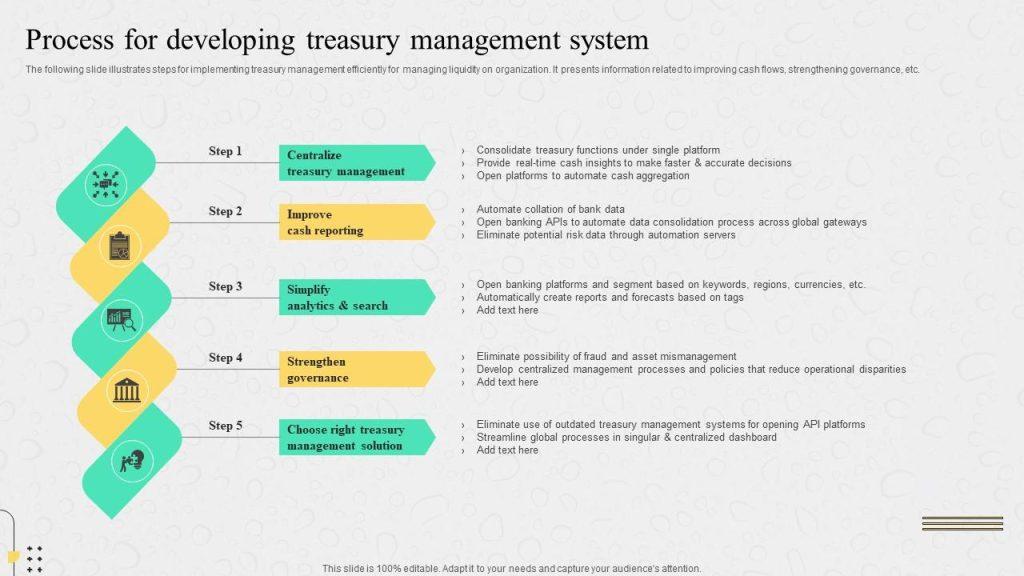
Now that your business has made the decision to adopt a TMS. What’s next? Planning, of course, to ensure not only that the implementation project is a success but also that your team members adopt and fully utilise it.
Here are a few things to consider when planning.
Deployment models: On-premise vs cloud-based TMS
Choosing the type of deployment model will substantially affect how fast the business can implement the system and what it costs long-term. On-premise solutions live on the company’s servers, which can give users complete control and customisation options, but need heavy IT involvement and upkeep. Cloud-based options, particularly Software-as-a-Service (SaaS) solutions, have grown increasingly popular in recent years due to their quick implementation and minimal to no upfront costs.
Read more:From On-Premises to Cloud: Strategy for a Successful Financial Management Transformation
Essential features to look for
– A good treasury management system should pack these features:
– Cash flow forecasting tools that show the complete picture, with options to dig into specific business areas
– Risk management tools that track currency changes, interest rates, and counterparty risks as they happen
– Automation features that cut down manual work, reduce mistakes, and leave clear audit trails
Read more:What to Look for in a Treasury Management Solution
Security and compliance considerations
Treasury systems handle sensitive financial data, so top-notch security is vital. The TMS needs multi-layered security with firewalls, encryption, and two-factor authentication. User management controls should restrict permissions based on roles and keep detailed records of system activities.
Plan the implementation project in phases
Breaking implementation into smaller chunks with clear goals helps the project team stay focused. Set realistic timelines that include testing time and possible delays. Build a team that includes project managers, technical experts, and financial specialists to handle everything in the process.
Train the treasury team and monitor adoption
The treasury team needs thorough and detailed training programs that fit different user groups. Even the best system falls short without proper training. Mix different learning methods like classroom sessions, online modules, and hands-on practice. Create documentation that helps share knowledge. Set up support systems that help people long after the original implementation.
Treasury management systems have grown beyond being exclusive tools for large corporations. These systems are now vital resources for businesses of all sizes. Companies that still use manual processes face major setbacks, from missed opportunities to limited financial visibility and increasing security risks. Digital transformation is not the only solution, but it is one of the options to help automate, streamline, and enhance the treasury function and beyond.
Interested in learning more about the topic of technology in finance and wanting to keep updated on the world of treasury management? Subscribe to the TRG Blog today to always stay in the loop!