


Diversity, Equity, Inclusion, and Belonging (DEIB) is often viewed as the ethical imperative of the modern workplace. Their values and benefits have been mentioned again and again in countless articles, from driving innovation to building a more engaged workforce, increasing productivity, etc. Still, many DEIB programs crumble, costing companies billions.
The case of the retail giant Target is a textbook example of such a bold commitment turning sour, losing over $20 billion in shareholder value.
How can leaders move beyond good intentions? The answer lies in gaining a deeper, objective understanding of the “unseen” factors that truly define a culture of inclusion and belonging.
Read more:Measure, Track, Enhance Diversity and Inclusion with Technology
What is diversity, equity, inclusion and belonging (DEIB)?
These four principles, Diversity, Equity, Inclusion, and Belonging (DEIB), serve as fundamental guidelines which organisations use to attract and retain employees in today’s competitive labour market.
– Diversityin the workforce does not stop at just the diversity in professional backgrounds, individual experiences, and viewpoints. The definition of diversity goes past physical characteristics, like gender, ethnicity, and age, to encompass educational background, professional skills, mental approaches, and more. A team that consists of a rich mix of members tends to perform better at problem-solving and innovative solutions because of their different perspectives.
– Equity calls for equal access to resources and career development opportunities based on the unique needs and demands of each employee.
– Inclusion requires organisations to actively create environments where all employees are respected, valued, and empowered to contribute.
– Belonging signals that diversity is not only welcomed but celebrated to drive loyalty, trust, and commitment across the workforce. Workplace security exists when employees can show their genuine selves at work, which leads to a sense of belonging.
Read more:Diversity and Inclusion in the World of Remote Work
According to Gallup, when employees’ voices are heard, companies see 27% lower employee turnover rates, 40% reduced workplace accidents, and 12% increased productivity levels. [1]
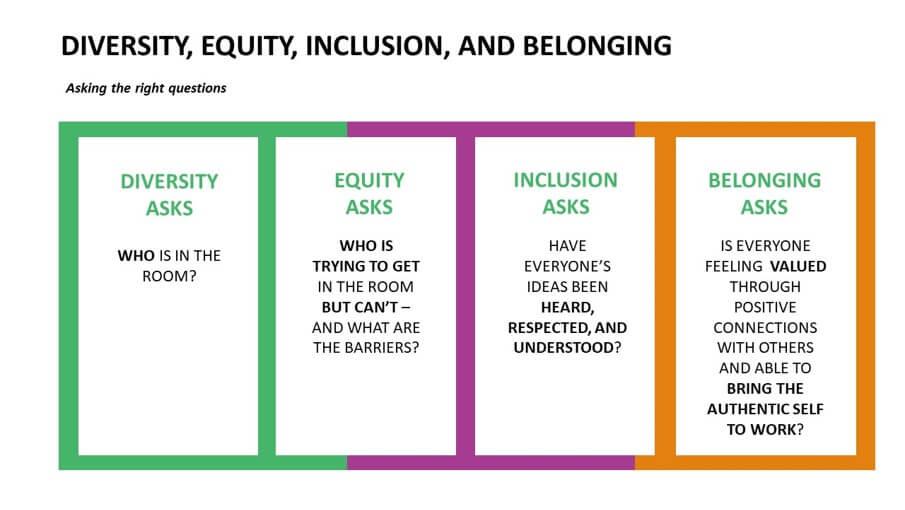
Image credit: Julia Schmidt,Executive Support Magazine
All these sound simple… on paper. The problem? Many employers still treat DEIB as a “social media hashtag” that they need to include to polish their brands or a passing trend rather than adopting each element of DEIB into their long-term talent management strategies.
The result? Well, let’s take a look at the latest victim of this social trend, Target, to see the scale of the impact.
Target – From being the poster child for DEI in corporations across America
We all know (or at least have heard of) Target, one of the largest retailers in the US. The retailer has gone through various economic crises, presidential evolutions, and product and service innovations before reaching impressive numbers today – operating nearly 2000 stores and managing over 400 thousand employees.
“Target was one of corporate America’s most forceful supporters of diversity and inclusion initiatives…” according to CNN [2]. The motive behind Target’s “aggressive” move dated back to 2020 when the murder of George Floyd, an African-American man, happened right in Minneapolis, Target’s home city and 10 minutes away from its headquarters.
The George Floyd case enraged the public, becoming the foundation for countless uproars and social movements against racism and violence at the hands of police. The murder case also impacted Target CEO Brian Cornell and employees. As a result, Target pledged to:
– Increase its Black workforce by 20% within three years
– Advance racial equity, including establishing an executive Racial Equity Action and Change committee with the purpose of driving lasting impacts for Black employees and customers
– Commit more than $2 billion to Black-owned businesses and suppliers by the end of 2025 by adding products from Black-owned vendors to Target stores
– Invest $100 million in Black-led scholarships and nonprofit organisations for support
Read more:The 6-Step Guide to Developing a Diversity and Inclusion Plan
These were certainly challenging commitments that Target brought on itself. However, all the hard work has enabled Target to earn an honouring award in 2022 from the Executive Leadership Council, a prominent organisation of global Black CEOs.
In an interview with Fortune in 2023 [3], Cornell stated that DEI initiatives are adding value and have helped Target drive sales through higher engagement between the brand and its team and customers.
But fast forward to early 2025, and the retailer decided to dial back from being a “DEI Supporter”. What gives?
To being boycotted
Target revealed its new strategic approach to the public during the first quarter of 2025 [2], announcing that it would:
– End its workforce representation goals and dissolve the executive racial equity committee
– Transition its “supplier diversity” function into a broader “supplier engagement” model
– Withdraw from external DEI surveys and public benchmarks
– Replace specific demographic commitments with a new framework, “Belonging at the Bullseye”
Basically, Target is rolling back on supporting Black employees, promoting Black-owned businesses, improving experiences of Black shoppers, etc., in response to “political, legal and social changes”, i.e., pushback from right-wing activists, legal challenges, and demands from conservative customers.
Read more:Leadership Development: What Can We Learn from Toys-R-Us Failure?
The announcement has received a massive backlash, even a boycott, against the brand from DEI activists, the American Federation of Teachers (AFT), the Chicago Teachers Union, and civil rights organisations, including the National Action Network and the National Newspaper Publishers Association. This signals that the controversy will not subside in a couple of weeks.
The results were brutal:
– Target’s stock has plummeted 33%, making the company lose over $20 billion in shareholder value by mid-September 2025
– Sales fell 1.9% in the second quarter with notable decreases in traffic, transaction frequency, and average spend
– Operating income dropped 19.4% in the second quarter, and earnings per share fell about 20%
– Target’s market capitalisation has fallen from $129 billion in 2021 to $61.3 billion (just before the boycotts began) and is now at around $41.6 billion
– The expected 2025 annual revenue is $106.6 billion, down from $107.4 billion in 2024
Sources: Investopedia [4] and Macro Trends [5]
However, Target is not the only big corporation that decided to scale back on DEI policies. Other major businesses that undertook the same path include Amazon, Meta, and Walmart. Needless to say, they all face public pressure.
What can businesses learn?
Target’s change in strategy shows that DEIB requires more than just following trends. It is easy for organisations to make bold commitments, but for them to reach long-term success, DEIB needs to become the business’s priority and be well integrated into their operations.
1. Inevitable external risks
What Target and most organisations tend to do is make bold and concrete statements to the public – a common best practice to show their commitments and to validate their accountability.
However, this also comes with a risk – being a prime target for critics or being politically weaponised and challenged. These pivotal movements not only require a pilot but also careful weighing of all internal benefits, defining clear metrics, and possible external risks (e.g., backlash).
Businesses should consider asking the following questions before making such commitments:
– Are we prepared to lose a segment of customers or partners (as Target experienced with conservative backlash)?
– Is the CEO/Board personally committed to defending this?
– What is our ‘walk-back’ contingency plan?
– Do we have the internal talent and budget to achieve this?
– Have we prepared our frontliners for any public outcry?
– How will we communicate this to all employees?
2. DEIB is not a Marketing stunt; it is a business priority
Any of the elements within DEIB should not be treated as a Marketing ploy to garner the public’s attention or a temporary response to a larger, influential social movement. When things are treated as face value and not a core business strategy or corporate identity, organisations lose more than just trust.
Target’s retreat demonstrates that DEIB was viewed as an add-on. When the pressure hit, the initiatives quickly became dispensable, the executive committee was “dissolved”, and specific goals were “transitioned” away.
Consider these questions to ensure DEIB is woven into the company’s DNA and decision-making authority:
– Is this a core business value or a reaction to a moment?
– Is the DEIB leader reporting to the CEO or the head of HR?
– Is DEIB a mandatory lens for all major decisions?
– Are we embedding DEIB into core functions?
– How are non-DEIB executives being held accountable?
– Is our commitment reflected in our talent pipelines and development programs?
– When we communicate our values, do we talk about impact (sustained effort) or intent (easily discarded)?
3. Tightened relationships with stakeholders
Target’s experience is a textbook example of a company caught in the crossfire of America’s culture wars, alienating both sides in the process. The ultimate lesson for businesses wanting to onboard with DEIB initiatives is to clearly determine who their core customer, as well as value-aligned stakeholders, are and understand both their stance plus opposition.
Consider these questions to identify, map, and prioritise the company’s relationships with stakeholders/ clients before making bold commitments:
– Who is our core, long-term, and growing customer base? Subsequently, how do we tailor our communications to maintain the loyalty of the broad middle ground?
– Which non-customer stakeholders (investors, suppliers, future talents, local influencers, etc.) hold the most power?
– What is the financial cost of a boycott from each major group?
– Who are our external allies who will publicly defend our position?
– Is our language consistent across all platforms?
4. The impacted bottom line
Target’s financial performance is heavily impacted; the results are real, immediate, and long-term, which will take quite some time for this retail giant to recover from.
To avoid treating DEIB not as a material financial issue but as an HR or PR one, businesses can consider asking these questions:
– Beyond feeling good, what is the anticipated financial ROI of this initiative?
– How will we audit and measure the financial impact?
– How much are we currently losing due to inactivity/ poor diversity?
– How will we communicate DEIB’s business case to sceptical investors?
– Are we prepared for the cost of retreat (after seeing how Target’s stock plummeted after they scaled back)?
– What are the financial implications of employee attrition due to controversy?
Leveraging psychometric assessments for deep DEIB integration
Diversity is visible (gender and race), but Inclusion and Belonging are internal states. How can businesses measure, evaluate, and analyse them using quantifiable metrics? This is where psychometric assessments come in to dissect and provide insights on how personality traits and cognitive approaches can influence the way employees interact and feel valued.
Tools like Great People Inside (GPI) provide objective data to enable businesses to integrate DEIB into their core strategies.
For instance, the assessments measure various dimensions like:
– Tolerance for Ambiguity and Openness to Change: Measure if leaders and employees have the flexibility to embrace new viewpoints and ways of working.
– Empathy and Relational Intelligence: Measure whether managers are naturally equipped to foster equitable teams or need targeted development to handle sensitive cultural differences.
Conflicts are inevitable in diverse teams. Data from psychometric assessments can help identify potential causes based on personality and behavioural differences (e.g., preference for detail vs. high-level thinking). This information is useful for managers to prevent conflicts from getting out of control. For instance, managers can frame the difference as a diversity of thought issue, not a personal failure or cultural clash.
Additionally, results from assessments can reveal potential skills or knowledge gaps in an individual/a specific group. Businesses can utilise results to design tailored developmental as well as succession plans, thus enhancing equity while minimising bias.
Read more:Key Criteria to Consider When Selecting Psychometric Assessments
Employing readily available solutions like psychometric assessments allows businesses to avoid costly mistakes by treating DEIB as a Marketing checklist. Instead, with concrete data and analytics, businesses can build a more resilient internal psychological and behavioural foundation for current and future DEIB programs that yield true lasting impacts.

Sources:
[1] https://www.gallup.com/workplace/395102/drives-culture-belonging.aspx
[2] https://edition.cnn.com/2025/02/03/business/target-dei-walmart-amazon
[3] https://fortune.com/2023/05/17/target-ceo-brian-cornell-interview-diversity-equity-inclusion/
[4] https://www.investopedia.com/target-faces-boycott-without-dei-11804311
[5] https://www.macrotrends.net/stocks/charts/TGT/target/revenue